
YOU HAVE A INTUITIVE DESIGN
INTUITIVE DESIGN
STRENGTHS
Strengths are inherent abilities or qualities that a person naturally excels in. These are often cultivated and developed over time through practice and experience.
10 STRENGTHS
SUMMARY
As someone with an intuitive motivational design, your strengths lie in your remarkable ability to perceive and act on subtle cues. Your discernment enables you to identify underlying truths and recognize the nuances of situations, while your decisiveness allows you to make confident choices swiftly. You possess an extraordinary foresight, anticipating challenges and opportunities with clarity. Your talent for planning ensures you are prepared for any scenario, demonstrating readiness in all you undertake.
Your intuitive reasoning allows you to connect seemingly unrelated dots, fostering innovative solutions and perspectives. You excel in solving mysteries, using your intuition to uncover hidden truths and bring clarity to complex problems. Your keen observation skills allow you to notice what others might overlook, providing critical insights. Additionally, your ability to defend ensures that you can safeguard yourself and others, upholding integrity and resilience in the face of challenges. These strengths make you an insightful and protective presence, capable of navigating complexities with wisdom and precision.
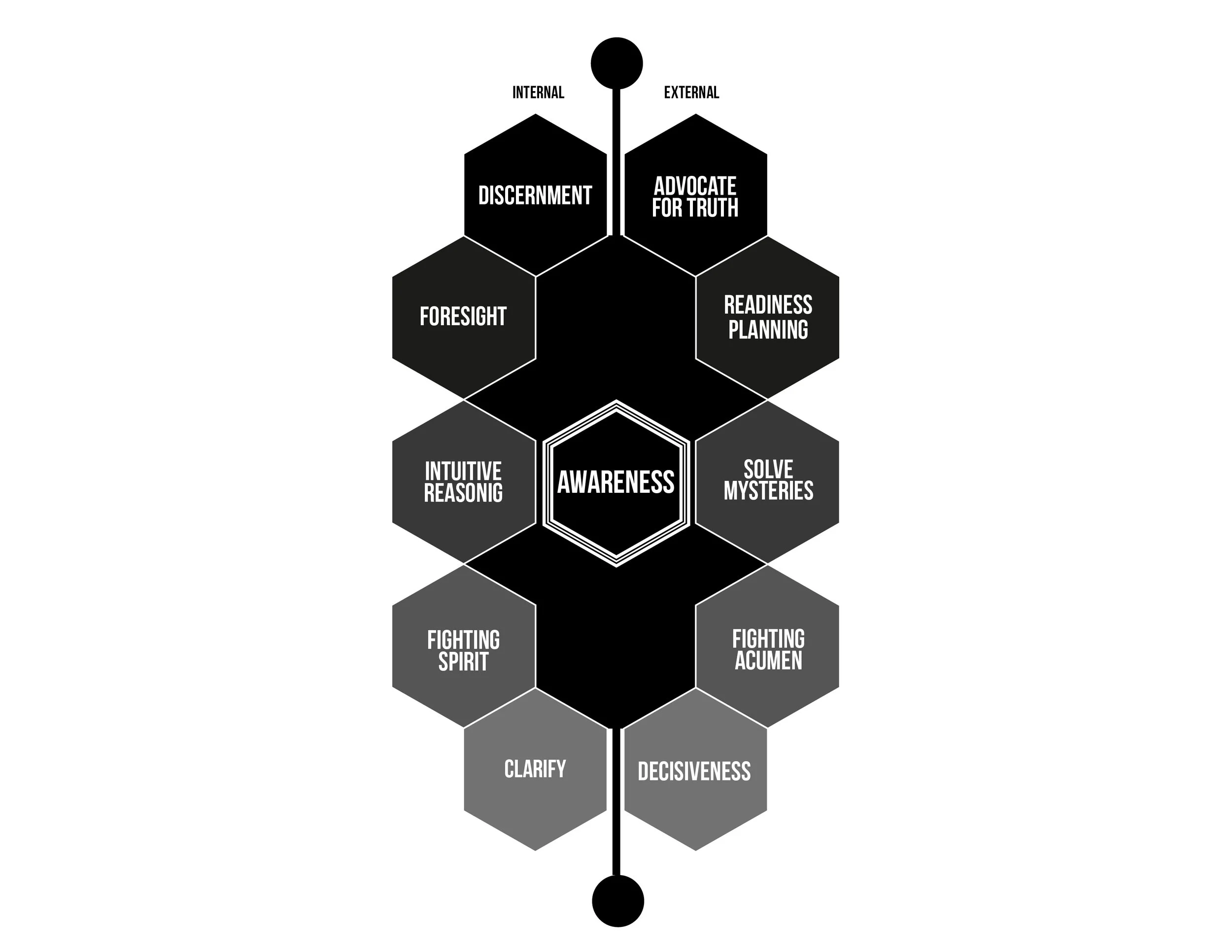
You can scroll down or use this menu to get a closer look at each Strength.
-
CLICK ON LINK BELOW TO ACCESS EACH STRENGTH PROFILE
DISCERNMENT
INTUITIVE DESIGN
STRENGTHS
Strengths are inherent abilities or qualities that a person naturally excels in. These are often cultivated and developed over time through practice and experience.
DISCERNMENT
You possess the strength of discernment, which allows you to perceive and understand subtle nuances and underlying truths in various situations. This ability enables you to see beyond surface-level appearances and identify the core issues at play, making you adept at evaluating people, environments, and circumstances with remarkable accuracy. With discernment, you can make more informed decisions, avoid potential pitfalls, and navigate complex social and professional landscapes effectively. This strength helps you build trust and credibility, as others recognize your ability to see things clearly and objectively. Discernment also enhances your problem-solving skills, as you can identify the root cause of issues and address them directly. Your perceptive nature allows you to anticipate potential challenges and opportunities, positioning you for long-term success. Overall, discernment empowers you to make sound judgments that benefit both yourself and those around you.
EXAMPLES
click + expand
-
In your role as a manager at a growing tech company, your intuitive awareness helps you recognize when team members are facing unseen difficulties. Noticing subtle shifts in behavior, such as a new hire becoming withdrawn, you proactively address underlying issues, providing targeted support like mentorship and gradual integration. This intuitive approach fosters employee wellbeing, enhances team morale, and prevents potential productivity issues.
-
Within your close personal relationships, your discernment allows you to notice subtle emotional shifts. For instance, if a friend becomes distant or quiet, your intuition guides you to reach out thoughtfully, facilitating conversations that uncover deeper issues. Your empathetic approach strengthens trust and deepens connections, providing comfort and understanding to loved ones when they need it most.
-
Your intuitive discernment enhances your academic environment by helping you identify when classmates or students may be struggling. Observing subtle changes in engagement or performance, you initiate supportive conversations or adjustments, enabling peers or students to better manage stress, regain confidence, and stay motivated toward academic success.
-
As a community leader or volunteer, your perceptive insight identifies deeper community concerns before they escalate. By noticing subtle dynamics and underlying tensions in community projects or discussions, you intervene sensitively to mediate conflicts, offer needed resources, and cultivate cohesion and collaboration within the community.
-
In creative environments, your intuitive awareness significantly enhances your artistic or collaborative output. When evaluating new ideas or creative concepts, your perceptive questioning and keen attention to subtle details ensure that ambitious proposals are grounded, realistic, and aligned with project resources, enhancing the effectiveness and originality of creative outcomes.
-
As an entrepreneur, your discernment enables you to evaluate business opportunities carefully, uncovering hidden risks and nuanced details that others might miss. This intuitive scrutiny ensures thoughtful decision-making, safeguarding you from poor investments and positioning your business for sustainable growth and long-term success.
-
Working within healthcare settings, your intuitive sensitivity is crucial in recognizing subtle changes in patient conditions or emotional states. By carefully observing nonverbal cues or minor symptoms, you facilitate early interventions, improved patient outcomes, and a compassionate care environment, positively impacting patient trust and wellness.
-
Within tech-driven environments, your ability to perceive deeper implications enables you to identify potential issues early, such as in crisis situations like data breaches. Your clear, intuitive understanding allows rapid pinpointing of underlying problems, efficient decision-making, and implementation of effective solutions. This awareness maintains high standards of innovation, quality, and trust, solidifying your leadership in dynamic tech settings.
STRENGTH TRAINING
DISCERNMENT
Insight: Strengthening Discernment
Strengthening discernment involves enhancing your ability to perceive and understand subtle details and complexities in situations. Start by practicing mindfulness and reflection to heighten your awareness and focus. Progress by analyzing case studies or real-life scenarios to sharpen your ability to identify underlying issues and patterns. Ultimately, apply your discernment skills in decision-making processes, using your insights to guide yourself and others toward sound judgments.
Activities
-
Coaching Tip: Spend 10 minutes daily meditating or journaling about your observations and thoughts. This practice will help you become more attuned to your surroundings and your internal state, increasing your overall awareness and focus.
Activity 1:Mindfulness Meditation - Set aside a quiet time each day for mindfulness meditation. Focus on your breathing and observe your thoughts without judgment. This helps in calming the mind and increasing awareness of subtle details in your environment.
Activity 2:Observation Journal - Carry a small notebook with you and jot down observations throughout the day. At the end of the day, spend a few minutes reflecting on what you’ve noted. Look for any patterns or insights that emerge from your observations.
-
Coaching Tip: Discuss your analyses with a mentor or peer group to gain different perspectives and refine your skills. Collaboration and feedback are key to developing a well-rounded perspective.
Activity 1: Case Study Review - Choose case studies related to your field of interest and analyze them in detail. Identify the main issues, the stakeholders involved, and the outcomes. Consider what could have been done differently and why.
Activity 2:Scenario Analysis Workshops - Participate in or organize workshops where real-life scenarios are discussed. Work in groups to dissect each scenario, identifying the underlying issues and proposing potential solutions.
-
Coaching Tip: Use your insights to inform choices in professional or personal contexts, and seek feedback to evaluate the effectiveness of your discernment. This application will help solidify your skills and demonstrate their value in real-world settings.
Activity 1:Decision-Making Journal - Document decisions you make in both professional and personal contexts. Write down the factors you considered, the insights that guided you, and the outcomes. Review this journal regularly to identify patterns in your decision-making process.
Activity 2:Feedback Sessions - After making significant decisions, seek feedback from trusted colleagues or mentors. Discuss what went well and what could be improved. Use this feedback to refine your discernment skills.
-
Engage in Diverse Experiences: Broaden your exposure to different situations, people, and environments. This diversity will enrich your understanding and enhance your ability to discern subtleties in various contexts.
Continuous Learning: Stay curious and committed to learning. Read books, attend workshops, and engage in discussions that challenge your thinking and expand your knowledge.
Reflective Practice: Make reflection a regular part of your routine. Whether through meditation, journaling, or conversation, reflection helps consolidate learning and deepen insights.
Mind-Body Connection: Engage in activities that strengthen the mind-body connection. These practices can enhance your overall awareness and help you stay grounded and focused.
Mentorship: Seek out mentors who exemplify strong discernment skills. Learn from their experiences and ask for guidance in developing your own abilities.
Mind Mapping: Use mind mapping techniques to visually organize complex information. This can help you see relationships and patterns more clearly, aiding in the development of your discernment skills.
By following these steps and incorporating these activities into your routine, you can strengthen your discernment abilities, leading to better understanding and decision-making in all areas of your life.
WAYS WE CAN USE OUR STRENGTHS
DISCERNMENT
With your keen sense of discernment, you can accurately assess situations, people, and decisions, allowing you to make wise choices. This ability to see through complexities and understand underlying motives helps guide others toward the best outcomes. By exercising discernment, you protect your team or community from potential pitfalls and steer them in the right direction.
click + expand
-
Discernment allows you to see beyond surface-level interactions and understand the underlying motives that drive people's actions. In negotiations, this means you can identify hidden agendas or true intentions, enabling you to craft strategies that better address the needs of all parties involved. In interpersonal relationships, this skill helps you navigate complex emotional dynamics, leading to more meaningful and honest communication. Understanding these motives is essential for resolving conflicts, building trust, and achieving mutually beneficial outcomes.
Practical Applications:
Sales Negotiations: Use discernment to identify the real concerns or desires of a client, allowing you to tailor your pitch to meet their deeper needs and close deals more effectively.
Conflict Resolution: Apply discernment in personal or professional conflicts to understand the root cause of disagreements, leading to solutions that address the underlying issues rather than just the symptoms.
Partnership Evaluations: In business partnerships, use discernment to assess whether potential partners have aligned goals and values, ensuring long-term compatibility and success.
Relationship Building: In personal relationships, use discernment to recognize when someone’s actions are driven by insecurity or fear, allowing you to respond with empathy and support.
-
Discernment enables you to move beyond superficial symptoms and identify the actual causes of problems, leading to more effective and lasting solutions. In business, this might involve understanding why a project is failing or why customer satisfaction is low, and then addressing those issues directly. In personal life, discernment helps you recognize emotional or psychological factors that may be influencing behavior or decision-making. This deeper understanding allows for targeted interventions that solve problems at their source rather than merely treating the symptoms.
Practical Applications:
Process Improvement: Use discernment to identify inefficiencies in business processes, allowing you to implement changes that improve productivity and reduce costs.
Health and Wellness: In personal health, apply discernment to identify lifestyle factors contributing to stress or illness, leading to more effective wellness strategies.
Team Dynamics: Use discernment to diagnose underlying issues in team dynamics, such as poor communication or unclear roles, and take steps to resolve them.
Customer Satisfaction: In business, use discernment to analyze customer feedback and identify the core issues leading to dissatisfaction, enabling you to make strategic improvements.
-
Discernment allows you to assess the true risks associated with investment opportunities by looking beyond immediate gains and considering long-term implications. This skill helps you avoid decisions based on hype or trends, focusing instead on the fundamental factors that will determine the success of an investment. By weighing the potential rewards against the risks, you can make more informed decisions that align with your financial goals. This approach is essential for building a stable and profitable investment portfolio.
Practical Applications:
Stock Market: Use discernment to evaluate the long-term potential of stocks, avoiding overhyped investments that may not deliver sustained growth.
Real Estate: Apply discernment in real estate investments by assessing factors such as location, market trends, and future development plans to ensure a profitable return.
Business Ventures: In entrepreneurship, use discernment to evaluate the risks of launching a new business or product, considering factors like market demand, competition, and resource allocation.
Retirement Planning: Apply discernment to choose investment vehicles that balance risk and reward, ensuring that your retirement savings grow steadily over time.
-
Discernment helps you evaluate the character and reliability of potential hires or team members, ensuring that they align with your organization’s culture and long-term goals. Beyond assessing qualifications, this skill allows you to determine how well individuals will fit within a team, contribute to its success, and uphold ethical standards. By focusing on character and integrity, you can build a cohesive, trustworthy team that works well together and supports the organization’s values. This approach reduces the risk of hiring mistakes and promotes a positive work environment.
Practical Applications:
Interview Techniques: Use discernment during interviews to ask questions that reveal a candidate's true character, such as how they handle ethical challenges or difficult situations.
Team Integration: Apply discernment when forming teams to ensure that new members will complement existing dynamics and contribute positively to the group.
Leadership Selection: In leadership hiring, use discernment to identify individuals with the integrity and vision necessary to guide the organization effectively.
Performance Reviews: During performance evaluations, use discernment to assess not just job performance but also how well an employee’s character aligns with the company’s values.
-
Discernment allows healthcare professionals to notice subtle symptoms or changes in a patient’s condition that might be overlooked by others, leading to more accurate and timely diagnoses. This skill is especially important in cases where symptoms are vague or when multiple conditions might present similarly. By carefully observing and interpreting these cues, you can catch issues early, before they develop into more serious health problems. This approach not only improves patient outcomes but also enhances the overall quality of care provided.
Practical Applications:
Early Detection: Use discernment to identify early signs of serious conditions, such as cancer or neurological disorders, based on subtle changes in patient behavior or test results.
Complex Cases: In cases with multiple or conflicting symptoms, apply discernment to piece together the correct diagnosis, ensuring that patients receive appropriate treatment.
Chronic Illness Management: Use discernment to monitor chronic conditions, recognizing when subtle changes indicate that a treatment plan needs adjustment.
Patient Communication: Apply discernment in patient interactions to understand when a patient might be withholding information or underreporting symptoms, leading to more accurate diagnoses.
-
Discernment is crucial in legal and investigative work, where the ability to determine truthfulness can significantly impact the outcome of a case. This skill allows you to detect inconsistencies in testimony, identify deception, and understand the true motives behind actions or statements. By carefully analyzing behavior, language, and evidence, you can build stronger cases and make more informed decisions. This approach is essential for ensuring justice and achieving fair outcomes in legal proceedings.
Practical Applications:
Witness Interrogation: Use discernment during witness interrogation to detect inconsistencies or signs of deception, strengthening the reliability of the evidence presented.
Jury Selection: In legal cases, apply discernment to evaluate potential jurors' biases or inclinations, ensuring a fair and impartial jury is selected.
Fraud Investigation: In financial or corporate investigations, use discernment to uncover fraudulent activities by identifying subtle discrepancies in documents or statements.
Contract Negotiations: Apply discernment in legal negotiations to assess the sincerity of the opposing party’s offers and intentions, leading to more favorable outcomes for your client.
-
Discernment helps leaders and counselors navigate complex ethical dilemmas by distinguishing between right and wrong, even when the answers aren’t clear-cut. This skill allows you to consider the long-term consequences of decisions and to ensure that your actions align with both ethical standards and the well-being of those affected. In leadership, this might involve balancing profit with social responsibility, while in counseling, it could mean guiding clients to make decisions that are true to their values. By applying discernment, you can lead with integrity and provide counsel that supports personal and organizational growth.
Practical Applications:
Corporate Governance: Use discernment in leadership to balance business profitability with ethical practices, ensuring that decisions benefit all stakeholders without compromising integrity.
Client Counseling: As a counselor, apply discernment to help clients navigate moral dilemmas, ensuring that their choices align with their values and contribute to their well-being.
Policy Development: In leadership roles, use discernment to develop policies that uphold ethical standards while meeting organizational goals, promoting a culture of integrity.
Conflict of Interest Management: Apply discernment in situations where potential conflicts of interest arise, ensuring that decisions are made transparently and ethically.
-
Discernment enables you to distinguish between what is merely popular and what has enduring quality and substance in art, literature, or media. This skill is crucial for curators, editors, and content creators who aim to provide audiences with works that offer depth, insight, and long-term value. By focusing on quality rather than trends, you can contribute to a richer cultural discourse and ensure that your work resonates with audiences over time. This approach helps build a reputation for excellence and integrity in your field.
Practical Applications:
Publishing: As an editor, use discernment to select manuscripts that offer unique perspectives or significant literary value, even if they are not immediately commercially viable.
Art Curation: In a gallery setting, apply discernment to choose works that challenge viewers intellectually or emotionally, rather than simply appealing to current trends.
Content Creation: For media producers, use discernment to create content that provides lasting value and impact, ensuring that your work remains relevant and respected over time.
Educational Resources: In education, apply discernment to curate teaching materials that not only meet curriculum standards but also inspire critical thinking and creativity among students.
-
Discernment allows you to appreciate and navigate the subtle cultural differences that can impact global business or travel. This skill is essential for building strong relationships, avoiding misunderstandings, and ensuring successful interactions in a multicultural environment. By understanding the underlying values, customs, and communication styles of different cultures, you can tailor your approach to meet the needs and expectations of your international counterparts. This approach fosters respect, collaboration, and success in global ventures.
Practical Applications:
International Negotiations: Use discernment in global business negotiations to understand the cultural context of your counterpart’s position, allowing you to navigate discussions more effectively and reach agreements that respect both parties' values.
Cross-Cultural Management: As a manager of a multicultural team, apply discernment to create a work environment that respects and integrates diverse cultural perspectives, leading to improved collaboration and productivity.
Travel Planning: In personal travel, use discernment to adapt to local customs and practices, enhancing your travel experience and showing respect for the host culture.
Marketing Strategies: In global marketing, apply discernment to create campaigns that resonate with different cultural audiences, ensuring that your brand message is both effective and respectful.
-
Discernment helps you navigate the vast array of options available for personal development or spiritual growth, allowing you to choose paths that truly resonate with your core values and long-term goals. This skill enables you to sift through popular trends or superficial advice and focus on practices that offer genuine and lasting benefits. By making informed choices, you can embark on a journey of growth that is deeply aligned with your true self, leading to greater fulfillment and purpose in life.
Practical Applications:
Choosing Educational Paths: Use discernment to select courses or training programs that align with your career goals and personal interests, ensuring that your investment in education leads to meaningful growth.
Spiritual Practices: In spiritual development, apply discernment to choose practices or teachings that genuinely resonate with your beliefs and values, leading to deeper spiritual fulfillment.
Personal Coaching: When seeking personal development coaching, use discernment to choose a coach whose approach aligns with your values and goals, ensuring that the guidance you receive is truly beneficial.
Lifestyle Changes: In making lifestyle changes, apply discernment to choose habits or routines that genuinely enhance your well-being and align with your long-term vision for your life.
DECISIVENESS
INTUITIVE DESIGN
STRENGTHS
Strengths are inherent abilities or qualities that a person naturally excels in. These are often cultivated and developed over time through practice and experience.
DECISIVENESS
Your decisiveness empowers you to make swift and confident decisions, even in high-pressure situations. This strength lets you weigh options quickly, trust your judgment, and take action without hesitation. Decisiveness is crucial in both personal and professional settings, as it enables you to move forward with clarity and purpose. By being decisive, you can avoid the pitfalls of overthinking and procrastination, ensuring that you make the most of opportunities as they arise. This strength also inspires confidence in others, as they see you as a reliable and authoritative figure who can be trusted to make important decisions. Decisiveness enhances your leadership capabilities, as you can guide teams and projects with certainty and direction. Ultimately, your ability to make prompt and effective decisions contributes to your overall success and efficiency.
EXAMPLES
click + expand
-
Imagine you're managing a high-stakes project within a rapidly growing company. As deadlines approach, you notice that your current strategy isn't yielding desired results. Rather than hesitating or delaying, your decisiveness kicks in. You swiftly analyze alternatives and confidently pivot to a new approach that utilizes your team's strengths and aligns better with organizational goals. Your timely decision energizes your team, ensuring project success and strengthening your leadership credibility.
-
In your personal life, your decisiveness smooths complex situations. Suppose your family struggles to agree on vacation plans, leading to frustration and indecision. You promptly assess everyone's preferences and choose a balanced option that incorporates relaxation and cultural activities. Your confident choice resolves tensions, fosters excitement, and enables enjoyable, stress-free family experiences.
-
Your decisiveness significantly impacts your academic pursuits. Imagine you’re part of a group assignment, and differing opinions threaten progress. Quickly evaluating options, you suggest a balanced direction clearly aligned with assignment requirements, resolving disagreements efficiently. Your swift decision-making boosts group productivity, maintains motivation, and ensures successful academic outcomes.
-
In community initiatives, your decisive nature becomes invaluable. Imagine you're coordinating a neighborhood event when a key volunteer cancels at the last minute. Without hesitation, you reassign roles swiftly, maintaining event momentum. Your rapid decision ensures a seamless experience for attendees and volunteers alike, reinforcing your leadership and community cohesion.
-
In a creative context, decisiveness sharpens your effectiveness. Suppose you're leading a design project, and your team struggles with competing concepts. You quickly analyze each option's potential, selecting the idea that best aligns creatively and practically. Your clear and rapid decision reinvigorates the creative process, resulting in impactful, timely, and innovative outcomes.
-
Your decisiveness is essential as an entrepreneur. Imagine evaluating multiple investor offers for your startup under tight timelines. Swiftly analyzing each proposal, you decisively select the investor whose vision matches your company's long-term goals. This quick, confident choice not only secures essential funding but also reinforces trust in your leadership among stakeholders and employees.
-
In healthcare scenarios, your ability to act decisively proves crucial. Picture a medical emergency where immediate action is needed. Quickly assessing available data, you confidently execute the best medical response, reassuring patients and staff alike. Your decisive actions promote efficient crisis resolution, patient safety, and professional confidence in critical situations.
-
Within tech-driven environments, decisiveness drives progress. Suppose your team encounters unexpected technical setbacks shortly before a product launch. You swiftly evaluate the situation, promptly deciding on alternative solutions. Your rapid, confident decisions allow for timely innovation, ensuring successful product delivery and maintaining high professional standards and trust.
STRENGTH TRAINING
DECISIVENESS
Insight: Strengthening Foresight
Strengthening foresight involves improving your ability to anticipate future trends, challenges, and opportunities. Start by regularly reviewing industry reports, articles, and trend analyses to stay informed. Progress by engaging in scenario planning, and envisioning various future outcomes and their potential impacts. Ultimately, integrate foresight into your strategic planning, using your predictions to guide long-term goals and actions.
Activities
click + expand
-
Coaching Tip: Summarize your findings and discuss them with colleagues to refine your understanding. This practice will help you stay informed and broaden your perspective through shared insights.
Activity 1:Weekly Industry Review - Dedicate time each week to read industry reports, articles, and trend analyses relevant to your field. Highlight key points and summarize your findings in a document.
Activity 2:Discussion Groups - Form a discussion group with colleagues or peers where each member shares insights from their readings. This collaborative effort can deepen your understanding and provide diverse perspectives.
Activity 3:Insight Journal - Keep a journal where you regularly note down trends, predictions, and significant insights. Review it periodically to observe how trends evolve over time.
-
Coaching Tip: Create detailed scenarios and analyze their potential impacts on your projects or goals. This will help you consider different possibilities and prepare for various future conditions.
Activity 1:Scenario Development Workshops - Participate in or organize workshops where you develop multiple future scenarios. Consider best-case, worst-case, and most likely outcomes for your projects or goals.
Activity 2:Impact Analysis - For each scenario, analyze the potential impacts on your work or industry. Identify key drivers, potential challenges, and opportunities that each scenario presents.
Activity 3:Decision Trees - Use decision trees to map out potential future events and their consequences. This visual tool can help you understand the branching possibilities and make more informed decisions.
-
Coaching Tip: Use your predictions to set long-term goals and regularly review and adjust plans based on new insights. This will ensure your strategies remain relevant and proactive.
Activity 1:Strategic Foresight Meetings - Incorporate foresight into your regular strategic planning meetings. Discuss future trends and scenarios and how they might affect your long-term goals.
Activity 2:Predictive Modeling - Utilize predictive modeling tools to forecast future trends based on current data. Integrate these forecasts into your strategic plans to guide decision-making.
Activity 3:Regular Plan Reviews - Set up a schedule for regular reviews of your strategic plans. Adjust them as new trends and insights emerge to keep your plans aligned with anticipated future developments.
-
Network with Futurists: Connect with professionals who specialize in foresight and future studies. Their expertise can provide valuable insights and enhance your own foresight capabilities.
Attend Conferences and Webinars: Participate in conferences, webinars, and workshops focused on future trends and strategic foresight. These events can offer fresh perspectives and networking opportunities.
Diverse Sources: Diversify your sources of information to include different industries, global perspectives, and unconventional viewpoints. This broad approach can help you spot trends that might not be immediately obvious.
Historical Analysis: Study historical trends and how past predictions have played out. Understanding the accuracy and limitations of past foresight efforts can improve your ability to make better predictions.
Tech Tools: Utilize technology and software designed for trend analysis and scenario planning. Tools like AI and big data analytics can enhance your ability to anticipate future developments.
Personal Reflection: Take time for personal reflection on how future trends might impact your personal and professional life. This holistic view can enrich your overall foresight skills.
By following these activities and coaching tips, you can strengthen your foresight, enabling you to anticipate and prepare for future trends, challenges, and opportunities more effectively. This will enhance your strategic planning and decision-making, positioning you for long-term success.
WAYS WE CAN USE OUR STRENGTHS
DECISIVENESS
Your decisiveness enables you to make quick, clear, and confident decisions, even under pressure. This strength ensures that progress isn’t stalled by indecision, allowing you and those around you to move forward with purpose. By being decisive, you provide direction and leadership that others can rely on, especially in critical moments.
click + expand
-
Decisiveness in leadership involves making timely decisions that move teams forward without unnecessary delays. In business, this means assessing the situation, gathering relevant information, and then making a clear decision that guides the team’s actions. Decisiveness prevents analysis paralysis, boosts team confidence, and ensures that projects stay on track. By setting a strong example, you inspire your team to trust their own decision-making abilities and maintain momentum in their work.
Practical Applications:
Project Management: As a project manager, use decisiveness to allocate resources efficiently and set clear deadlines, ensuring that the project progresses smoothly.
Team Meetings: During meetings, make quick decisions on key issues to avoid lengthy discussions that delay action, helping the team maintain focus and productivity.
New Initiatives: When launching new initiatives, use decisiveness to establish goals and objectives, allowing your team to start work immediately with a clear understanding of expectations.
Performance Management: In leadership, use decisiveness to address performance issues promptly, providing feedback and setting improvement plans to keep the team on track.
-
In crisis situations, decisiveness is critical to managing uncertainty and preventing escalation. This involves quickly assessing the situation, understanding the potential risks and impacts, and making a decision that minimizes damage and maintains stability. Decisiveness in a crisis not only provides a clear direction for your team but also reassures stakeholders that the situation is under control. Effective crisis management depends on your ability to make swift, informed choices that prioritize safety and continuity.
Practical Applications:
Emergency Response: In a business setting, use decisiveness to implement emergency response plans quickly, ensuring the safety of employees and minimizing operational disruptions.
Public Relations: During a PR crisis, make rapid decisions on how to communicate with the public and media, controlling the narrative and protecting the organization’s reputation.
Resource Allocation: In a resource shortage, use decisiveness to prioritize essential functions and allocate resources where they are most needed, maintaining critical operations.
Operational Continuity: During a systems failure, apply decisiveness to initiate backup procedures and restore operations as quickly as possible, minimizing downtime and loss.
-
Decisiveness in implementing changes involves acting swiftly once a decision has been made, rather than hesitating or second-guessing. This approach ensures that necessary changes are put into place efficiently, allowing the organization to adapt and improve continuously. Whether it’s adjusting a business strategy or optimizing processes, decisiveness helps maintain momentum and reduces the resistance that often accompanies change. By acting decisively, you demonstrate confidence in the chosen course of action, encouraging others to support the transition.
Practical Applications:
Process Optimization: Use decisiveness to streamline workflows by quickly implementing new technologies or methodologies that improve efficiency and reduce costs.
Strategy Shifts: In response to market changes, apply decisiveness to pivot the business strategy, ensuring the company remains competitive and aligned with current trends.
Policy Updates: When updating company policies, use decisiveness to roll out changes promptly, providing clear communication and training to ensure smooth adoption.
Cultural Change: In leadership, use decisiveness to drive cultural changes within the organization, setting clear expectations and leading by example to foster a new work environment.
-
Decisiveness in conflict resolution involves taking a clear, firm stance on issues to prevent prolonged disputes and maintain harmony. This approach requires you to evaluate the situation, consider all perspectives, and then make a decision that resolves the conflict fairly and effectively. By taking a decisive position, you reduce uncertainty and demonstrate leadership, which can de-escalate tensions and encourage others to follow suit. Firmness in conflict resolution also helps establish clear boundaries and expectations, preventing future issues.
Practical Applications:
Workplace Conflicts: Use decisiveness to mediate workplace conflicts by making fair, informed decisions that address the root causes and set clear expectations for future behavior.
Negotiations: In business negotiations, apply decisiveness to take a firm stance on key terms, ensuring that your interests are protected while also reaching a mutually beneficial agreement.
Disciplinary Actions: In management, use decisiveness when addressing misconduct or performance issues, setting clear consequences and ensuring that standards are upheld.
Personal Relationships: In personal life, apply decisiveness to resolve conflicts by setting boundaries and communicating your stance clearly, fostering healthier relationships.
-
Decisiveness in project management involves setting a clear direction and making prompt decisions that keep the project on track. This requires you to evaluate the project’s needs, consider various options, and then choose the best course of action to achieve the desired outcomes. By making clear decisions, you eliminate ambiguity and ensure that all team members are aligned and focused on the same goals. Decisiveness in project management also helps prevent delays, as it minimizes the time spent on indecision and re-evaluation.
Practical Applications:
Project Planning: Use decisiveness to finalize project plans quickly, allowing the team to start work with a clear understanding of objectives, timelines, and deliverables.
Resource Management: In project management, apply decisiveness to allocate resources effectively, ensuring that all aspects of the project are adequately supported.
Problem-Solving: When challenges arise during a project, use decisiveness to choose a solution quickly, minimizing disruptions and keeping the project on schedule.
Stakeholder Communication: In managing stakeholder expectations, use decisiveness to provide clear updates and make firm commitments, ensuring that everyone is on the same page.
-
Decisiveness in prioritization involves making quick, clear decisions about which tasks are most important and should be addressed first. This skill is crucial for managing time effectively, ensuring that high-priority tasks receive the attention they need while less critical activities are deferred or delegated. By prioritizing efficiently, you can achieve your goals more effectively and reduce stress, as you focus your energy on the most impactful activities. Decisiveness in prioritization also helps you manage workload and avoid the overwhelm that comes from juggling too many tasks at once.
Practical Applications:
Daily Planning: Use decisiveness to create a daily task list that prioritizes activities based on importance and deadlines, ensuring that you stay focused and productive throughout the day.
Work-Life Balance: In personal life, apply decisiveness to prioritize activities that contribute to your well-being and happiness, ensuring that you maintain a healthy work-life balance.
Team Task Management: As a manager, use decisiveness to prioritize team tasks, delegating effectively to ensure that all critical projects are completed on time.
Crisis Response: In emergency situations, use decisiveness to quickly prioritize tasks that address the most urgent issues, ensuring that critical needs are met first.
-
Decisiveness in trading involves making quick, informed decisions to buy or sell assets based on market conditions and financial goals. This skill is essential in the fast-paced environment of financial markets, where hesitation can lead to missed opportunities or increased risks. By executing trades confidently, you can capitalize on favorable market conditions and minimize losses. Decisiveness in trading also requires you to trust your analysis and instincts, even in volatile markets, ensuring that you stick to your strategy and achieve your financial objectives.
Practical Applications:
Day Trading: In day trading, use decisiveness to make quick buy or sell decisions based on real-time market data, maximizing short-term profits.
Long-Term Investments: For long-term investments, apply decisiveness to enter or exit positions at the right time, based on thorough analysis and market trends.
Portfolio Management: As a portfolio manager, use decisiveness to rebalance portfolios regularly, ensuring that asset allocation aligns with the client’s risk tolerance and financial goals.
Risk Management: In trading, use decisiveness to set and adhere to stop-loss orders, protecting your investments from significant losses.
-
Decisiveness in making major life decisions involves evaluating your options and choosing a path forward with confidence. Whether it’s changing careers, relocating to a new city, or making significant lifestyle changes, decisiveness helps you move forward without being paralyzed by uncertainty or fear. This approach ensures that you take control of your life’s direction and pursue opportunities that align with your long-term goals. By acting decisively, you can embrace change and make transitions smoother and more successful.
Practical Applications:
Career Transitions: Use decisiveness to choose a new career path that aligns with your skills, interests, and long-term goals, allowing you to transition smoothly and with confidence.
Relocation Decisions: When considering a move, apply decisiveness to evaluate the pros and cons quickly and choose the best location for your personal and professional life.
Educational Pursuits: In deciding whether to pursue further education, use decisiveness to assess the potential benefits and make a commitment to a program that supports your career aspirations.
Lifestyle Changes: For major lifestyle changes, such as adopting a new diet or exercise routine, use decisiveness to start and stick with your new habits, ensuring long-term success.
-
Decisiveness in leadership involves making clear, confident decisions that inspire trust and motivate others to follow your lead. By demonstrating decisiveness, you create an environment where team members feel secure in the direction being taken and are more likely to support and implement your decisions. This approach helps build credibility and authority as a leader, as others see you as capable of guiding the organization toward its goals. Decisiveness also fosters a culture of action and accountability, encouraging everyone to contribute to the team’s success.
Practical Applications:
Vision Setting: In leadership, use decisiveness to articulate a clear vision and strategy for the team, inspiring confidence and commitment among team members.
Decision-Making: In team meetings, apply decisiveness to make tough decisions quickly, demonstrating your ability to lead effectively even under pressure.
Change Management: During times of organizational change, use decisiveness to communicate changes clearly and implement them swiftly, minimizing uncertainty and maintaining morale.
Performance Leadership: In managing performance, use decisiveness to set clear expectations and hold team members accountable, driving continuous improvement and achievement.
-
Decisiveness in setting boundaries involves clearly defining what is acceptable and unacceptable in your interactions with others. This skill is crucial for maintaining healthy relationships and a productive work environment, as it helps prevent misunderstandings, overcommitment, and burnout. By setting and enforcing boundaries decisively, you protect your time, energy, and well-being, while also respecting the needs and limits of others. This approach fosters mutual respect and ensures that all parties understand and adhere to agreed-upon expectations.
Practical Applications:
Work-Life Balance: Use decisiveness to set clear boundaries between work and personal life, ensuring that you have time to relax and recharge without work encroaching on your personal time.
Professional Relationships: In the workplace, apply decisiveness to establish boundaries around your availability and workload, preventing burnout and ensuring that you can deliver high-quality work.
Personal Relationships: In personal life, use decisiveness to set boundaries with family and friends, communicating clearly what you can and cannot accommodate to maintain healthy relationships.
Conflict Avoidance: In both work and personal settings, use decisiveness to set boundaries that prevent conflicts, such as being clear about your limits and expectations from the outset.
FORESIGHT
INTUITIVE DESIGN
STRENGTHS
Strengths are inherent abilities or qualities that a person naturally excels in. These are often cultivated and developed over time through practice and experience.
FORESIGHT
You have the strength of foresight, enabling you to anticipate future trends, challenges, and opportunities. This ability allows you to plan strategically and prepare for what lies ahead, giving you a significant advantage in both personal and professional endeavors. Foresight involves thinking ahead and considering the long-term implications of your actions, helping you make decisions that are beneficial in the future. By leveraging foresight, you can identify potential obstacles and devise proactive solutions to mitigate risks. This strength also allows you to capitalize on emerging trends and innovations, ensuring that you stay ahead of the curve. Foresight enhances your strategic planning skills, enabling you to set realistic goals and develop effective action plans. Ultimately, this ability helps you create a clear vision for your future and work towards it with confidence and purpose.
EXAMPLES
click + expand
-
Imagine you're the CEO of a rapidly evolving tech company. Recognizing early signs of an industry-wide shift toward artificial intelligence and machine learning, you proactively invest in R&D, hire specialists in emerging technologies, and build strategic partnerships. Your foresight positions your company as a market leader when the trend accelerates, setting you apart from competitors caught off-guard.
-
Your foresight significantly impacts your personal decisions, particularly with family planning. For instance, anticipating rising college education costs for your children, you proactively establish and regularly fund a college savings plan. This strategic approach ensures your children’s educational opportunities, reducing future financial stress and fostering long-term family security.
-
Within academic environments, your foresight proves essential. Anticipating potential disruptions in your coursework or projects, such as limited access to key resources, you proactively seek alternative materials and develop flexible plans. Your forward-thinking ensures consistent academic performance and reduces stress, even when unexpected challenges arise.
-
In community projects, your foresight enhances effectiveness. For example, when coordinating a local event, you foresee possible attendance surges or logistical issues. You proactively secure additional resources and volunteers, ensuring the event proceeds smoothly and positively impacts community satisfaction and involvement.
-
Your foresight in creative endeavors significantly influences success. Suppose you anticipate changing audience preferences in your artistic field. You proactively adapt your creative approach, exploring innovative techniques and fresh content styles. This strategic adaptation maintains your relevance and positions you as a forward-thinking leader in your creative community.
-
Foresight in entrepreneurship provides competitive advantages. Imagine anticipating supply chain disruptions before they occur. You proactively diversify suppliers and build inventory reserves. Your strategic planning ensures business continuity, minimizes risks, and positions your enterprise advantageously when disruptions affect others in your industry.
-
In healthcare, foresight significantly enhances personal wellness. Recognizing early the risks associated with a sedentary lifestyle, you proactively adopt healthier routines—regular exercise and balanced nutrition. This preventative approach significantly reduces future health risks, promoting sustained well-being and improved quality of life.
-
Your foresight within technology-driven contexts greatly impacts project success. Anticipating potential technological disruptions or resource shortages during critical product development, you proactively secure alternative options, adapt timelines, and reinforce infrastructure. Your proactive approach ensures seamless innovation and timely product launches, maintaining high standards and industry competitiveness.
In all these scenarios, your foresight allows you to anticipate and prepare for future developments, turning potential challenges into opportunities and ensuring long-term success and stability. Whether in professional settings, personal life, project management, relationships, health, or finances, this strength helps you create a clear and strategic path forward, enabling you to achieve your goals with confidence and purpose.
STRENGTH TRAINING
FORESIGHT
Insight: Strengthening Foresight
Strengthening foresight involves improving your ability to anticipate future trends, challenges, and opportunities. Start by regularly reviewing industry reports, articles, and trend analyses to stay informed. Progress by engaging in scenario planning, and envisioning various future outcomes and their potential impacts. Ultimately, integrate foresight into your strategic planning, using your predictions to guide long-term goals and actions.
Activities
click + expand
-
Coaching Tip: Summarize your findings and discuss them with colleagues to refine your understanding. This practice will help you stay informed and broaden your perspective through shared insights.
Activity 1:Weekly Industry Review - Dedicate time each week to read industry reports, articles, and trend analyses relevant to your field. Highlight key points and summarize your findings in a document.
Activity 2:Discussion Groups - Form a discussion group with colleagues or peers where each member shares insights from their readings. This collaborative effort can deepen your understanding and provide diverse perspectives.
Activity 3:Insight Journal - Keep a journal where you regularly note down trends, predictions, and significant insights. Review it periodically to observe how trends evolve over time.
-
Coaching Tip: Create detailed scenarios and analyze their potential impacts on your projects or goals. This will help you consider different possibilities and prepare for various future conditions.
Activity 1:Scenario Development Workshops - Participate in or organize workshops where you develop multiple future scenarios. Consider best-case, worst-case, and most likely outcomes for your projects or goals.
Activity 2:Impact Analysis - For each scenario, analyze the potential impacts on your work or industry. Identify key drivers, potential challenges, and opportunities that each scenario presents.
Activity 3:Decision Trees - Use decision trees to map out potential future events and their consequences. This visual tool can help you understand the branching possibilities and make more informed decisions.
-
Coaching Tip: Use your predictions to set long-term goals and regularly review and adjust plans based on new insights. This will ensure your strategies remain relevant and proactive.
Activity 1:Strategic Foresight Meetings - Incorporate foresight into your regular strategic planning meetings. Discuss future trends and scenarios and how they might affect your long-term goals.
Activity 2:Predictive Modeling - Utilize predictive modeling tools to forecast future trends based on current data. Integrate these forecasts into your strategic plans to guide decision-making.
Activity 3:Regular Plan Reviews - Set up a schedule for regular reviews of your strategic plans. Adjust them as new trends and insights emerge to keep your plans aligned with anticipated future developments.
-
Network with Futurists: Connect with professionals who specialize in foresight and future studies. Their expertise can provide valuable insights and enhance your own foresight capabilities.
Attend Conferences and Webinars: Participate in conferences, webinars, and workshops focused on future trends and strategic foresight. These events can offer fresh perspectives and networking opportunities.
Diverse Sources: Diversify your sources of information to include different industries, global perspectives, and unconventional viewpoints. This broad approach can help you spot trends that might not be immediately obvious.
Historical Analysis: Study historical trends and how past predictions have played out. Understanding the accuracy and limitations of past foresight efforts can improve your ability to make better predictions.
Tech Tools: Utilize technology and software designed for trend analysis and scenario planning. Tools like AI and big data analytics can enhance your ability to anticipate future developments.
Personal Reflection: Take time for personal reflection on how future trends might impact your personal and professional life. This holistic view can enrich your overall foresight skills.
By following these activities and coaching tips, you can strengthen your foresight, enabling you to anticipate and prepare for future trends, challenges, and opportunities more effectively. This will enhance your strategic planning and decision-making, positioning you for long-term success.
WAYS WE CAN USE OUR STRENGTHS
FORESIGHT
Your ability to anticipate future events and outcomes allows you to prepare effectively for what lies ahead. This foresight helps you and your team avoid risks and seize opportunities before they arise. By thinking ahead, you create strategies that lead to long-term success and stability.
click + expand
-
Foresight enables you to anticipate market trends by analyzing current data, understanding industry shifts, and recognizing emerging patterns. This ability helps businesses stay ahead of the competition by adapting their strategies to meet future demands. By predicting these trends, companies can innovate, launch products, or pivot their business models in ways that capitalize on upcoming opportunities. This proactive approach reduces the risk of being caught off guard by market changes and positions the business for long-term success.
Practical Applications:
Product Development: Use foresight to guide the development of new products that meet emerging customer needs, ensuring they are ready for market as demand grows.
Strategic Investments: Apply foresight to make informed decisions about where to allocate resources, such as investing in technologies or markets poised for growth.
Marketing Campaigns: Use foresight to design marketing campaigns that align with future consumer behavior trends, ensuring your brand remains relevant and engaging.
Competitive Analysis: Apply foresight to anticipate competitors’ moves and develop strategies to counteract their potential impact on your market position.
-
Foresight allows you to anticipate potential challenges in your personal finances or career and take proactive steps to address them. Whether it's saving for retirement, preparing for an economic downturn, or planning a career transition, foresight helps you build resilience and achieve long-term stability. By planning ahead, you can create contingency plans, diversify your income streams, and continue growing professionally despite uncertainties. This forward-thinking approach empowers you to navigate life’s challenges with confidence and security.
Practical Applications:
Retirement Planning: Use foresight to develop a comprehensive retirement plan that accounts for potential market fluctuations and changes in your financial needs over time.
Career Development: Apply foresight to identify skills that will be in demand in the future, allowing you to pursue relevant training and education to stay competitive in your field.
Emergency Savings: Use foresight to build an emergency fund that can cover unexpected expenses, such as medical bills or job loss, providing financial security in uncertain times.
Debt Management: Apply foresight to create a debt repayment strategy that prioritizes high-interest debts and minimizes long-term financial burden.
-
Foresight enables you to stay ahead of technological advancements by identifying emerging technologies and understanding how they might impact your industry or field. This skill is crucial for innovation, as it allows you to adapt your products, services, or business models to leverage new technologies before they become mainstream. By anticipating these changes, you can position your organization as a leader in adopting and integrating new technologies, giving you a competitive edge. This proactive approach also helps you avoid obsolescence in a rapidly evolving technological landscape.
Practical Applications:
R&D Investments: Use foresight to direct research and development efforts toward technologies that are likely to shape the future of your industry, ensuring your company remains at the forefront of innovation.
Product Roadmaps: Apply foresight to create product roadmaps that incorporate upcoming technological advancements, allowing you to deliver cutting-edge solutions to customers.
Tech Partnerships: Use foresight to identify potential technology partners or acquisitions that can enhance your organization’s capabilities and accelerate innovation.
Workforce Training: Apply foresight to implement training programs that equip your workforce with the skills needed to work with emerging technologies, ensuring they are prepared for future demands.
-
Foresight in emergency management involves anticipating potential crises—such as natural disasters, pandemics, or cyberattacks—and developing plans to mitigate their impact. This proactive approach ensures that organizations, communities, and individuals are better equipped to respond quickly and effectively when a crisis occurs. By preparing for a range of scenarios, you can minimize damage, protect lives, and ensure continuity of operations. Foresight in crisis management is critical for reducing vulnerability and enhancing resilience in the face of unexpected challenges.
Practical Applications:
Disaster Preparedness Plans: Use foresight to develop comprehensive disaster preparedness plans that include evacuation procedures, communication strategies, and resource allocation.
Business Continuity Planning: Apply foresight to create business continuity plans that ensure critical operations can continue during and after a crisis, minimizing disruption and financial loss.
Crisis Drills: Use foresight to organize and conduct regular crisis drills that prepare employees or community members for various emergency scenarios, improving response times and coordination.
Supply Chain Resilience: Apply foresight to assess and strengthen supply chain resilience by identifying potential vulnerabilities and securing alternative sources for critical materials and components.
-
Foresight allows you to set long-term goals in personal development or education by envisioning the skills, knowledge, and experiences you will need to succeed in the future. This involves identifying trends in your field, understanding the evolving demands of the job market, and planning your learning and development accordingly. By setting these goals, you ensure that your personal and professional growth aligns with future opportunities and challenges. Foresight in this context helps you stay relevant, adaptable, and prepared for the future.
Practical Applications:
Educational Planning: Use foresight to choose educational programs or certifications that align with future industry needs, ensuring that your skills remain relevant and in demand.
Skill Development: Apply foresight to identify and cultivate emerging skills that will enhance your career prospects, such as digital literacy or data analysis.
Career Path Mapping: Use foresight to map out a long-term career path that includes key milestones and development opportunities, guiding your decisions and efforts over time.
Personal Growth Plans: Apply foresight to create personal growth plans that focus on areas such as leadership, communication, or emotional intelligence, helping you excel in both professional and personal contexts.
-
Foresight enables you to anticipate societal changes—such as shifts in demographics, consumer behavior, or cultural values—and adapt your business models or career paths accordingly. By understanding these trends, you can position your business or career to meet new demands, avoid obsolescence, and capitalize on emerging opportunities. This forward-thinking approach ensures that you remain competitive and relevant as society evolves. Foresight in this area is crucial for long-term sustainability and success in a rapidly changing world.
Practical Applications:
Business Model Innovation: Use foresight to redesign business models that align with changing consumer preferences, such as increased demand for sustainability or digital services.
Market Entry Strategies: Apply foresight to identify emerging markets or demographic segments that are likely to grow, guiding your market entry strategies for maximum impact.
Career Shifts: Use foresight to plan career shifts that align with societal changes, such as moving into industries that are expected to expand due to technological or cultural trends.
Product Diversification: Apply foresight to diversify product lines that cater to evolving societal needs, ensuring your business remains relevant and attractive to a broad audience.
-
Foresight in community planning or urban development involves anticipating the future needs of communities, such as housing, transportation, education, and healthcare. This ability helps planners and developers create sustainable, resilient, and livable communities that can adapt to population growth, environmental changes, and technological advancements. By identifying these needs early, you can design infrastructure and services that meet the demands of future generations. Foresight in this context is essential for building cities and communities that thrive in the long term.
Practical Applications:
Sustainable Infrastructure: Use foresight to design and implement sustainable infrastructure projects, such as green buildings or renewable energy systems, that meet future environmental standards and community needs.
Transportation Planning: Apply foresight to develop transportation networks that accommodate future population growth and technological advancements, such as autonomous vehicles or smart transit systems.
Affordable Housing Initiatives: Use foresight to plan and advocate for affordable housing projects that address future population growth and income disparities, ensuring that all residents have access to safe and affordable homes.
Public Health Facilities: Apply foresight to identify future healthcare needs and plan for the development of public health facilities that can serve growing and aging populations.
-
Foresight helps you prepare for major life transitions, such as retirement or parenthood, by anticipating the challenges and opportunities these changes will bring. This involves planning your finances, lifestyle, and support systems to ensure a smooth and successful transition. Whether it’s building a retirement nest egg, planning for the costs of raising a child, or adjusting to new roles and responsibilities, foresight allows you to approach these transitions with confidence. By preparing in advance, you can enjoy these new phases of life without unnecessary stress or uncertainty.
Practical Applications:
Retirement Savings Plans: Use foresight to create a comprehensive retirement savings plan that accounts for your desired lifestyle, healthcare needs, and potential inflation.
Parenthood Preparation: Apply foresight to prepare financially and emotionally for parenthood, including budgeting for childcare, education, and healthcare expenses.
Estate Planning: Use foresight to develop an estate plan that ensures your assets are managed and distributed according to your wishes, providing peace of mind for you and your loved ones.
Lifestyle Adjustments: Apply foresight to plan lifestyle adjustments that accommodate your new role, such as downsizing your home in retirement or setting up a nursery for a new baby.
-
Influence Policy-Making by Anticipating Societal Impacts
Foresight in policy-making involves anticipating the long-term societal impacts of current issues and trends, and using this knowledge to influence the development of policies that address future challenges. This skill is critical for shaping policies that promote social welfare, economic stability, and environmental sustainability. By understanding the potential consequences of policy decisions, you can advocate for solutions that are proactive rather than reactive, ensuring that society is better prepared for future developments. Foresight in policy-making helps create a more resilient and forward-looking society.
Practical Applications:
Legislative Proposals: Use foresight to draft and advocate for legislative proposals that address future societal challenges, such as climate change or technological unemployment.
Public Health Policies: Apply foresight to influence the development of public health policies that anticipate and mitigate the impacts of future pandemics or health crises.
Economic Planning: Use foresight to contribute to economic policies that promote long-term growth and stability, considering factors such as demographic shifts and technological advancements.
Environmental Regulations: Apply foresight to advocate for environmental regulations that protect natural resources and promote sustainability, ensuring that policies address future ecological challenges.
\
-
Foresight in leadership involves setting a clear, forward-looking vision that guides teams toward long-term success. This vision provides direction, inspiration, and motivation, helping team members understand how their efforts contribute to the organization’s future goals. By articulating a compelling vision, you can align the team’s work with the organization’s strategic objectives and create a sense of purpose that drives performance. Foresight in this context ensures that the team remains focused, adaptable, and resilient in the face of changing circumstances.
Practical Applications:
Strategic Planning: Use foresight to develop a long-term strategic plan that outlines the team’s goals, milestones, and key initiatives, providing a roadmap for future success.
Vision Communication: Apply foresight to communicate your vision effectively, ensuring that all team members understand their role in achieving the organization’s long-term objectives.
Team Alignment: Use foresight to align team activities and projects with the organization’s strategic goals, ensuring that everyone is working toward a common purpose.
Performance Metrics: Apply foresight to establish performance metrics that reflect the team’s progress toward achieving the long-term vision, providing regular feedback and motivation to stay on track.
READINESS PLANNING
INTUITIVE DESIGN
STRENGTHS
Strengths are inherent abilities or qualities that a person naturally excels in. These are often cultivated and developed over time through practice and experience.
READINESS PLANNING
Your planning strength allows you to create detailed and effective plans to achieve your goals. This skill ensures that you consider all variables, set realistic timelines, and allocate resources efficiently. Planning involves organizing tasks, setting priorities, and developing step-by-step strategies to achieve desired outcomes. With strong planning skills, you can anticipate potential challenges and devise contingency plans to address them. This ability enhances your time management skills, ensuring that you make the most of your resources and stay on track to meet your objectives. Planning also involves setting measurable milestones and tracking progress, allowing you to adjust your strategies as needed. Ultimately, your planning strength enables you to approach complex projects with confidence and precision, ensuring successful outcomes.
EXAMPLES
click + expand
-
Imagine you're organizing a high-profile international conference with numerous attendees and distinguished speakers. Leveraging your exceptional planning abilities, you define clear objectives, develop comprehensive timelines, and assign precise roles. You anticipate potential challenges—like travel delays or tech issues—and proactively establish contingency measures. Your meticulous approach ensures smooth execution, fosters team clarity, and results in a highly successful event that enhances your professional reputation.
-
In your personal projects, such as a major home renovation, planning is invaluable. Clearly defining goals—such as improved aesthetics and energy efficiency—you carefully set budgets, research contractors, establish realistic timelines, and anticipate possible setbacks. Regular monitoring and timely adjustments ensure the project stays on track, leading to a satisfying and successful home transformation that aligns perfectly with your vision and financial expectations.
-
In an academic context, planning helps you successfully tackle complex projects. For example, faced with a demanding research assignment, you systematically break down tasks—literature review, data collection, analysis, writing—and allocate specific timelines and milestones. Proactively identifying challenges, such as limited access to resources, you plan contingencies accordingly. This structured approach ensures efficient progress, yielding high-quality results and academic achievement.
-
Your planning skills greatly enhance community projects, such as organizing a family reunion with diverse participants. Carefully selecting dates and locations, coordinating logistics like accommodation, catering, and activities, and anticipating potential obstacles (weather disruptions or cancellations), you proactively develop backup solutions. This detailed planning ensures smooth operations, enjoyable experiences, and strengthened community bonds.
-
Planning significantly benefits your creative endeavors. For instance, coordinating a large artistic showcase requires detailed timelines for concept development, venue booking, participant coordination, and marketing campaigns. Anticipating possible challenges—like scheduling conflicts or technical difficulties—you establish robust contingency strategies. Your meticulous approach ensures successful and impactful creative events, boosting your professional reputation in the arts community.
-
Planning is essential when launching a new entrepreneurial venture. Carefully setting clear business objectives, conducting market research, securing resources, assembling a skilled team, and outlining precise strategies, you anticipate challenges such as cash flow or supply chain disruptions, implementing proactive solutions. Your detailed planning ensures an efficient and impactful business launch, building momentum and laying a solid foundation for sustainable success.
-
Within healthcare, planning ensures optimal patient outcomes. Imagine managing patient care during peak periods—your structured approach involves clearly defined schedules, effective resource allocation, and contingency preparations for emergencies or unforeseen staffing challenges. Your careful organization fosters efficient operations, improved patient care quality, and professional reliability.
-
Effective planning significantly advances tech projects and innovation initiatives. For example, managing a critical technology rollout involves systematically scheduling milestones, coordinating cross-functional teams, anticipating potential technical difficulties or resource shortages, and proactively devising alternative solutions. Your structured approach ensures seamless execution, successful product launches, and enhanced competitive advantage in rapidly evolving technological markets.
In all these scenarios, your planning strength enables you to approach complex projects with confidence and precision. Whether in professional settings, personal life, academics, event planning, relationships, or community service, your ability to create detailed and effective plans ensures successful outcomes and helps you achieve your goals.
STRENGTH TRAINING
READINESS PLANNING
Insight: Enhancing Planning Skills
Enhancing your planning skills involves developing the ability to create detailed, actionable plans that prepare you for various scenarios. Start by creating daily to-do lists and weekly schedules to organize your tasks and manage your time effectively. Progress by developing project plans that include timelines, resources, and risk assessments. Ultimately, lead complex projects that require comprehensive planning and coordination, refining your readiness and adaptability.
Activities
click + expand
-
Coaching Tip: Prioritize tasks and set specific deadlines to improve time management. This will help you stay organized and focused on completing your tasks efficiently.
Activity 1:Daily To-Do Lists - Every morning, write a list of tasks you need to complete for the day. Prioritize them by importance and urgency. Check off tasks as you complete them to track your progress.
Activity 2:Weekly Schedules - At the start of each week, create a schedule outlining your major tasks and deadlines. Allocate specific time blocks for each task to ensure you manage your time effectively.
Activity 3:Time Blocking - Use a calendar app to block out time for different activities throughout the day. This helps to create a visual representation of your time, making it easier to stay on track.
-
Coaching Tip: Use project management tools to organize and track your plans. This ensures you have a clear overview of your project and can manage it more effectively.
Activity 1:Project Timeline Creation - Develop a detailed timeline for your project, including all major milestones and deadlines. Use tools like Gantt charts to visualize your timeline.
Activity 2:Resource Allocation - Identify all the resources needed for your project, including people, materials, and budget. Ensure that each resource is allocated appropriately to meet your project goals.
Activity 3:Risk Assessment - Conduct a risk assessment for your project. Identify potential risks, their likelihood, and impact. Develop contingency plans to mitigate these risks.
-
Coaching Tip: Conduct regular reviews and adjust plans as needed to ensure successful execution. This continuous monitoring and adaptation will help keep your project on track.
Activity 1:Project Kickoff Meetings - Hold a kickoff meeting to align your team on project goals, roles, and responsibilities. Ensure everyone understands the plan and their part in it.
Activity 2:Regular Progress Reviews - Schedule regular check-ins and progress reviews with your team. Use these meetings to track progress, address issues, and adjust plans as necessary.
Activity 3:Post-Project Evaluation - After completing a project, conduct a thorough evaluation. Review what went well, what didn’t, and how you can improve your planning processes for future projects.
-
SMART Goals: Set SMART (Specific, Measurable, Achievable, Relevant, Time-bound) goals for your projects. This framework helps to create clear and actionable plans.
Feedback Loop: Establish a feedback loop with your team or peers. Regular feedback can provide insights into how well your plans are working and where improvements are needed.
Technology Integration: Use project management software like Trello, Asana, or Microsoft Project to organize, track, and communicate your plans. These tools offer various features to streamline your planning process.
Delegate Tasks: Learn to delegate tasks effectively. Assigning the right tasks to the right people can improve efficiency and help you focus on higher-level planning.
Learn from Experience: Reflect on past projects and plans. Identify what strategies worked and what didn’t, and apply these lessons to future planning.
Adaptability: Stay flexible and adaptable. Plans often need to change as projects progress. Being able to pivot and adjust your plans is crucial for successful project management.
Communication: Maintain clear and consistent communication with your team. Ensure that everyone is informed about updates, changes, and their responsibilities.
By implementing these activities and coaching tips, you can enhance your planning skills, enabling you to create detailed, actionable plans that prepare you for various scenarios and lead to successful project outcomes.
WAYS WE CAN USE OUR STRENGTHS
READINESS PLANNING
You excel at planning and preparing in advance, ensuring that you’re ready for any scenario. This proactive approach minimizes surprises and allows for smoother execution of tasks and goals. Your careful planning not only boosts your confidence but also reassures those who depend on you, creating an environment where everyone is equipped to succeed.
click + expand
-
Planning to be ready involves creating detailed contingency plans that ensure business operations can continue smoothly in the face of unexpected disruptions. These plans cover scenarios such as supply chain interruptions, equipment failures, or sudden shifts in market conditions. By preparing for various outcomes, businesses can minimize downtime, reduce losses, and maintain customer satisfaction even during crises. This proactive approach ensures that the company remains resilient and capable of navigating challenges effectively.
Practical Applications:
Supply Chain Disruptions: Create contingency plans for supply chain interruptions by identifying alternative suppliers and establishing emergency procurement procedures to keep production running smoothly.
IT System Failures: Develop backup protocols for IT systems, including data recovery plans and temporary manual processes, to ensure continuity in case of technical failures.
Market Shifts: Prepare contingency strategies to quickly adapt to sudden changes in market demand or economic conditions, such as pivoting to new products or services.
Human Resources: Develop plans for sudden workforce shortages due to illness or other factors by cross-training employees and maintaining a pool of temporary workers.
-
Planning for natural disasters involves creating comprehensive emergency kits and evacuation plans to ensure safety and readiness. This includes assembling necessary supplies, identifying safe evacuation routes, and conducting regular drills to familiarize everyone with the procedures. By being prepared, individuals and organizations can reduce the risk of injury, loss of life, and property damage during disasters. This readiness fosters a sense of security and confidence, knowing that effective measures are in place.
Practical Applications:
Home Safety: Assemble a home emergency kit with essential supplies such as food, water, medications, and first-aid materials, ensuring your family is prepared for natural disasters.
Workplace Evacuation: Develop and regularly update workplace evacuation plans, conducting drills to ensure employees know how to exit the building quickly and safely.
Community Planning: Coordinate with local authorities to establish community-wide disaster response plans, including designated shelters and communication strategies.
Education: Implement disaster preparedness education programs in schools, teaching students and staff how to respond effectively in emergencies.
-
Event planning requires meticulous preparation, including the development of backup plans to address potential issues such as equipment failure, weather disruptions, or no-show vendors. By considering all possible scenarios, you can ensure that the event proceeds smoothly, even if unexpected problems arise. This readiness not only enhances the event’s success but also demonstrates professionalism and reliability to clients and attendees. Having well-thought-out backup plans allows you to adapt quickly and maintain control in any situation.
Practical Applications:
Outdoor Events: For outdoor events, create contingency plans that include alternative indoor venues in case of bad weather, ensuring the event can proceed as planned.
Technical Failures: Prepare backup equipment and technical support for presentations or performances to address any potential audio-visual issues quickly.
Vendor Issues: Establish backup arrangements with secondary vendors to step in if the primary vendor fails to deliver, avoiding disruptions to the event schedule.
Logistics: Develop alternative transportation or accommodation plans for event attendees in case of travel delays or overbooking.
-
Effective resource management in project management involves planning and allocating resources such as time, money, personnel, and materials to ensure that the project stays on track. This requires anticipating needs, budgeting accurately, and monitoring resource usage throughout the project’s lifecycle. By managing resources efficiently, you can avoid waste, prevent bottlenecks, and ensure that the project is completed on time and within budget. This level of preparedness is crucial for the successful execution of any project.
Practical Applications:
Resource Allocation: Use project management tools to allocate resources efficiently, ensuring that each task has the necessary personnel and materials to be completed on time.
Budget Management: Develop a detailed budget that accounts for all potential expenses, and monitor spending closely to prevent cost overruns.
Time Management: Create a project timeline with milestones and deadlines, allowing you to track progress and make adjustments as needed to stay on schedule.
Risk Management: Identify potential resource shortages or risks and develop strategies to address them before they impact the project’s progress.
-
Planning for financial security involves creating long-term strategies to ensure that you have sufficient resources for retirement or other major life goals. This includes assessing your current financial situation, setting clear objectives, and making informed investment decisions. By planning ahead, you can build a robust financial portfolio that supports your desired lifestyle in retirement or provides financial stability for future endeavors. This proactive approach reduces financial stress and helps you achieve peace of mind.
Practical Applications:
Retirement Planning: Develop a comprehensive retirement plan that includes savings goals, investment strategies, and expected expenses, ensuring you have sufficient funds to maintain your lifestyle.
Diversified Investments: Create a diversified investment portfolio that balances risk and reward, protecting your assets while seeking growth opportunities.
Emergency Fund: Establish an emergency fund that can cover unexpected expenses, providing financial security in case of job loss, medical emergencies, or other unforeseen events.
Estate Planning: Prepare an estate plan that includes wills, trusts, and other legal documents to ensure your assets are managed and distributed according to your wishes.
-
Thorough preparation for presentations involves researching your topic in-depth, understanding your audience, and developing clear, compelling content. Additionally, having alternative approaches or backup materials ready ensures that you can adapt to any situation, such as unexpected questions or technical difficulties. This level of preparedness enhances your credibility, engages your audience, and increases the likelihood of delivering a successful presentation. Being ready with alternatives also allows you to handle unforeseen challenges confidently.
Practical Applications:
Audience Analysis: Conduct thorough research on your audience to tailor your presentation’s content and style to their interests and level of knowledge, ensuring maximum engagement.
Data Support: Prepare data and evidence to back up your key points, and have additional examples or case studies ready in case you need to elaborate on certain topics.
Technical Backups: Bring backup copies of your presentation on multiple devices (e.g., USB drive, cloud storage) and prepare alternative formats (e.g., printed handouts) in case of technical issues.
Q&A Readiness: Anticipate potential questions from your audience and prepare well-researched answers to ensure you can respond confidently and accurately.
-
Coordinating logistics for travel or large-scale operations involves detailed planning to ensure that all elements, such as transportation, accommodation, schedules, and resources, are organized and executed smoothly. This requires anticipating potential issues, such as delays or cancellations, and having contingency plans in place. By planning thoroughly, you can avoid disruptions, ensure the timely arrival of people and materials, and manage complex operations with confidence. Effective logistics coordination is key to the success of large-scale events, projects, or travel plans.
Practical Applications:
Travel Itineraries: Create detailed travel itineraries that include alternative routes, transportation options, and accommodation plans in case of delays or cancellations.
Supply Chain Management: Coordinate the logistics of supply chain operations to ensure timely delivery of goods and materials, accounting for potential disruptions.
Event Coordination: Plan and organize large-scale events with detailed schedules and logistical plans, ensuring that all aspects of the event run smoothly and on time.
Personnel Management: Coordinate the logistics of large teams by organizing travel, accommodations, and schedules, ensuring that everyone arrives and operates efficiently.
-
Anticipating project needs involves forecasting the requirements of a project at each stage and planning resources, timelines, and contingencies to meet those needs. This proactive approach helps you avoid delays, cost overruns, and resource shortages, ensuring that the project proceeds smoothly from start to finish. By planning for every aspect of the project, you can respond quickly to any changes or challenges that arise, keeping the project on track. Effective anticipation and planning are crucial for successful project management.
Practical Applications:
Resource Forecasting: Develop detailed forecasts of resource needs (e.g., materials, labor, time) for each phase of the project, ensuring that everything is in place before it’s needed.
Risk Assessment: Identify potential risks that could impact the project and create contingency plans to address them, minimizing disruptions.
Timeline Adjustments: Anticipate potential delays and build flexibility into the project timeline, allowing for adjustments without compromising the overall schedule.
Budget Planning: Create a comprehensive budget that anticipates all possible expenses, including contingency funds for unexpected costs, to keep the project financially stable.
-
Organizing personal schedules to optimize time management involves prioritizing tasks, setting realistic deadlines, and creating a structured plan for daily, weekly, and long-term activities. This approach helps you make the most of your time, ensuring that you stay productive and focused while also maintaining a healthy work-life balance. By planning your schedule carefully, you can achieve your goals more efficiently and reduce stress. Effective time management is key to personal and professional success.
Practical Applications:
Daily Task Lists: Create daily task lists that prioritize high-impact activities and set clear deadlines for each task, helping you stay focused and productive throughout the day.
Time Blocking: Use time-blocking techniques to allocate specific periods for different tasks or activities, ensuring that you dedicate sufficient time to each priority.
Long-Term Planning: Develop long-term schedules that map out key milestones, deadlines, and goals, allowing you to stay on track and avoid last-minute rushes.
Work-Life Balance: Plan your personal schedule to include time for relaxation, hobbies, and family, ensuring that you maintain a healthy balance between work and personal life.
-
Effective negotiation preparation involves gathering relevant data, understanding the interests of all parties, and developing clear strategies to achieve your objectives. By being well-prepared, you can approach negotiations with confidence, make informed decisions, and respond effectively to counteroffers or objections. Planning ahead also allows you to anticipate potential challenges and prepare alternative strategies, increasing your chances of reaching a favorable outcome. This level of preparation is essential for successful negotiations in any context.
Practical Applications:
Market Research: Conduct thorough market research to gather data on pricing, competitors, and industry trends, providing a solid foundation for your negotiation strategy.
Interest Mapping: Identify the interests and priorities of all parties involved in the negotiation, allowing you to craft proposals that address their key concerns while advancing your objectives.
BATNA Development: Prepare your Best Alternative to a Negotiated Agreement (BATNA) to strengthen your negotiating position and ensure that you have a viable fallback option.
Scenario Planning: Develop and rehearse different negotiation scenarios, including potential objections and counteroffers, so you are prepared to respond effectively during the actual negotiation.
INTUITIVE REASONING
INTUITIVE DESIGN
STRENGTHS
Strengths are inherent abilities or qualities that a person naturally excels in. These are often cultivated and developed over time through practice and experience.
INTUITIVE REASONING
You possess intuitive reasoning, enabling you to solve problems and make connections that others might overlook. This strength allows you to trust your instincts and draw from your subconscious knowledge, leading to innovative solutions. Intuitive reasoning involves synthesizing information and recognizing patterns without the need for extensive analysis. This ability enhances your problem-solving skills, as you can quickly identify viable solutions and act on them. Intuitive reasoning also helps you navigate complex situations with ease, as you can rely on your gut feelings to guide you. This strength is particularly valuable in creative and innovative fields, where out-of-the-box thinking is essential. By leveraging intuitive reasoning, you can make informed decisions and uncover unique opportunities that others might miss.
EXAMPLES
click + expand
-
Imagine you're a software developer encountering significant technical difficulties during a crucial project. When conventional methods fail, your intuitive reasoning guides you to combine algorithms from unrelated areas, creating an innovative hybrid solution. Trusting this sudden insight, you rapidly prototype your idea, resolving performance issues and significantly improving the application. Your intuitive decision-making highlights your ingenuity, benefiting your team and the overall project success.
-
In personal situations, your intuitive reasoning strengthens relationships by guiding you in subtle interpersonal interactions. Suppose you sense a friend’s emotional distress even without explicit indicators. Trusting your intuition, you reach out proactively, initiating a conversation that allows them to share their struggles openly. Your timely support enhances emotional connection, deepens your friendship, and provides valuable help during challenging times.
-
Intuitive reasoning supports your academic performance by enhancing problem-solving and critical thinking. Imagine working on complex coursework or research projects where typical analytical methods leave you stuck. Relying on your intuitive insights, you suddenly make connections between disparate ideas, unlocking creative solutions and achieving deeper understanding. Your intuitive breakthroughs lead to improved results, original perspectives, and commendation from educators.
-
Within community projects, your intuitive reasoning helps identify and respond effectively to emerging issues. For instance, you might intuitively sense underlying tensions or concerns among community members before they openly express them. Taking proactive steps, you facilitate dialogue and address concerns early, strengthening community cohesion and enhancing mutual trust.
-
In creative contexts, your intuitive reasoning drives innovation. Suppose you’re designing a brand identity for a client, yet the provided guidelines lack inspiration. Guided by intuition, you combine contrasting design elements—such as vintage and minimalist styles—into a cohesive concept. Your instinctive creativity results in distinctive, resonant branding, impressing your clients and influencing industry trends.
-
Intuitive reasoning significantly enhances your entrepreneurial ventures. Imagine recognizing an emerging consumer trend not yet evident through traditional market analysis. Trusting your instincts, you swiftly launch products and marketing campaigns aligned with this nascent trend. Your intuitive strategic decisions position your business ahead of competitors, yielding significant early success and securing competitive advantages.
-
In healthcare scenarios, intuitive reasoning enhances patient care. Suppose you observe subtle, unexplained symptoms in a patient that standard tests haven’t yet clarified. Trusting your intuitive understanding of the situation, you pursue alternative diagnostic paths, uncovering underlying issues and initiating timely treatment. Your intuitive insight significantly improves patient outcomes and demonstrates the value of perceptive, patient-centered care.
-
Within technology-driven environments, intuitive reasoning is invaluable. Imagine facing sudden, critical disruptions in your supply chain. While conventional responses stall, your intuition recalls a potential alternative supplier encountered previously. Acting swiftly on this insight, you resolve the crisis efficiently, ensuring uninterrupted operations and demonstrating your capacity for intuitive, agile decision-making.
In all these scenarios, your intuitive reasoning allows you to solve problems, make connections, and uncover opportunities that others might overlook. Whether in professional settings, creative fields, personal life, strategic planning, problem-solving, or relationships, this strength helps you navigate complexities with ease and achieve innovative solutions.
STRENGTH TRAINING
INTUITIVE REASONING
Insight: Strengthening Intuitive Reasoning
Strengthening intuitive reasoning involves combining instinctive insights with logical thinking to solve problems effectively. Start by engaging in puzzles and games that require logical thinking and intuition. Progress by analyzing real-world problems, and applying both intuition and logic to develop solutions. Ultimately, participate in strategic discussions and decision-making processes where intuitive reasoning is crucial for innovative problem-solving.
Activities
click + expand
-
Coaching Tip: Spend time weekly on activities like Sudoku or logic puzzles to sharpen your reasoning skills. These activities will help you develop the ability to combine intuitive insights with logical analysis.
Activity 1:Sudoku and Logic Puzzles - Dedicate time each week to solving Sudoku puzzles or similar logic-based games. These activities help train your brain to identify patterns and develop logical strategies.
Activity 2:Chess or Strategy Games - Play chess or other strategy games that require both intuition and strategic thinking. Analyze your moves and consider both immediate and long-term consequences.
Activity 3:Brain Teasers - Challenge yourself with brain teasers that require creative thinking and logic. These can help you practice thinking outside the box and developing innovative solutions.
-
Coaching Tip: Discuss your problem-solving approach with others to gain feedback and refine your methods. This collaborative effort will enhance your ability to balance intuition and logic in real-world scenarios.
Activity 1:Case Study Analysis - Choose real-world case studies relevant to your field and analyze them using both logical reasoning and intuitive insights. Identify the problem, consider different solutions, and justify your approach.
Activity 2:Problem-Solving Workshops - Participate in or organize workshops where you tackle real-world problems. Work in groups to develop solutions, combining intuitive insights with logical analysis.
Activity 3:Reflective Journaling - After solving real-world problems, write a reflection on how you used both intuition and logic. Consider what worked well and what could be improved in your approach.
-
Coaching Tip: Use your intuitive reasoning to contribute innovative solutions and evaluate their effectiveness. Engaging in strategic discussions will help you apply your skills in high-stakes environments and refine your decision-making abilities.
Activity 1:Strategic Planning Meetings - Take an active role in strategic planning meetings at work or in other organizations. Use your intuitive reasoning to propose innovative solutions and strategic directions.
Activity 2:Innovation Think Tanks - Join or form think tanks focused on innovation and strategic development. Collaborate with others to tackle complex problems and develop groundbreaking solutions.
Activity 3:Decision-Making Simulations - Participate in simulations or role-playing exercises that mimic high-stakes decision-making environments. Practice using intuitive reasoning to make quick, effective decisions and reflect on the outcomes.
-
Balance Intuition and Logic: Regularly practice balancing intuitive insights with logical analysis. Reflect on how these two approaches complement each other and how they can be integrated effectively.
Continuous Learning: Stay curious and keep learning. Engage in activities that challenge your thinking and expose you to new perspectives, enhancing both your intuition and logical reasoning skills.
Feedback Loop: Establish a feedback loop with mentors or peers. Regular feedback on your problem-solving approaches can provide valuable insights and help you refine your intuitive reasoning.
Mindfulness Practices: Engage in mindfulness practices like meditation to enhance your intuitive abilities. A clear and focused mind can better tap into intuitive insights.
Diverse Experiences: Seek diverse experiences and environments. Exposure to different situations and challenges can enhance your ability to apply intuitive reasoning in various contexts.
Study Cognitive Biases: Learn about cognitive biases and how they impact decision-making. Understanding these biases can help you refine your intuitive reasoning and avoid common pitfalls.
Scenario Planning: Regularly practice scenario planning to anticipate possible outcomes and develop strategies. This helps in combining intuition with logical foresight to prepare for different future scenarios.
WAYS WE CAN USE OUR STRENGTHS
INTUITIVE REASONING
Your intuitive reasoning combines logic with gut feeling, allowing you to solve problems in innovative ways. This ability to trust your instincts while analyzing information helps you make sound decisions that others might not see immediately. By leveraging intuitive reasoning, you bring fresh perspectives to challenges and uncover solutions that might otherwise be overlooked.
click + expand
-
Intuitive reasoning allows you to approach complex scientific or engineering problems by combining logical analysis with a deep, instinctual understanding of how different elements interact. This ability enables you to develop innovative solutions that might not be immediately obvious through conventional methods. By leveraging intuition, you can make connections between disparate pieces of data or concepts, leading to breakthroughs that advance knowledge or technology. This approach is particularly valuable in fields where standard methods fall short or when dealing with unprecedented challenges.
Practical Applications:
Hypothesis Formation: Use intuitive reasoning to form hypotheses in scientific research that connect various data points or observations in novel ways, leading to groundbreaking experiments.
System Design: Apply intuitive reasoning to design complex systems in engineering, such as developing more efficient algorithms or sustainable energy solutions that require innovative thinking.
Troubleshooting: In engineering, use intuitive reasoning to troubleshoot system failures by considering unconventional causes or solutions that others might overlook.
Research Methodologies: Develop new research methodologies by intuitively understanding which experimental approaches are likely to yield the most meaningful results.
-
Intuitive reasoning enables you to connect seemingly unrelated ideas or concepts, leading to the creation of innovative products or services. This ability to see potential where others might not allows you to combine different technologies, materials, or methods to create something entirely new and valuable. By trusting your instincts and recognizing the hidden relationships between diverse ideas, you can push the boundaries of innovation and develop products that meet unarticulated needs or solve existing problems in novel ways.
Practical Applications:
Product Development: Use intuitive reasoning to develop new products by combining features or technologies from different industries, creating unique offerings that stand out in the market.
R&D Collaboration: Collaborate with researchers from diverse fields, using intuitive reasoning to identify how their findings could be applied to innovate within your industry.
Design Thinking: Apply intuitive reasoning in design thinking workshops to brainstorm and prototype new ideas that merge different concepts, leading to breakthrough innovations.
Cross-Industry Innovation: Use intuitive reasoning to identify opportunities for innovation by applying successful strategies or technologies from one industry to another.
-
Intuitive reasoning allows you to make strategic decisions by relying on a combination of gut feelings and accumulated experience. This approach is particularly useful in situations where data is incomplete or ambiguous, and quick, decisive action is required. By trusting your instincts, which are informed by your past experiences, you can navigate complex decisions with confidence, often arriving at solutions that are both effective and innovative. This ability to make sound decisions without needing exhaustive analysis can be a significant advantage in fast-paced environments.
Practical Applications:
Business Strategy: Use intuitive reasoning to make quick strategic decisions in business, such as entering new markets or launching new products, based on your instincts and industry experience.
Crisis Management: Apply intuitive reasoning in crisis situations to make immediate decisions that mitigate risks and capitalize on opportunities, even when full information is not available.
Leadership: In leadership roles, use intuitive reasoning to guide your team by making decisions that balance short-term needs with long-term goals, based on your intuitive understanding of the situation.
Investment Choices: Trust your instincts when making investment decisions, especially in rapidly changing markets where traditional analysis might not provide clear guidance.
-
Intuitive reasoning helps you understand complex human behaviors by recognizing underlying patterns and motivations that might not be immediately obvious. This ability is particularly valuable in fields like psychology and marketing, where understanding the subtleties of human behavior can lead to more effective interventions or campaigns. By intuitively grasping why people act the way they do, you can develop strategies that resonate on a deeper emotional or psychological level, leading to better outcomes in therapy, advertising, or customer engagement.
Practical Applications:
Market Segmentation: Use intuitive reasoning to segment markets based on subtle behavioral cues, creating more targeted and effective marketing campaigns that resonate with specific audiences.
Consumer Psychology: Apply intuitive reasoning to understand consumer decision-making processes, helping to craft messages or products that align with their desires and values.
Therapeutic Interventions: In psychology, use intuitive reasoning to tailor therapeutic approaches based on an intuitive understanding of a patient’s underlying issues or needs.
Brand Positioning: Use intuitive reasoning to position a brand in a way that connects with the deep-seated emotions and aspirations of your target audience.
-
Intuitive reasoning equips you to navigate ambiguous situations where clear answers are not readily available, allowing you to make decisions or take actions with confidence. This skill is especially useful in business or personal life when faced with uncertainty, as it enables you to trust your instincts and move forward despite the lack of concrete information. By using intuitive reasoning, you can assess the situation from multiple angles, drawing on your inner sense of what feels right and making decisions that align with your goals and values.
Practical Applications:
Business Leadership: Use intuitive reasoning to make leadership decisions in uncertain business environments, such as entering a new market or pivoting a business model, even when data is inconclusive.
Personal Decisions: Apply intuitive reasoning to make personal life decisions, such as choosing a new career path or moving to a different city, based on what feels intuitively right.
Conflict Resolution: Use intuitive reasoning to navigate conflicts in the workplace or personal life, finding solutions that feel balanced and fair, even when the situation is complex and unclear.
Innovation: Apply intuitive reasoning to navigate the development of new products or services in ambiguous markets, trusting your gut to guide you toward successful outcomes.
-
Intuitive reasoning allows you to recognize patterns in data, processes, or behaviors that others might overlook, leading to more efficient and effective solutions. This skill is particularly valuable in optimizing processes, as it enables you to identify areas of improvement that might not be obvious through conventional analysis. By seeing these patterns, you can streamline workflows, reduce waste, and enhance overall productivity. This ability to intuitively understand how different elements interact makes you a valuable asset in any organization looking to optimize its operations.
Practical Applications:
Process Improvement: Use intuitive reasoning to identify inefficiencies in business processes, such as redundant steps or bottlenecks, and develop streamlined workflows that improve productivity.
Data Analysis: Apply intuitive reasoning to analyze large datasets, spotting trends or correlations that lead to actionable insights for business strategy or product development.
Quality Control: In manufacturing or service delivery, use intuitive reasoning to detect subtle quality issues or inconsistencies, allowing for early intervention and process refinement.
Customer Service: Use intuitive reasoning to optimize customer service processes by identifying patterns in customer feedback and adjusting procedures to better meet their needs.
-
Intuitive reasoning is a powerful tool in the creative process, allowing you to develop innovative and original solutions in design, art, or other creative fields. This ability helps you break free from conventional thinking and explore new ideas that push the boundaries of your craft. By trusting your intuition, you can create works that resonate emotionally with audiences, stand out in competitive markets, and express your unique artistic vision. This approach fosters creativity and innovation, leading to designs and artworks that are both impactful and memorable.
Practical Applications:
Artistic Expression: Use intuitive reasoning to explore new artistic techniques or mediums, creating works that challenge traditional boundaries and offer fresh perspectives.
Design Innovation: Apply intuitive reasoning in design to develop products or spaces that are both functional and aesthetically pleasing, addressing user needs in novel ways.
Creative Problem-Solving: In creative fields, use intuitive reasoning to solve design challenges, such as finding the perfect balance between form and function in a product or artwork.
Brand Identity: Use intuitive reasoning to craft a unique brand identity that visually and emotionally connects with your target audience, differentiating your brand from competitors.
-
Intuitive reasoning enables you to understand your personal needs and growth opportunities on a deep, instinctual level, guiding your development in a way that aligns with your true self. This skill helps you identify areas where you need to focus your energy, whether it’s improving certain skills, addressing emotional challenges, or pursuing new experiences. By trusting your intuition, you can make choices that support your overall well-being and lead to more fulfilling and meaningful personal growth. This approach ensures that your development path is authentic and deeply aligned with who you are.
Practical Applications:
Self-Reflection: Use intuitive reasoning to reflect on your experiences and emotions, identifying patterns and insights that guide your personal development journey.
Goal Setting: Apply intuitive reasoning to set personal growth goals that resonate with your deeper needs and aspirations, ensuring that your efforts lead to meaningful progress.
Wellness Practices: Use intuitive reasoning to choose wellness practices, such as meditation, exercise, or diet, that feel right for your body and mind, supporting overall health.
Career Development: Apply intuitive reasoning to navigate your career path, making decisions about education, job changes, or skill development that align with your long-term vision.
-
Intuitive reasoning allows you to interpret data in ways that reveal deeper insights, going beyond the obvious conclusions to uncover hidden patterns or meanings. This skill is particularly valuable in fields like data science, market research, or business intelligence, where understanding the underlying trends and implications of data can lead to more informed decisions. By using intuitive reasoning, you can draw connections between seemingly unrelated data points, leading to discoveries that others might miss. This approach enhances your ability to make strategic decisions based on a richer understanding of the data.
Practical Applications:
Market Research: Use intuitive reasoning to analyze market research data, identifying subtle trends or consumer behaviors that can inform product development or marketing strategies.
Financial Analysis: Apply intuitive reasoning in financial analysis to detect underlying patterns in stock market data or financial reports, guiding investment decisions.
Customer Insights: Use intuitive reasoning to interpret customer feedback and behavior data, uncovering insights that can improve customer satisfaction and loyalty.
Strategic Planning: Apply intuitive reasoning to analyze business performance data, identifying opportunities for growth or areas for improvement that are not immediately obvious.
-
Intuitive reasoning helps you make informed health decisions by assessing symptoms and treatments based on both logical analysis and a deep, instinctual understanding of your body and well-being. This ability allows you to choose healthcare options that feel right for you, even when medical information is complex or conflicting. By trusting your intuition, you can navigate health challenges with confidence, selecting treatments that align with your needs and lifestyle. This approach supports holistic well-being, combining medical advice with personal insights for optimal health outcomes.
Practical Applications:
Symptom Tracking: Use intuitive reasoning to track and assess your symptoms over time, identifying patterns that can guide discussions with healthcare providers.
Treatment Choices: Apply intuitive reasoning to evaluate different treatment options, selecting those that resonate with your body’s needs and your personal preferences.
Preventive Care: Use intuitive reasoning to choose preventive care practices, such as diet, exercise, or stress management, that intuitively feel beneficial for your overall health.
Alternative Therapies: Apply intuitive reasoning to explore alternative therapies, such as acupuncture or herbal medicine, that align with your intuition about what your body needs.
SOLVE MYSTERIES
INTUITIVE DESIGN
STRENGTHS
Strengths are inherent abilities or qualities that a person naturally excels in. These are often cultivated and developed over time through practice and experience. #intuitive-strengths-menu
SOLVE MYSTERIES
Your ability to solve mysteries means you excel at uncovering hidden truths and resolving complex puzzles. This strength is particularly valuable in investigative and analytical roles, where uncovering details and understanding intricate situations is crucial. Solving mysteries involves gathering information, identifying patterns, and drawing logical conclusions based on the evidence. This ability enhances your critical thinking skills, as you can approach problems systematically and methodically. Your talent for solving mysteries allows you to tackle complex issues with confidence and precision. This strength also involves a keen attention to detail, as you can spot subtle clues that others might overlook. Ultimately, your ability to solve mysteries empowers you to bring clarity and resolution to ambiguous and challenging situations.
EXAMPLES
click + expand
-
Imagine you're a forensic accountant investigating financial irregularities in a corporation. Small, seemingly unrelated transactions catch your attention. Leveraging your ability to solve mysteries, you methodically analyze and cross-reference these details, uncovering a sophisticated scheme diverting company funds. Your diligent investigation exposes the fraud, identifies those responsible, and safeguards the company’s integrity and financial health.
-
In personal relationships, your skill in solving mysteries deepens your connections. Suppose you notice a friend behaving unusually withdrawn, especially around work-related discussions. Attentively observing and gently questioning, you uncover underlying stress at their job. Your perceptive insights allow you to offer meaningful support and guidance, strengthening your relationship and helping your friend navigate a difficult situation.
-
In academic research, your mystery-solving abilities lead to significant breakthroughs. Imagine you're studying a disease with unknown origins. Carefully analyzing extensive data sets, you recognize subtle patterns correlating environmental factors with disease outbreaks. Your meticulous approach reveals critical insights, significantly advancing understanding and enabling the development of targeted treatments and preventive strategies.
-
Within community settings, your talent for solving mysteries helps address complex issues proactively. For instance, if community engagement suddenly decreases without clear reasons, you meticulously gather feedback, observe subtle community dynamics, and analyze patterns. Identifying underlying issues such as unclear communication or unmet needs, you propose effective solutions that restore community participation and satisfaction.
-
In creative endeavors, solving mysteries enhances your innovative potential. Suppose you're an author crafting a compelling mystery novel. Your natural curiosity and analytical skills allow you to intricately weave subtle clues throughout the narrative, captivating readers with depth and unpredictability. Your structured yet imaginative approach ensures engaging storytelling that resonates deeply with your audience.
-
Your ability to solve mysteries significantly benefits entrepreneurial ventures. Imagine your new product unexpectedly underperforms in the market. Rather than making assumptions, you methodically analyze customer feedback, market trends, and usage data. Uncovering subtle but crucial insights into consumer needs and product perception, you adjust your strategy, improving market positioning and achieving business growth.
-
In healthcare scenarios, your mystery-solving skills improve patient outcomes. Suppose you're a medical practitioner facing a patient with perplexing symptoms. By closely examining patient histories, subtle physical clues, and diagnostic results, you identify an overlooked underlying condition. Your methodical and detailed analysis leads to accurate diagnoses and effective treatments, enhancing patient care quality.
-
In technical problem-solving, your ability to solve mysteries proves essential. Imagine persistent, elusive software bugs cause recurring system failures. Carefully reviewing code and operational patterns, you uncover a hidden yet critical error. Your precise analytical approach resolves complex technical issues, stabilizes system performance, and positions you as a trusted, innovative team member.
STRENGTH TRAINING
SOLVING MYSTERIES
The intuitive strength of solving mysteries for those with a primary Awareness drive is rooted in their natural sensitivity to what is unseen, unnoticed, or misunderstood. Strengthening this ability refines your capacity to perceive underlying truths, motives, and realities that others often miss. This training is not just about solving puzzles; it’s about enhancing your perception, increasing your discernment, and deepening your understanding of hidden dynamics in people and situations.
People with an Awareness drive often gravitate toward this strength naturally but can greatly enhance its effectiveness through intentional practice. By strengthening this skill, you improve your ability to uncover patterns, notice discrepancies, and intuitively navigate complex, unclear circumstances.
Activities
-
Coaching Tip: Observation is the foundation of solving mysteries. Focus on noticing small details, patterns of behavior, and inconsistencies in environments and conversations.
Activity 1: Observation Journaling
Spend 10 minutes daily observing people, places, or situations. Record your observations in a journal. Note small details others might overlook, such as body language, tone shifts, or environmental cues.Activity 2: Pattern Recognition Practice
Look for patterns in nature, literature, or daily routines. Identify how small elements contribute to larger systems or outcomes. Write brief summaries of your findings.Activity 3: Perception Challenges
Engage with puzzles, logic games, or mystery stories designed to sharpen perception. Reflect on how your intuition contributed to solving them.
-
Coaching Tip: Awareness-driven mystery solving is not just about seeing but understanding. Focus on interpreting what you observe, asking deeper "why" questions.
Activity 1: Character Analysis in Media
Watch films or read novels known for complex characters. Write character profiles that outline hidden motives and likely future behaviors. Compare your analyses to the unfolding story.Activity 2: Motive Mapping
Practice mapping potential motives in real-life scenarios (e.g., workplace dynamics). Identify visible actions vs. possible unseen motivations. Assess your accuracy over time.Activity 3: Cause-and-Effect Chains
Take a situation from news or history. Break it down into a sequence of events, tracing causes and effects. Identify unseen influences or overlooked details that contributed to the outcome.
-
Coaching Tip: True mastery comes when you can navigate ambiguity and still draw meaningful conclusions. Practice trusting your intuition while verifying it through observation and reflection.
Activity 1: Live Scenario Analysis
Attend meetings or observe environments where group dynamics are in play. Predict outcomes based on subtle cues (tension, enthusiasm, avoidance). Validate your predictions over time.Activity 2: Shadow Problem-Solving Sessions
Join or observe strategic discussions in your work or community. Quietly track the underlying issues others aren't seeing. Offer insights when appropriate.Activity 3: Intuition Journals and Reviews
Keep a journal of intuitive impressions in real-life situations. Revisit after events unfold to measure your accuracy and refine your sense-making process.
-
Train Your "Inner Detective": Approach situations with curiosity rather than judgment. Adopt the mindset of uncovering, not accusing.
Trust, but Verify: Intuition is sharpened when tested against reality. Regularly assess your intuitive insights with tangible outcomes to build reliability.
Mindfulness Practices: Enhance your inner awareness through mindfulness or meditation. Increased self-awareness sharpens your perception of others.
Create Quiet Space: Awareness thrives in quiet. Regularly step away from noise and distraction to let your observations surface and settle into insights.
Learn from Experts: Study the methodologies of detectives, analysts, or psychologists who excel at uncovering hidden truths. Apply their methods to your own situations.
Leverage Feedback: Seek feedback from trusted individuals about your perceptions. Honest feedback can refine your discernment and validate your accuracy.
Keep Curiosity Alive: Curiosity is the fuel for discovery. Never assume you know all the answers—allow your questions to evolve as you uncover more.
By integrating these activities and coaching practices into your routine, you’ll strengthen your ability to solve mysteries intuitively, making you more perceptive, insightful, and capable of revealing what is hidden beneath the surface.
STRENGTH TRAINING
SOLVING MYSTERIES
The intuitive strength of solving mysteries for those with a primary Awareness drive is rooted in their natural sensitivity to what is unseen, unnoticed, or misunderstood. Strengthening this ability refines your capacity to perceive underlying truths, motives, and realities that others often miss. This training is not just about solving puzzles; it’s about enhancing your perception, increasing your discernment, and deepening your understanding of hidden dynamics in people and situations.
People with an Awareness drive often gravitate toward this strength naturally but can greatly enhance its effectiveness through intentional practice. By strengthening this skill, you improve your ability to uncover patterns, notice discrepancies, and intuitively navigate complex, unclear circumstances.
Activities
-
Coaching Tip: Observation is the foundation of solving mysteries. Focus on noticing small details, patterns of behavior, and inconsistencies in environments and conversations.
Activity 1: Observation Journaling
Spend 10 minutes daily observing people, places, or situations. Record your observations in a journal. Note small details others might overlook, such as body language, tone shifts, or environmental cues.Activity 2: Pattern Recognition Practice
Look for patterns in nature, literature, or daily routines. Identify how small elements contribute to larger systems or outcomes. Write brief summaries of your findings.Activity 3: Perception Challenges
Engage with puzzles, logic games, or mystery stories designed to sharpen perception. Reflect on how your intuition contributed to solving them.
-
Coaching Tip: Awareness-driven mystery solving is not just about seeing but understanding. Focus on interpreting what you observe, asking deeper "why" questions.
Activity 1: Character Analysis in Media
Watch films or read novels known for complex characters. Write character profiles that outline hidden motives and likely future behaviors. Compare your analyses to the unfolding story.Activity 2: Motive Mapping
Practice mapping potential motives in real-life scenarios (e.g., workplace dynamics). Identify visible actions vs. possible unseen motivations. Assess your accuracy over time.Activity 3: Cause-and-Effect Chains
Take a situation from news or history. Break it down into a sequence of events, tracing causes and effects. Identify unseen influences or overlooked details that contributed to the outcome.
-
Coaching Tip: True mastery comes when you can navigate ambiguity and still draw meaningful conclusions. Practice trusting your intuition while verifying it through observation and reflection.
Activity 1: Live Scenario Analysis
Attend meetings or observe environments where group dynamics are in play. Predict outcomes based on subtle cues (tension, enthusiasm, avoidance). Validate your predictions over time.Activity 2: Shadow Problem-Solving Sessions
Join or observe strategic discussions in your work or community. Quietly track the underlying issues others aren't seeing. Offer insights when appropriate.Activity 3: Intuition Journals and Reviews
Keep a journal of intuitive impressions in real-life situations. Revisit after events unfold to measure your accuracy and refine your sense-making process.
-
Train Your "Inner Detective": Approach situations with curiosity rather than judgment. Adopt the mindset of uncovering, not accusing.
Trust, but Verify: Intuition is sharpened when tested against reality. Regularly assess your intuitive insights with tangible outcomes to build reliability.
Mindfulness Practices: Enhance your inner awareness through mindfulness or meditation. Increased self-awareness sharpens your perception of others.
Create Quiet Space: Awareness thrives in quiet. Regularly step away from noise and distraction to let your observations surface and settle into insights.
Learn from Experts: Study the methodologies of detectives, analysts, or psychologists who excel at uncovering hidden truths. Apply their methods to your own situations.
Leverage Feedback: Seek feedback from trusted individuals about your perceptions. Honest feedback can refine your discernment and validate your accuracy.
Keep Curiosity Alive: Curiosity is the fuel for discovery. Never assume you know all the answers—allow your questions to evolve as you uncover more.
By integrating these activities and coaching practices into your routine, you’ll strengthen your ability to solve mysteries intuitively, making you more perceptive, insightful, and capable of revealing what is hidden beneath the surface.
WAYS WE CAN USE OUR STRENGTHS
SOLVE MYSTERY
Your talent for solving mysteries through intuition enables you to uncover hidden truths and connect seemingly unrelated dots. This strength helps you unravel complex situations and provides clarity where others might be confused. By trusting your intuition, you solve problems that require deep insight and creativity, leading to breakthroughs that benefit those around you.
click + expand
-
Intuitive reasoning in law enforcement allows investigators to approach unsolved crimes by connecting disparate clues and making sense of incomplete or ambiguous evidence. This ability is crucial for piecing together complex cases where traditional methods may have failed to yield results. By trusting their instincts and recognizing subtle patterns, investigators can generate new leads and hypotheses, potentially solving cold cases that have long remained a mystery. This approach is invaluable in criminal investigations, where innovative thinking can make the difference between an unsolved case and a breakthrough.
Practical Applications:
Cold Case Reviews: Use intuitive reasoning to revisit cold cases, identifying overlooked evidence or connections that could lead to new investigative avenues.
Criminal Profiling: Apply intuitive reasoning in criminal profiling to understand the psychological patterns of suspects, leading to more accurate predictions of their behavior.
Witness Interviews: During witness interviews, use intuitive reasoning to detect inconsistencies or hidden truths that can provide new insights into the case.
Crime Scene Analysis: Employ intuitive reasoning to analyze crime scenes, interpreting subtle clues that may not be immediately apparent but could be critical to solving the case.
-
In archaeology, intuitive reasoning helps researchers uncover the mysteries of ancient civilizations by making connections between artifacts, architectural remains, and historical records. This ability allows archaeologists to piece together the lives, cultures, and technologies of people who lived thousands of years ago, often with limited physical evidence. By intuitively understanding the significance of findings and how they relate to broader historical contexts, archaeologists can develop theories that explain the evolution of human societies. This approach is essential for advancing our understanding of the past and preserving its legacy.
Practical Applications:
Site Excavation: Use intuitive reasoning to determine where to dig during archaeological excavations, increasing the chances of discovering significant artifacts or structures.
Artifact Analysis: Apply intuitive reasoning to analyze artifacts, interpreting their use and cultural significance within the context of the ancient civilization.
Historical Reconstruction: Use intuitive reasoning to reconstruct ancient societies, connecting the dots between various findings to create a coherent picture of how people lived.
Cultural Interpretation: Employ intuitive reasoning to interpret the symbolic meanings of ancient art, religious artifacts, or burial practices, shedding light on the beliefs and values of past civilizations.
-
Intuitive reasoning in financial audits and data analysis enables professionals to detect hidden patterns, anomalies, or irregularities that may indicate fraud, errors, or opportunities for optimization. This skill is crucial for uncovering issues that standard analytical methods might miss, such as subtle trends in financial transactions or discrepancies in large datasets. By trusting their instincts and looking beyond the obvious, auditors and analysts can identify underlying causes and propose effective solutions. This approach enhances the accuracy and depth of financial audits and data-driven decision-making.
Practical Applications:
Fraud Detection: Use intuitive reasoning to spot unusual patterns in financial data that may indicate fraudulent activity, leading to more effective prevention and detection efforts.
Risk Assessment: Apply intuitive reasoning in risk assessments to identify potential financial risks that are not immediately apparent from the data, helping to mitigate them proactively.
Data Mining: Use intuitive reasoning to uncover hidden trends or correlations in large datasets, providing valuable insights for business strategy or financial planning.
Performance Analysis: Employ intuitive reasoning to analyze financial performance data, identifying underlying factors that contribute to success or failure, and recommending strategic adjustments.
-
Intuitive reasoning in academic research helps historians and scholars solve historical mysteries by interpreting incomplete records, conflicting accounts, and gaps in knowledge. This ability allows researchers to connect various sources and form hypotheses that explain historical events, social movements, or cultural shifts. By using intuition to guide their investigations, scholars can uncover new perspectives on well-known histories or bring to light forgotten aspects of the past. This approach is vital for advancing historical knowledge and enriching our understanding of how past events have shaped the present.
Practical Applications:
Archival Research: Use intuitive reasoning to identify relevant documents or artifacts in archives that may hold the key to solving historical mysteries.
Source Criticism: Apply intuitive reasoning to critically analyze historical sources, discerning the reliability and biases of different accounts to construct a more accurate narrative.
Historical Reconstruction: Use intuitive reasoning to piece together historical events from fragmented or conflicting sources, providing a clearer understanding of the past.
Theory Development: Employ intuitive reasoning to develop new historical theories that challenge established interpretations and offer fresh insights into historical events.
-
Intuitive reasoning in scientific research allows scientists to develop theories that explain unexplained phenomena by synthesizing existing knowledge with new observations. This ability is particularly valuable in fields where current models fall short or where anomalies challenge established theories. By trusting their intuition, scientists can propose innovative hypotheses that push the boundaries of our understanding and guide future research. This approach is essential for scientific advancement, as it encourages exploration beyond the limits of conventional thinking.
Practical Applications:
Anomaly Investigation: Use intuitive reasoning to investigate scientific anomalies, developing theories that offer plausible explanations and guide further experimentation.
Hypothesis Generation: Apply intuitive reasoning to generate novel hypotheses that challenge existing theories and open up new areas of scientific inquiry.
Interdisciplinary Research: Use intuitive reasoning to connect concepts from different scientific disciplines, leading to breakthrough theories that address complex phenomena.
Theory Refinement: Employ intuitive reasoning to refine existing scientific theories, integrating new data and insights that improve their explanatory power.
-
Intuitive reasoning in literary analysis helps readers and scholars uncover deeper meanings, themes, and connections within a text that might not be immediately apparent. This ability allows for a more nuanced understanding of the work, revealing underlying messages, symbolic structures, or intertextual references that enrich the reading experience. By using intuition to guide their interpretations, analysts can explore the complexities of literature and contribute to a deeper appreciation of the text. This approach is vital for literary criticism, education, and creative inspiration.
Practical Applications:
Theme Exploration: Use intuitive reasoning to explore the themes and motifs in a literary work, uncovering how they interact to create a richer, more complex narrative.
Character Analysis: Apply intuitive reasoning to analyze characters’ motivations and relationships, revealing deeper psychological or philosophical insights.
Symbol Interpretation: Use intuitive reasoning to interpret symbols and metaphors in literature, uncovering hidden layers of meaning that enhance the text’s impact.
Comparative Analysis: Employ intuitive reasoning to draw connections between different literary works, identifying shared themes, styles, or influences that contribute to a broader understanding of the genre or author’s oeuvre.
-
Intuitive reasoning can be used to critically explore conspiracy theories, distinguishing between plausible explanations and unfounded speculation. This skill allows you to analyze the evidence supporting various theories, considering the motivations, logic, and inconsistencies that may be present. By using intuition to guide your investigation, you can assess the likelihood of different scenarios while remaining open to alternative explanations. This approach is important for maintaining a balanced perspective, avoiding the traps of confirmation bias, and promoting rational discourse.
Practical Applications:
Evidence Evaluation: Use intuitive reasoning to evaluate the evidence supporting a conspiracy theory, identifying credible sources and recognizing when information has been manipulated or misrepresented.
Logical Analysis: Apply intuitive reasoning to assess the logical coherence of a conspiracy theory, determining whether it is internally consistent and whether the proposed connections are plausible.
Motivation Exploration: Use intuitive reasoning to explore the motivations behind a conspiracy theory, understanding the psychological, social, or political factors that might drive its popularity.
Alternative Explanations: Employ intuitive reasoning to develop and consider alternative explanations for the events or phenomena addressed by a conspiracy theory, promoting a more balanced and informed perspective.
-
Intuitive reasoning in genealogy allows you to uncover your family history by piecing together incomplete records, oral histories, and other sources. This ability helps you make connections between relatives, trace lineage, and understand the broader historical context of your ancestors' lives. By trusting your intuition, you can navigate the complexities of genealogical research, overcoming gaps in documentation or conflicting information. This approach is essential for building a comprehensive and meaningful family history that honors your heritage.
Practical Applications:
Record Analysis: Use intuitive reasoning to analyze historical records, such as census data, birth certificates, and immigration documents, to trace your family lineage.
Oral Histories: Apply intuitive reasoning to interpret oral histories or family stories, identifying key details that can be cross-referenced with written records.
Historical Contextualization: Use intuitive reasoning to place your ancestors’ lives within the broader historical context, understanding how social, economic, or political factors influenced their experiences.
Genealogical Puzzles: Employ intuitive reasoning to solve genealogical puzzles, such as identifying unknown relatives or connecting distant branches of the family tree.
-
Intuitive reasoning in healthcare is crucial for diagnosing rare or complex medical conditions that may not present with clear or typical symptoms. This ability allows healthcare professionals to connect subtle signs, patient history, and clinical intuition to identify conditions that might otherwise be missed. By trusting their instincts and considering all possible explanations, practitioners can provide early and accurate diagnoses, leading to more effective treatment plans. This approach is especially valuable in cases where standard diagnostic procedures do not yield definitive answers.
Practical Applications:
Symptom Recognition: Use intuitive reasoning to recognize rare symptoms or combinations of symptoms that suggest the presence of an uncommon medical condition.
Differential Diagnosis: Apply intuitive reasoning to develop a differential diagnosis that considers a wide range of possibilities, even those that are rare or atypical.
Case Study Analysis: Use intuitive reasoning to analyze medical case studies, drawing parallels between past cases and current patients to identify potential diagnoses.
Patient History Integration: Employ intuitive reasoning to integrate detailed patient histories with current symptoms, identifying patterns that might indicate a rare condition.
-
Intuitive reasoning is a powerful tool for writers and game designers when creating fictional mysteries that captivate and challenge audiences. This ability allows you to weave intricate plots, develop compelling characters, and plant subtle clues that keep readers or players engaged and guessing. By trusting your intuition, you can craft stories that are not only entertaining but also intellectually stimulating, with twists and turns that feel both surprising and satisfying. This approach is essential for creating immersive and memorable experiences in literature and interactive media.
Practical Applications:
Plot Development: Use intuitive reasoning to develop complex, multi-layered plots that keep readers or players engaged, with twists and turns that are both unexpected and logical.
Character Creation: Apply intuitive reasoning to create characters with hidden motives, secrets, or connections that gradually unfold as the mystery progresses.
Clue Planting: Use intuitive reasoning to plant subtle clues throughout the story or game that lead to the mystery’s resolution, ensuring that they are challenging yet fair.
Storytelling Pacing: Employ intuitive reasoning to pace the mystery’s unfolding, balancing tension and revelation to maintain suspense and satisfaction throughout the narrative.
-
Intuitive reasoning in linguistics allows researchers to decipher ancient texts and languages that have been lost or forgotten over time. This skill involves recognizing patterns in symbols, syntax, and phonetics that may not have a direct reference in modern languages. By intuitively understanding the context and possible meanings, linguists can reconstruct languages, interpret ancient writings, and unlock the knowledge contained within them. This approach is crucial for preserving historical knowledge and understanding the evolution of human communication.
Practical Applications:
Language Reconstruction: Use intuitive reasoning to piece together the grammar and vocabulary of extinct languages by comparing them with related languages or dialects.
Text Interpretation: Apply intuitive reasoning to interpret ancient manuscripts or inscriptions, making educated guesses about the meaning of unknown words or phrases based on context and symbolism.
Symbol Decoding: Use intuitive reasoning to decode symbols or pictographs found in ancient texts, linking them to known concepts or cultural practices.
Cross-Linguistic Analysis: Employ intuitive reasoning to compare multiple ancient languages, identifying similarities that can provide clues to their meanings and origins.
-
Intuitive reasoning in forensic science allows investigators to analyze evidence in ways that reveal connections or insights that might not be immediately apparent. This skill is vital in cases where forensic data, such as DNA, fingerprints, or ballistic reports, may not provide straightforward answers. By intuitively connecting different pieces of evidence, investigators can develop a coherent narrative of the crime, identify suspects, or exonerate the innocent. This approach is essential for solving complex cases and ensuring that justice is served.
Practical Applications:
Evidence Correlation: Use intuitive reasoning to correlate various pieces of forensic evidence, such as matching DNA to crime scenes or linking weaponry to specific injuries, to build a case.
Crime Scene Reconstruction: Apply intuitive reasoning to reconstruct the sequence of events at a crime scene, using forensic evidence to create a plausible scenario that fits all the facts.
Suspect Identification: Use intuitive reasoning to analyze forensic evidence in the context of suspect behavior or known criminal patterns, narrowing down potential suspects.
Case Reassessment: Employ intuitive reasoning to reassess cold cases by reinterpreting forensic evidence with fresh insights, potentially uncovering new leads or overturning wrongful convictions.
OBSERVANT
INTUITIVE DESIGN
STRENGTHS
Strengths are inherent abilities or qualities that a person naturally excels in. These are often cultivated and developed over time through practice and experience.
OBSERVANT
You are highly observant, noticing details that others might miss. This strength allows you to gather valuable information from your surroundings, contributing to your ability to make informed decisions and spot potential issues before they arise. Being observant involves paying close attention to both the physical environment and the behaviors of people around you. This ability enhances your situational awareness, enabling you to respond appropriately to changes and developments. Your observant nature helps you identify opportunities and risks that others might overlook, giving you a strategic advantage. This strength also involves being attuned to non-verbal cues, allowing you to understand underlying emotions and intentions. Ultimately, your keen observation skills enable you to navigate complex situations with insight and precision.
EXAMPLES
click + expand
-
Imagine you’re a project manager conducting a team update meeting. Your observant nature notices a team member, Alex, behaving unusually withdrawn. Trusting your observations, you privately inquire and discover Alex is overwhelmed with their tasks. Acting promptly, you provide necessary resources and support, resolving the issue and ensuring the project's smooth progress and sustained team morale.
-
In your personal relationships, being observant deepens your connections. Suppose at a family gathering, your typically cheerful cousin Sarah seems quiet and distracted. Noticing her subtle behavioral changes, you gently approach her. Sarah confides in you about personal challenges she's facing, and your timely, empathetic support strengthens your familial bond, offering essential comfort when needed.
-
In an academic context, observation significantly enhances your effectiveness. Imagine noticing subtle signs of confusion among classmates during a complex lecture. You proactively clarify the material, benefiting not only your own comprehension but also assisting peers in gaining clearer understanding, thereby fostering a more supportive learning environment.
-
Your observant skills greatly enhance community activities. Suppose during a community meeting, you observe tensions or misunderstandings arising through subtle body language cues. Proactively addressing these signals, you encourage open dialogue, resolving conflicts swiftly and promoting harmony, trust, and cooperation within your community.
-
In creative professions, your observant nature enriches your work significantly. For instance, as a writer observing people interacting in a café, you carefully note their body language and emotional exchanges. These nuanced observations become authentic inspirations for character development, enhancing your storytelling and creating engaging, realistic narratives.
-
Observation is invaluable within entrepreneurial endeavors. Imagine running a retail startup and observing subtle shifts in customer preferences before they become widely recognized. Quickly adjusting your product offerings based on these observations, you gain a competitive edge, better serve customers, and enhance your business’s success and relevance in the market.
-
In healthcare, your observant nature substantially improves patient outcomes. Imagine noticing subtle symptoms or slight changes in a patient's behavior that others overlook. Acting promptly, you investigate further, uncover underlying health issues early, and implement timely treatments, significantly enhancing patient care quality and health outcomes.
-
Observation plays a critical role in technological innovation and operations. Suppose you manage IT security at a major event. Carefully observing crowd behavior, you detect subtle suspicious activity overlooked by others. Taking swift preventive actions, you effectively address potential threats, maintain safety, and ensure the successful and secure operation of the event.
STRENGTH TRAINING
OBSERVANT
Insight: Enhancing Observational Skills for Strategic Awareness
Being observant is a natural extension of the Awareness motivational drive. It involves more than simply seeing what's in front of you—it’s about actively noticing patterns, anomalies, and underlying dynamics that others overlook. This strength allows you to gather essential information, identify opportunities and risks early, and navigate both people and environments with precision. Strengthening this skill helps you refine your ability to read situations accurately and make informed decisions, especially in ambiguous or fast-changing circumstances.
Highly observant individuals excel in interpreting non-verbal cues, detecting subtle environmental shifts, and perceiving underlying emotions or motives. These skills provide a strategic advantage in both professional and personal environments.
Activities
click + expand
-
Coaching Tip: Begin by heightening your awareness of your immediate surroundings. Focus on training your attention to notice fine details, subtle shifts, and hidden patterns.
Activity 1: Daily Observation Logs
Spend 5-10 minutes daily documenting small observations about your environment (colors, sounds, interactions, arrangements). Reflect on how these small details contribute to the bigger picture.Activity 2: "Notice Three New Things" Challenge
Wherever you go (home, work, public spaces), challenge yourself to notice three things you hadn’t noticed before. Write them down or discuss them with someone.Activity 3: Mindful Observation Exercises
Practice sitting quietly in a space and focusing your senses—what do you see, hear, smell, feel? Develop deeper sensory awareness through intentional observation.
-
Coaching Tip: Observation extends beyond environments to people. Pay attention to body language, tone, and unspoken cues to understand emotions and motives.
Activity 1: Body Language Tracking
In meetings or social settings, focus on non-verbal communication. Take notes on posture, eye contact, and facial expressions. Compare these cues with verbal messages.Activity 2: Behavioral Patterns Recognition
Observe recurring behaviors in colleagues, friends, or clients. Identify patterns in reactions, decision-making, and communication styles. Reflect on how these behaviors influence outcomes.Activity 3: Emotional Cues Journaling
Reflect on interactions where you sensed underlying emotions that weren’t openly expressed. Journal your perceptions and outcomes to strengthen your interpretive accuracy.
-
Coaching Tip: At this stage, your observation skills become tools for strategy. Use them to anticipate outcomes, manage risks, and identify hidden opportunities.
Activity 1: Environmental Scanning for Strategy
Before making decisions (business, social, or personal), conduct a thorough scan of your environment for unnoticed factors—mood shifts, emerging trends, or unstated needs. Document how these observations influence your strategy.Activity 2: Observation-Driven Decision Mapping
Use your observations to build predictive models for possible scenarios. Document early warning signs or indicators you observe and plan proactive responses.Activity 3: Role in Dynamic Systems
Observe how people and systems interact over time in organizations or communities. Identify leverage points where small changes could lead to significant improvements or disruptions.
-
Slow Down: Observant people often see more because they intentionally slow down to notice. Practice intentional pauses to absorb more detail.
Stay Open-Minded: Avoid jumping to conclusions too quickly. Keep your mind open to multiple interpretations as you gather more data through observation.
Train Your Senses: Enhance your sensitivity through activities that engage your senses—art, music, nature walks, or mindfulness exercises.
Reflect and Review: Review your observations regularly. Ask, "What did I miss? What did I misinterpret? What did I understand correctly?" This feedback sharpens future observations.
Discern the Signal from the Noise: Not all observations are equally important. Learn to prioritize observations that influence outcomes.
Blend with Intuition: Combine observation with intuition. Let the facts inform your gut instincts, and let your instincts guide deeper observation.
By strengthening your observant nature through these activities, you’ll sharpen your ability to notice, interpret, and act on subtle information. This enhanced vigilance allows you to move through complex environments with greater clarity, confidence, and strategic foresight.
WAYS WE CAN USE OUR STRENGTHS
OBSERVANT
Your sharp observational skills allow you to notice details and patterns that others might miss. This attentiveness helps you gather crucial information and understand situations more fully. By being observant, you can preempt issues and identify opportunities, ensuring that you and your team are always informed and prepared.
click + expand
-
Being observant allows you to identify untapped opportunities in the market by noticing gaps that others might overlook. This could involve recognizing underserved customer segments, unmet needs, or emerging trends that haven't yet been capitalized on. By paying close attention to these subtle indicators, you can develop products or services that address these gaps, giving your business a competitive advantage. This ability is crucial for entrepreneurs and business leaders looking to innovate and grow in a crowded marketplace.
Practical Applications:
Product Development: Use your observational skills to identify market gaps and develop new products or services that fill those needs, giving your business a unique selling proposition.
Competitive Analysis: Apply your observant nature to analyze competitors' offerings, identifying weaknesses or areas they haven't addressed, and using this insight to differentiate your own products.
Customer Feedback: Observe customer behavior and feedback to spot dissatisfaction with current market offerings, then create solutions that better meet their expectations.
Strategic Planning: Use observations of market trends and consumer behavior to inform your business strategy, ensuring you stay ahead of the curve in a dynamic marketplace.
-
An observant nature allows you to catch subtle but crucial details in contracts or legal documents that others might miss. This attention to detail can prevent costly mistakes, legal disputes, or unfavorable terms from slipping through. By thoroughly reviewing these documents and noticing inconsistencies, ambiguities, or unusual clauses, you can protect your interests or those of your clients. This skill is particularly valuable in law, business negotiations, and contract management, where precision and vigilance are key.
Practical Applications:
Contract Review: Use your observational skills to thoroughly review contracts before signing, ensuring that all terms are clear, fair, and aligned with your expectations.
Legal Compliance: Apply your attention to detail to ensure that all legal documents comply with relevant laws and regulations, avoiding potential legal pitfalls.
Negotiation Leverage: Use your ability to spot details to identify clauses that could be renegotiated for better terms, giving you an advantage in negotiations.
Risk Management: In risk management, carefully observe and identify potential liabilities or risks in legal documents, allowing you to mitigate them effectively.
-
Being observant of body language enables you to read emotions and intentions in personal or professional interactions more accurately. This skill helps you understand what others might not be expressing verbally, such as discomfort, enthusiasm, or deceit. By noticing subtle cues like facial expressions, posture, and gestures, you can respond more empathetically and effectively, whether in negotiations, team dynamics, or personal relationships. This awareness fosters better communication and builds stronger, more trusting relationships.
Practical Applications:
Negotiation Tactics: Use your ability to read body language during negotiations to gauge the other party’s true feelings about proposals, adjusting your strategy accordingly.
Conflict Resolution: In conflict resolution, observe body language to detect underlying emotions, helping you address the root causes of disagreements more effectively.
Team Leadership: As a team leader, observe your team’s body language during meetings to assess their engagement, stress levels, and overall morale, allowing you to take appropriate action.
Personal Relationships: Use your observational skills in personal relationships to recognize when someone is upset or uncomfortable, enabling you to offer support or initiate a meaningful conversation.
-
An observant nature allows you to spot potential safety hazards in workplaces or public spaces that others might overlook. This ability to notice unsafe conditions, such as exposed wiring, slippery floors, or poorly maintained equipment, helps prevent accidents and injuries. By identifying these risks early, you can take corrective action to ensure a safer environment for everyone. This skill is crucial in roles like safety management, facility maintenance, and public health, where vigilance can save lives and prevent costly incidents.
Practical Applications:
Workplace Inspections: Use your observational skills to conduct thorough workplace inspections, identifying hazards and ensuring compliance with safety regulations.
Public Safety: Apply your attention to detail in public spaces, noticing potential dangers like broken sidewalks or unsecured equipment, and reporting them to the appropriate authorities.
Safety Training: In safety training, use your ability to spot hazards to educate others on how to recognize and address risks in their environments.
Accident Prevention: Implement proactive safety measures based on your observations, such as installing warning signs or improving lighting in high-risk areas.
-
Being observant in a healthcare setting allows you to notice subtle changes in a patient’s health that might indicate the onset of a condition or a reaction to treatment. This ability to detect early signs of illness, discomfort, or complications is crucial for timely intervention and effective care. By paying close attention to these changes, you can adjust treatment plans, provide appropriate care, and improve patient outcomes. This skill is essential for nurses, doctors, and other healthcare providers who are responsible for patient monitoring and care.
Practical Applications:
Early Diagnosis: Use your observational skills to notice early symptoms of illness in patients, leading to quicker diagnoses and more effective treatment.
Treatment Monitoring: Apply your attention to detail to monitor patients’ responses to treatment, adjusting medication or care plans as needed to ensure the best outcomes.
Patient Communication: Observe changes in a patient’s demeanor or behavior, using these insights to guide conversations about their health and well-being.
Emergency Response: In emergency situations, use your ability to spot subtle changes in vital signs or appearance to identify patients who need immediate attention.
-
An observant nature helps you see patterns in data or behaviors that others might miss, allowing for deeper insights and more accurate conclusions in research. This skill is invaluable in scientific, social, or market research, where identifying trends, correlations, or anomalies can lead to significant discoveries. By recognizing these patterns, you can develop theories, validate hypotheses, or make informed predictions. This approach enhances the quality and impact of your research, leading to more meaningful contributions to your field.
Practical Applications:
Data Analysis: Use your observational skills to analyze datasets, identifying patterns or trends that can inform research conclusions or business strategies.
Behavioral Studies: Apply your attention to detail in behavioral research to spot patterns in human or animal behavior that reveal underlying psychological or social dynamics.
Market Research: In market research, observe consumer behavior patterns to identify emerging trends or shifts in preferences, guiding product development and marketing efforts.
Hypothesis Testing: Use your ability to see patterns to test hypotheses, ensuring that your research is based on robust and repeatable observations.
-
Being observant enhances your ability to appreciate art by allowing you to notice details that others might overlook, such as subtle brushstrokes, color contrasts, or thematic elements. This deeper level of observation helps you understand the artist’s intent, technique, and the emotional or cultural context of the work. By paying close attention to these nuances, you can gain a richer, more informed appreciation of the artwork, whether in visual arts, literature, or performance. This skill is valuable for artists, critics, and art enthusiasts who seek to deepen their engagement with creative works.
Practical Applications:
Art Criticism: Use your observational skills to write detailed and insightful art critiques that highlight the nuances and intricacies of the artwork.
Curatorial Work: Apply your attention to detail in curatorial roles to select and organize art exhibits that emphasize the unique qualities and themes of each piece.
Art Creation: As an artist, use your ability to observe fine details to enhance your own work, incorporating subtle elements that add depth and meaning.
Art Education: In art education, teach students to observe and appreciate the details in art, helping them develop a more sophisticated understanding of different artistic styles and techniques.
-
Being observant allows you to spot emerging trends in fashion or technology by noticing subtle shifts in consumer preferences, cultural influences, or technological advancements. This ability to recognize the early signs of change helps you stay ahead of the curve, whether you’re developing new products, setting trends, or adapting to market demands. By identifying these trends early, you can position yourself or your business as a leader in the industry. This skill is particularly valuable in fast-paced fields like fashion design, tech innovation, and marketing.
Practical Applications:
Product Development: Use your observational skills to identify emerging trends in technology or fashion, guiding the development of products that align with future consumer demand.
Trend Forecasting: Apply your ability to spot trends to forecast future directions in your industry, helping companies make strategic decisions about product lines or marketing strategies.
Brand Positioning: In branding, use your insights into trends to position your brand as a trendsetter, creating marketing campaigns that resonate with early adopters.
Fashion Design: As a fashion designer, use your observational skills to incorporate emerging trends into your collections, keeping your designs fresh and relevant.
-
Being observant enables you to notice small signs of stress or discomfort in others, such as changes in body language, tone of voice, or behavior. This ability allows you to offer support or intervention before the situation escalates, fostering a more compassionate and responsive environment. By recognizing these signs early, you can address the underlying issues, whether in personal relationships, team dynamics, or customer service. This approach helps build trust and strengthens relationships, as people feel understood and cared for.
Practical Applications:
Team Management: Use your observational skills to identify signs of stress in team members, offering support or adjusting workloads to prevent burnout.
Customer Service: In customer service roles, notice subtle signs of dissatisfaction or discomfort in clients, addressing their concerns promptly to improve their experience.
Conflict Resolution: Apply your ability to observe stress in personal relationships, intervening early to resolve conflicts or offer emotional support.
Counseling: In counseling or therapy, use your observational skills to detect signs of distress in clients, guiding your approach to provide the most effective support.
-
An observant nature allows you to catch errors in written work or creative projects that might go unnoticed by others. This attention to detail is essential for ensuring the quality and accuracy of content, whether it’s in writing, design, or other creative endeavors. By carefully reviewing and editing work, you can identify and correct mistakes, inconsistencies, or flaws, leading to a polished and professional final product. This skill is invaluable in roles like editing, content creation, and quality assurance, where precision is key to success.
Practical Applications:
Editing: Use your observational skills to meticulously edit written work, catching grammatical errors, typos, and inconsistencies that could undermine the content’s quality.
Quality Control: Apply your attention to detail in creative projects, reviewing designs, layouts, or prototypes for flaws or inconsistencies before final production.
Proofreading: As a proofreader, use your ability to spot errors to ensure that all written materials are accurate and polished, enhancing the credibility of the publication.
Content Review: In content creation, use your observational skills to review and refine content, ensuring that it meets high standards of quality and coherence.
DEFENSIVE ACUMEN
INTUITIVE DESIGN
STRENGTHS
Strengths are inherent abilities or qualities that a person naturally excels in. These are often cultivated and developed over time through practice and experience.
DEFENSIVE ACUMEN
Your ability to defend enables you to protect yourself and others effectively, both physically and intellectually. This strength ensures that you can stand your ground in debates, advocate for your beliefs, and safeguard those under your care. Defending involves being assertive and confident in expressing your viewpoints while respecting others. This ability enhances your leadership skills, as you can advocate for your team and ensure their interests are represented. Your ability to defend also involves critical thinking and quick decision-making, allowing you to respond effectively to challenges and threats. This strength fosters a sense of security and trust among those around you, as they know you can be relied upon to stand up for what is right. Ultimately, your ability to defend empowers you to navigate conflicts and protect your well-being and that of others.
EXAMPLES
click + expand
-
Imagine you're in a team meeting where your colleague Maria faces unfair criticism about her project proposal. Your instinct to defend emerges, prompting you to calmly and assertively counter these criticisms. By presenting clear, evidence-based arguments supporting Maria’s ideas, you refocus the discussion constructively. Your action demonstrates integrity, supports your colleague, and fosters respect and a healthy work environment.
-
In your personal relationships, defending others strengthens connections. Suppose at a family gathering, a relative makes inappropriate comments about another family member. Recognizing this injustice, you intervene respectfully yet assertively, explaining why these remarks are harmful. Your willingness to speak up promotes a supportive and respectful atmosphere within your family, enhancing relationships.
-
In academic scenarios, your ability to defend creates respectful, inclusive environments. Imagine a class debate where a peer is personally attacked for their unpopular yet thoughtful opinion. You promptly step in, redirecting the focus to respectful argumentation and defending the student's right to their viewpoint. Your intervention reinforces a positive, open-minded academic community.
-
Within community initiatives, your defense skills protect collective interests. Suppose misinformation threatens your community group's reputation. You quickly organize a factual response, clearly addressing inaccuracies and protecting community trust. Your swift defense safeguards credibility, reassures stakeholders, and maintains the group's positive reputation.
-
Your ability to defend effectively supports creative endeavors. Imagine facing unfair criticism of a colleague's creative work during a public presentation. Calmly addressing the critiques, you highlight the thoughtful aspects of their work, encouraging balanced and respectful evaluation. Your advocacy fosters a supportive and productive creative environment.
-
Defending your business effectively enhances entrepreneurial success. Suppose your startup receives unjustified criticism in public forums. Promptly and respectfully addressing these concerns with transparency and evidence, you preserve your business’s integrity and reputation, reassure customers, and reinforce stakeholder trust.
-
In healthcare settings, your defense capability protects patient well-being and ethical standards. Imagine a situation where colleagues unfairly criticize a healthcare decision made for a patient’s best interests. You confidently advocate for evidence-based decisions, safeguarding patient care quality and professional integrity within your organization.
-
Within tech-driven environments, your defensive skills maintain high standards and trust. Suppose misinformation arises about your company's innovative product. Swiftly and clearly addressing inaccuracies with evidence-based explanations, you preserve credibility, reassure users, and maintain trust and transparency.
In all these scenarios, your ability to defend enables you to protect yourself and others, uphold justice and integrity, and foster a sense of security and trust. Whether in professional settings, personal life, academic environments, leadership roles, crisis management, or relationships, this strength empowers you to navigate conflicts and challenges effectively, ensuring the well-being and protection of those around you.
STRENGTH TRAINING
DEFENSIVE ACUMEN
Insight: Enhancing Defensive Acumen for Leadership and Protection
Defensive Acumen, tied to the Awareness drive, is the intuitive ability to protect, defend, and safeguard people, ideas, and environments from threats—whether obvious or hidden. This strength is not rooted in aggression but in vigilance, discernment, and strategic assertiveness. It enables you to sense potential threats before they materialize, defend truth with clarity, and create a secure space for yourself and others. Strengthening this ability refines your capacity for boundaries, critical thinking, and leadership under pressure.
Defensive Acumen strengthens your resilience, increases your ability to protect your values and people, and sharpens your confidence in standing firm. When honed, this strength supports wise advocacy, principled action, and a protective leadership style others can trust.
Activities
click + expand
-
Coaching Tip: Defense begins with clarity—knowing what is worth defending and practicing assertive, respectful communication.
Activity 1: Values Clarification Exercise
List your core beliefs, principles, and non-negotiables. Reflect on why these matter to you and how you’ve defended them in the past.Activity 2: Assertiveness Practice Scenarios
Write or role-play scenarios where you need to assert your viewpoint respectfully (e.g., disagreeing in a meeting, setting boundaries with a friend). Practice clear, firm, and calm communication.Activity 3: Boundary Setting in Daily Life
Identify areas where your boundaries are unclear or weak. Practice communicating these boundaries calmly and consistently, starting with small situations.
-
Coaching Tip: Strengthen your ability to detect manipulation, deflect attacks, and argue constructively. Defensive Acumen requires strategic thinking and calm under pressure.
Activity 1: Argument Mapping
Practice mapping out arguments—yours and others’—to identify strengths, weaknesses, and logical fallacies. This sharpens your debate and defense skills.Activity 2: Risk and Threat Analysis
Analyze situations (projects, relationships, organizations) for potential risks. Identify where defense or protection might be required before issues escalate.Activity 3: Controlled Conflict Practice
Engage in friendly debates or structured discussions where you practice defending your position logically, respectfully, and confidently.
-
Coaching Tip: Advanced defense integrates protection into leadership—standing up for people, ideas, and systems under your care while fostering trust and security.
Activity 1: Advocacy Role Exercises
Take on a leadership or advocacy role where you defend the interests of others (team representative, community advocate). Reflect on the strategies you use to balance assertiveness with fairness.Activity 2: Strategic Defensive Planning
In your work or personal life, develop proactive strategies to safeguard people, processes, and values. Consider legal, ethical, emotional, and relational defense strategies.Activity 3: Conflict Navigation Leadership
Facilitate or mediate conflicts where defense and resolution are both needed. Practice maintaining calm authority while protecting all parties’ dignity.
-
Respond, Don’t React: Defensive strength is most powerful when calm and measured. Practice pausing before responding to threats or challenges.
Clarify What’s Worth Defending: Not every battle deserves energy. Develop discernment about when to speak up and when to let go.
Stay Rooted in Principle, Not Ego: Defense becomes toxic when driven by pride. Keep your focus on principles and protection, not personal victory.
Observe First, Act Second: Awareness-driven defense relies on noticing threats early. Practice patience and observation to inform your strategy.
Strengthen Resilience: Defense is easier when you’re mentally and emotionally strong. Build habits of rest, reflection, and self-care to maintain your capacity.
Cultivate Allies: Defense is more effective within a trusted network. Build relationships with others who share your values and can support mutual protection.
By enhancing your Defensive Acumen through these practices, you strengthen your ability to protect yourself and others, advocate for what is right, and lead with courage and integrity. This resilience fosters trust and creates environments where people and principles can thrive under your watchful care.
WAYS WE CAN USE OUR STRENGTHS
DEFENSIVE ACUMEN
Your ability to defend yourself and others ensures that you can protect what is important. Whether it’s safeguarding ideas, people, or resources, your defensive skills provide security and peace of mind. By standing strong, you create a safe environment where progress and growth can flourish.
click + expand
-
The ability to defend in the legal field involves representing and protecting the rights of clients in court or during negotiations. This could include criminal defense, civil litigation, or advocating for individuals’ rights in matters such as discrimination, contracts, or family law. By effectively defending your client’s interests, you help ensure that justice is served and that legal processes are fair. This skill is crucial for lawyers, legal advocates, and public defenders who are committed to upholding the law and advocating for those in need.
Practical Applications:
Court Representation: Use your ability to defend to represent clients in court, presenting compelling arguments that protect their legal rights and achieve favorable outcomes.
Legal Negotiations: Apply your defense skills during negotiations to secure fair settlements or contracts that protect your client’s interests.
Client Advocacy: In legal advocacy, use your ability to defend to protect vulnerable clients, such as victims of abuse or discrimination, ensuring they receive the justice they deserve.
Pro Bono Work: Use your legal defense skills to offer pro bono services for individuals who cannot afford legal representation, helping them navigate the legal system and protect their rights.
-
The ability to defend intellectual property involves protecting ideas, inventions, or creative works from unauthorized use or infringement. This could include filing patents, trademarks, or copyrights, and taking legal action against those who violate these protections. By defending intellectual property, you ensure that creators and businesses retain control over their innovations and receive the recognition and financial rewards they deserve. This skill is vital for entrepreneurs, artists, and legal professionals specializing in intellectual property law.
Practical Applications:
Patent Protection: Use your ability to defend to secure patents for new inventions, preventing others from copying or profiting from your original ideas without permission.
Trademark Defense: Apply your defense skills to protect brand names, logos, or other trademarks from infringement, ensuring that your brand’s identity remains unique and legally protected.
Copyright Enforcement: Use your ability to defend to take legal action against copyright infringement, ensuring that your creative works are not used without authorization or compensation.
Licensing Agreements: In business, use your defense skills to negotiate and enforce licensing agreements that protect your intellectual property while allowing for controlled use by others.
-
The ability to defend in social justice involves standing up for individuals or groups who are marginalized, oppressed, or facing discrimination. This could include advocating for equal rights, protesting injustices, or working to change policies that perpetuate inequality. By defending the rights and dignity of others, you contribute to a more just and equitable society. This skill is essential for activists, community leaders, and social workers who are passionate about making a difference in their communities.
Practical Applications:
Advocacy Campaigns: Use your ability to defend to lead advocacy campaigns that raise awareness of social justice issues and push for legislative or policy changes.
Community Support: Apply your defense skills in community activism by organizing support networks for marginalized groups, ensuring they have access to resources and protection.
Legal Aid: Use your ability to defend to provide legal aid to individuals facing discrimination or injustice, helping them navigate the legal system and fight for their rights.
Public Speaking: In social justice work, use your defense skills to speak out against injustices in public forums, rallying others to join the cause and advocate for change.
-
The ability to defend in information technology involves protecting computer systems, networks, and data from cyber threats such as hacking, malware, or data breaches. This requires staying ahead of emerging threats, implementing robust security measures, and responding quickly to incidents. By defending against cyber threats, you help ensure the integrity, confidentiality, and availability of critical information. This skill is crucial for IT professionals, cybersecurity experts, and network administrators who are responsible for safeguarding digital assets.
Practical Applications:
Network Security: Use your ability to defend to implement firewalls, intrusion detection systems, and encryption protocols that protect networks from unauthorized access or attacks.
Incident Response: Apply your defense skills to quickly identify and respond to cybersecurity incidents, minimizing damage and restoring systems to secure operation.
Employee Training: Use your ability to defend to educate employees about cybersecurity best practices, reducing the risk of human error leading to security breaches.
Data Protection: In IT, use your defense skills to ensure that sensitive data is stored securely and that access is strictly controlled, protecting it from theft or loss.
-
The ability to defend your ideas in debates or academic discussions involves presenting well-reasoned arguments, backed by evidence, to support your positions against counterarguments. This requires critical thinking, effective communication, and the confidence to stand by your beliefs while engaging respectfully with differing viewpoints. By defending your ideas, you contribute to intellectual discourse, refine your thinking, and influence others. This skill is valuable in academia, public speaking, and any setting where ideas are challenged and debated.
Practical Applications:
Academic Research: Use your ability to defend to present and defend your research findings in academic journals, conferences, or peer reviews, contributing to the advancement of knowledge in your field.
Public Debates: Apply your defense skills in public debates, where you advocate for your ideas on social, political, or ethical issues, influencing public opinion and policy.
Classroom Discussions: In education, use your ability to defend to engage in classroom discussions, where you present and support your viewpoints, encouraging critical thinking among peers.
Thesis Defense: In graduate studies, use your defense skills to successfully defend your thesis or dissertation before a committee, demonstrating your expertise and the validity of your research.
-
The ability to defend in a family context involves creating and maintaining a safe and secure environment for your loved ones. This could include physical security measures, such as locks and alarm systems, as well as emotional security, like fostering open communication and setting healthy boundaries. By defending your family’s well-being, you help ensure their safety, happiness, and overall health. This skill is vital for parents, guardians, and anyone responsible for the care and protection of others.
Practical Applications:
Home Security Systems: Use your ability to defend to install and maintain home security systems, such as alarms, cameras, and smart locks, to protect your family from intrusions.
Emergency Preparedness: Apply your defense skills to prepare your home and family for emergencies, such as fires or natural disasters, by creating evacuation plans and keeping supplies on hand.
Boundary Setting: Use your ability to defend to establish and enforce boundaries that protect your family’s time, space, and emotional well-being, ensuring a peaceful home environment.
Health Safeguards: In family care, use your defense skills to protect your family’s health by staying informed about potential risks, such as environmental hazards or contagious diseases, and taking preventive measures.
-
The ability to defend in human resources or leadership roles involves advocating for the rights and interests of employees within an organization. This includes ensuring fair treatment, addressing grievances, and protecting employees from discrimination or unfair practices. By defending your team or staff, you help create a positive work environment where employees feel valued and supported. This skill is crucial for HR professionals, managers, and leaders who are responsible for maintaining a fair and productive workplace.
Practical Applications:
Employee Advocacy: Use your ability to defend to advocate for employees’ needs and concerns in meetings with upper management, ensuring that their voices are heard and respected.
Conflict Resolution: Apply your defense skills to mediate conflicts between employees or between employees and management, ensuring that resolutions are fair and uphold workers’ rights.
Policy Enforcement: Use your ability to defend to enforce workplace policies that protect employees from harassment, discrimination, or unsafe working conditions.
Career Development: In leadership, use your defense skills to support employees’ career growth, advocating for opportunities such as promotions, training, or mentorship programs.
-
The ability to defend in personal relationships or work environments involves setting and maintaining clear boundaries that protect your time, energy, and well-being. This could include saying no to unreasonable demands, managing expectations, and ensuring that interactions remain respectful and mutually beneficial. By defending your boundaries, you maintain healthy relationships and prevent burnout or resentment. This skill is essential for personal development, workplace harmony, and overall mental health.
Practical Applications:
Personal Boundaries: Use your ability to defend to establish personal boundaries with friends, family, and colleagues, ensuring that your needs are respected and your time is valued.
Work-Life Balance: Apply your defense skills to maintain a healthy work-life balance by setting limits on work hours and commitments, preventing burnout.
Respectful Communication: In personal or professional interactions, use your ability to defend to communicate boundaries clearly and respectfully, ensuring that others understand and honor them.
Conflict Management: Use your defense skills to manage conflicts that arise from boundary violations, addressing issues assertively while maintaining positive relationships.
-
The ability to defend your business against competitors involves making strategic decisions that protect your market position, intellectual property, and customer base. This could include innovation, brand differentiation, or legal action to prevent unfair competition. By defending your business, you ensure its sustainability and growth in a competitive market. This skill is crucial for entrepreneurs, business leaders, and managers who are responsible for navigating competitive challenges.
Practical Applications:
Market Differentiation: Use your ability to defend to develop unique products or services that differentiate your business from competitors, making it harder for others to encroach on your market share.
Competitive Intelligence: Apply your defense skills to gather and analyze information about competitors, allowing you to anticipate their moves and respond effectively.
Customer Loyalty Programs: Use your ability to defend to create customer loyalty programs that strengthen relationships with existing clients and make it more difficult for competitors to lure them away.
Legal Defense: In business, use your defense skills to protect your company from unfair competition or infringement through legal action, such as filing lawsuits or seeking injunctions.
-
The ability to defend your values in ethical or moral discussions involves articulating and standing by your principles in conversations where they might be challenged. This requires a strong sense of integrity, the courage to speak out, and the ability to present your case persuasively. By defending your values, you contribute to ethical decision-making and uphold standards of behavior that align with your beliefs. This skill is important in leadership, community involvement, and personal relationships, where moral and ethical issues often arise.
Practical Applications:
Ethical Decision-Making: Use your ability to defend to guide ethical decision-making in your organization or community, ensuring that actions and policies align with core values.
Moral Leadership: In leadership roles, apply your defense skills to stand up for ethical practices, even when faced with opposition or pressure to compromise.
Public Discourse: Use your ability to defend to participate in public debates or discussions about ethical issues, advocating for positions that reflect your values and promoting social responsibility.
Personal Integrity: In personal relationships, use your defense skills to maintain integrity by standing up for your beliefs and values, even when it’s difficult or unpopular.