
INTUITIVE DESIGN
STRENGTHS
Expanded Strength of Intuitive Design: Discernment
You possess the powerful strength of discernment, which grants you the ability to perceive and interpret subtle nuances, hidden patterns, and underlying truths that others may overlook. This unique skill allows you to look beyond surface-level appearances, helping you uncover the deeper issues and motivations driving people, events, and situations. Your discerning nature makes you especially adept at evaluating complex environments, accurately assessing people’s intentions, and identifying the core factors influencing any circumstance.
With discernment, you’re able to make well-informed decisions rooted in a deeper understanding of the dynamics at play. This ability enables you to foresee potential risks, avoid unnecessary mistakes, and approach challenges with strategic insight. Whether in social interactions, professional settings, or personal growth, your keen awareness helps you navigate both the obvious and the unseen with precision.
One of your greatest assets is the trust and credibility you build with others. People recognize your ability to see things with clarity and objectivity, which makes them value your perspective. You’re often turned to for advice and insight because of your proven ability to identify the truth of a matter, even when it is hidden or complex.
Discernment also greatly enhances your problem-solving capabilities. By identifying the root cause of issues instead of merely addressing the symptoms, you are able to implement effective, lasting solutions. Your sharp perception equips you to anticipate challenges before they fully develop, giving you the foresight to prepare for obstacles and seize opportunities well in advance. This positions you for sustainable, long-term success in both your personal and professional life.
Ultimately, discernment empowers you to make sound, ethical, and effective judgments that not only benefit you but also positively impact those around you. Your ability to read between the lines, understand complex motivations, and offer valuable insights gives you an edge in fostering trust, solving problems, and creating meaningful, lasting change in your environment.
cont’
Discernment is a powerful strength linked to the Awareness motivational drive. It is your innate ability to perceive and understand subtle nuances, hidden truths, and underlying patterns in situations, people, and environments. This perceptiveness allows you to see beyond what is immediately obvious and identify core issues, making you uniquely equipped to navigate complex scenarios with remarkable clarity. By honing this strength, you become a trusted source of insight and a reliable problem-solver.
Key Skills Related to Intuitive Discernment:
Critical Thinking: The ability to objectively analyze information, filter biases, and arrive at well-reasoned conclusions.
Emotional Intelligence: Perceiving and understanding the emotions and motives of others, which enhances relationship building.
Pattern Recognition: Identifying recurring themes and connections in various contexts, allowing for insightful assessments.
Situational Awareness: Being acutely aware of your surroundings, including social and environmental cues.
Root Cause Analysis: Pinpointing the underlying causes of issues and addressing them rather than merely treating symptoms.
Active Listening: Absorbing information from conversations and contexts, allowing for better assessments and judgments.
Adaptability: Adjusting your strategies based on nuanced shifts in circumstances.
Problem-solving: Devising solutions that address the heart of a problem, based on a deep understanding of its roots.
Five Levels of Competency in Intuitive Discernment
Level 1: Natural
Core Competence: You possess an inherent ability to see through situations and people, instinctively picking up on subtle cues and identifying core truths without formal training.
Behavioral Traits: At this stage, your discernment manifests spontaneously. You may not yet fully understand how or why you arrive at your insights, but others recognize your perceptiveness.
Example: You can sense when someone is hiding something or when there is more to a story than what’s being presented. Your decisions are largely guided by this gut-level awareness.
Level 2: Emerging
Core Competence: You begin developing a conscious understanding of your perceptive abilities, and you actively practice interpreting subtle cues. This leads to greater consistency in your assessments.
Behavioral Traits: You start refining your intuition by learning from experience, consciously observing situations, and improving your ability to articulate your insights.
Example: You not only sense when something is off, but you can begin to explain why. For instance, you might pick up on body language or a person's tone to reveal inconsistencies in their statements.
Level 3: Proficient
Core Competence: Your ability to discern is now sharpened through experience and focused practice. You use specific strategies to confirm and verify your intuitive insights.
Behavioral Traits: You have confidence in your perceptions and consistently apply them in personal and professional settings. You balance gut instinct with critical thinking to provide clear and reliable insights.
Example: In a professional setting, you can diagnose the root cause of a team's dysfunction by observing interactions and identifying unspoken tensions. Your judgments are well-reasoned and trusted by others.
Level 4: Advanced
Core Competence: You have mastered the ability to discern with accuracy across various domains—social, personal, or professional. Your insights are quick, reliable, and deep.
Behavioral Traits: You demonstrate a high level of adaptability, quickly analyzing complex environments and people. Your insights guide important decisions, and your input is highly sought after.
Example: As a manager, you foresee potential problems in a project based on minor early-stage issues that others overlook. You develop preemptive solutions that keep things running smoothly.
Level 5: Mastery
Core Competence: Your discernment has reached an almost intuitive, unconscious competence. You have a well-honed ability to read situations and people accurately, even in the most challenging or deceptive circumstances.
Behavioral Traits: You are not only able to discern subtle truths but also teach and guide others in developing this ability. People seek your counsel because of your exceptional clarity and ability to foresee outcomes.
Example: In negotiations, you can predict how various stakeholders will react before they voice their positions, allowing you to guide discussions to successful outcomes. You can also spot long-term opportunities and risks, ensuring long-term success for yourself and your team.
Progression Summary:
Natural (Level 1): Instinctive perception without fully understanding why.
Emerging (Level 2): Beginning to consciously hone and verify insights.
Proficient (Level 3): Confident, consistent, and articulate application of discernment.
Advanced (Level 4): Expert-level discernment applied strategically in complex scenarios.
Mastery (Level 5): Discernment becomes a second nature; used to guide and mentor others.
By progressing through these levels, your ability to discern and utilize your insights evolves into a powerful tool for personal success and for influencing others positively.
Expanded Strength of the Intuitive Design: Advocating (Advocacy for Truth)
Your ability to Advocate empowers you to speak for what is true, just, and aligned with reality—especially in situations where truth is overlooked, suppressed, or misunderstood. This strength allows you to bring clarity into environments where distortion, confusion, or imbalance exists.
Advocating is essential because truth often requires a voice. While others may remain silent, avoid conflict, or hesitate to speak up, you step forward to represent what is right with clarity and conviction. You don’t just perceive truth—you communicate it in a way that calls things back into alignment.
By operating in this strength, you avoid the common pitfalls of passivity, silence, or complicity. Instead, you create environments where truth is acknowledged, integrity is upheld, and misalignment is addressed. Your advocacy inspires confidence in others, as they experience you as someone who will speak when it matters most.
This strength enhances your leadership, relational influence, and moral authority. It positions you as a voice of clarity in complex situations, someone who can confront distortion while guiding people back toward what is accurate and just. Ultimately, your ability to advocate contributes to fairness, trust, and meaningful change.
Key Skills That Pertain to Advocating
Truth Articulation: The ability to clearly express what is accurate, real, and aligned.
Moral Clarity: Recognizing right from wrong in complex or ambiguous situations.
Courageous Expression: Speaking up even when it is uncomfortable or unpopular.
Protective Communication: Defending people, principles, or situations that are being misrepresented.
Clarity in Conflict: Bringing truth into conversations that are confused or emotionally charged.
Balanced Confrontation: Addressing issues directly without unnecessary aggression.
Relational Awareness: Understanding how truth impacts others while still communicating it.
Integrity Alignment: Ensuring your words and actions reflect what you believe to be true.
Influence Through Truth: Guiding others through clarity rather than force.
Consistency: Maintaining alignment in what you stand for across different situations.
Five Levels of Competency in Advocating
Level 1: Natural
What You Can Do:
You naturally speak up when something feels wrong or misaligned. You have an instinct to defend truth, but your delivery may be inconsistent or emotionally driven.
Skills at This Level:
Speaking up in obvious situations of misalignment
Expressing opinions based on instinct
Reacting to injustice or unfairness
Limited awareness of tone or impact
Example:
You quickly step in when someone is being treated unfairly, but your delivery may come across as reactive or unrefined.
Type of Work:
Environments where basic communication and willingness to speak up are valuable—peer settings, early team roles.
Level 2: Emerging
What You Can Do:
You begin to refine how you communicate truth. You become more aware of how your words impact others and start balancing conviction with clarity.
Skills at This Level:
More thoughtful communication of truth
Beginning to manage tone and delivery
Awareness of relational impact
Taking responsibility for how you advocate
Example:
In a team discussion, you raise concerns more clearly and respectfully, aiming to be understood rather than just heard.
Type of Work:
Team environments, collaborative roles, or positions requiring communication and feedback.
Level 3: Proficient
What You Can Do:
You consistently advocate for truth with clarity and composure. Others trust your voice because you are both honest and balanced in your approach.
Skills at This Level:
Clear, direct, and composed communication
Ability to address sensitive issues effectively
Balancing truth with relational awareness
Maintaining integrity in difficult conversations
Example:
During a challenging discussion, you articulate what others are missing in a way that brings clarity without escalating tension.
Type of Work:
Leadership roles, team facilitation, advisory positions, or environments requiring clear communication and integrity.
Level 4: Advanced
What You Can Do:
You excel at representing truth in complex or high-stakes situations. You can advocate for people, principles, or decisions while navigating emotional and relational dynamics with skill.
Skills at This Level:
Influencing outcomes through clear and principled communication
Representing others who cannot advocate for themselves
Navigating emotionally charged environments with composure
Maintaining authority without becoming forceful
Example:
In an organizational conflict, you speak on behalf of overlooked concerns, bringing clarity that shifts the direction of the conversation.
Type of Work:
Senior leadership, mediation, consulting, counseling, or roles requiring influence and principled communication.
Level 5: Mastery
What You Can Do:
Your advocacy is highly refined. You are a trusted voice of truth who can bring clarity, alignment, and justice into any environment. You influence not through force, but through precision, integrity, and presence.
Skills at This Level:
Mentoring others in communicating truth effectively
Shaping culture through principled influence
Bringing alignment to complex systems and relationships
Representing truth with both authority and humility
Example:
As a leader or advisor, you consistently guide individuals and organizations toward alignment by articulating truth in a way that creates understanding, trust, and action.
Type of Work:
Executive leadership, public speaking, advisory roles, mediation, or any position requiring high-level influence and integrity.
Summary of Advocating Progression
Natural: Speaks up instinctively, sometimes reactively.
Emerging: Begins refining communication and awareness of impact.
Proficient: Clear, balanced, and trusted in expressing truth.
Advanced: Influences complex situations and represents others effectively.
Mastery: Shapes environments and culture through principled advocacy.
Important IMD Distinction
To keep this clean within the Awareness system:
Fighting Spirit → stays in truth
Fighting Acumen → engages truth strategically
Advocating → speaks truth into the environment
It is the voice of Awareness.
Expanded Strength of the Intuitive Design: Decisiveness
Your decisiveness empowers you to make swift and confident decisions, even in high-pressure situations. This ability allows you to weigh options quickly, trust your instincts, and take immediate action without second-guessing yourself. Decisiveness is essential in both personal and professional environments, as it ensures that you move forward with clarity, purpose, and momentum.
By being decisive, you avoid the common pitfalls of overthinking, analysis paralysis, and procrastination. This ensures that you make the most of opportunities as they arise. Moreover, your decisiveness inspires confidence in others, as they see you as a reliable, authoritative figure who can be trusted to make critical decisions. Decisiveness enhances your leadership capabilities, as it positions you to guide teams and projects with certainty, direction, and vision. Ultimately, this strength contributes significantly to your overall success and efficiency, as well as the success of those who rely on your decision-making skills.
Key Skills That Pertain to Decisiveness:
Quick Decision-Making: The ability to make informed decisions in a short period of time.
Confidence in Judgment: Trusting your instincts and analysis when making decisions.
Risk Assessment: Weighing risks and rewards swiftly to determine the best course of action.
Action-Oriented: Turning decisions into immediate actions without unnecessary delay.
Handling Ambiguity: Comfort in making decisions with incomplete or uncertain information.
Delegation: Recognizing when to make decisions yourself and when to delegate to others.
Overcoming Procrastination: Avoiding overthinking and taking prompt action.
Resolving Conflicts: Making decisions that help mediate or resolve disputes quickly and effectively.
Adaptability: Being able to adjust your decisions when faced with new information or changing circumstances.
Decision Communication: Clearly articulating your decisions to others, ensuring they understand the reasoning and desired outcomes.
Five Levels of Competency in Decisiveness
Level 1: Natural
What You Can Do: You naturally make quick decisions based on gut instincts, often without overanalyzing the situation. Your decisiveness helps you avoid delays, but you may not always understand why you made the choice or fully consider all the variables.
Skills at This Level:
Reliance on intuition for quick choices.
Confident in simple decision-making processes.
Minimal consideration of consequences.
Example: In a casual setting, you quickly decide where to eat or what activity to do without hesitation, and your choices are usually satisfying to the group, though you may not reflect much on why.
Type of Work: Customer service, hands-on tasks, or any role requiring quick, low-stakes decisions.
Level 2: Emerging
What You Can Do: You begin to incorporate logical reasoning alongside your intuition when making decisions. You become more aware of the risks and rewards associated with different choices and can start explaining your decisions more clearly to others.
Skills at This Level:
Combining gut feelings with basic logic and reasoning.
Explaining your choices to others with more clarity.
Taking accountability for outcomes, whether positive or negative.
Example: In a team meeting, you decide to pivot the project focus after recognizing that the initial plan isn’t working. You can explain to the team why the change is needed and how it benefits the project.
Type of Work: Supervisory roles, operational work, or team leads, where you need to make decisions quickly but also justify them.
Level 3: Proficient
What You Can Do: You consistently make well-considered, accurate decisions in complex situations. Your decisions are trusted by others, and you can weigh risks and rewards with ease. You begin guiding teams through decision-making processes and can explain your rationale with data or clear logic.
Skills at This Level:
Confident decision-making in high-pressure or ambiguous situations.
Ability to weigh pros and cons rapidly and choose the best option.
Clear communication of decisions and their expected outcomes to others.
Example: During a business crisis, you decide to reallocate resources to focus on a key project, explaining your rationale to stakeholders and ensuring the team understands the benefits and risks.
Type of Work: Mid-level management, project leadership, and strategy development roles where decisions impact team outcomes and require strategic thinking.
Level 4: Advanced
What You Can Do: You excel in making decisions in high-stakes or uncertain environments. You are comfortable with ambiguity and can make critical decisions even when the available information is incomplete. Your decisiveness influences major outcomes, and others seek your advice on important matters.
Skills at This Level:
Making informed decisions quickly, even with incomplete information.
Leading teams through critical decision points with confidence and clarity.
Taking responsibility for high-risk decisions and adapting as needed.
Example: As a senior manager, you are asked to make a major decision regarding a potential partnership with limited time and information. You confidently make the call, guiding the organization toward a successful outcome.
Type of Work: Senior management, crisis leadership, high-stakes decision-making roles where outcomes have significant organizational impact.
Level 5: Mastery
What You Can Do: Your decision-making is highly refined, and you can navigate complex, high-pressure scenarios with ease. You not only make critical decisions for your organization but also mentor others in developing their own decisiveness. Your ability to influence and guide key strategies makes you a trusted leader at the highest levels.
Skills at This Level:
Mentoring and coaching others in decision-making.
Shaping long-term strategy through decisive leadership.
Anticipating challenges and making proactive decisions that shape future success.
Example: As an executive, you lead your company through a major restructuring, making tough decisions that set the course for future success. You mentor rising leaders on how to make high-impact decisions.
Type of Work: Executive leadership, strategic advisory roles, and high-level decision-making where your choices influence the long-term success of teams or entire organizations.
Summary of Decisiveness Progression
Natural: Quick decisions made based on instinct, without much analysis.
Emerging: Intuitive decisions are backed by simple logic; decisions are explained and justified.
Proficient: Consistently accurate, well-considered decisions with confidence and data to support them.
Advanced: High-level decision-making in complex, high-pressure situations with confidence and clarity.
Mastery: Strategic, long-term decisions that influence the organization, mentoring others in decisive leadership.
As you progress through these levels, your decisiveness becomes more refined, blending intuition with logic and risk analysis, while empowering you to make faster, more accurate decisions in increasingly complex situations. By focusing on these skills at each level, you can enhance your decision-making ability and leadership impact, ultimately shaping successful outcomes both for yourself and those you lead.
Expanded Strength of the Intuitive Design: Clarify (Ability to Clarify)
Your ability to Clarify empowers you to bring sudden, accurate understanding into situations that are complex, unclear, or emotionally charged. This strength allows you to recognize what is actually happening beneath the surface, name it with precision, and express it in a way that brings immediate clarity to others.
Clarification is not just analytical—it is intuitive. Your mind processes information beneath conscious awareness, absorbing patterns, emotional signals, contradictions, and subtle dynamics without needing a step-by-step breakdown. Then, often suddenly, clarity emerges. You see it. You know what’s going on—even if the full explanation comes later.
This makes your clarity both fast and deeply insightful.
By operating in this strength, you avoid the common pitfalls of confusion, misinterpretation, and surface-level thinking. While others may get lost in details or overwhelmed by complexity, you cut through it—identifying what actually matters. You don’t just gather information; you organize reality internally until it makes sense.
Once clarity forms, you are naturally driven to express it. Your communication becomes focused, direct, and anchored in what is most essential. You say what others are sensing but cannot articulate. You identify what doesn’t fit, reveal contradictions, and bring hidden dynamics into view.
This doesn’t just inform—it reframes.
Your insight often shifts how people see a situation entirely. It can reset emotional tone, dissolve confusion, and reorient conversations toward what is real and meaningful. In many cases, your clarity becomes the turning point that allows others to move forward.
Ultimately, your ability to clarify strengthens decision-making, deepens understanding, and brings alignment wherever confusion once existed.
Key Skills That Pertain to Clarify
Subconscious Pattern Recognition: Absorbing and organizing complex inputs without conscious effort.
Insight Generation: Arriving at clear understanding quickly, often without needing full data.
Core Issue Identification: Recognizing what is actually happening beneath surface-level details.
Precision Expression: Communicating clarity in a direct, focused, and meaningful way.
Contradiction Detection: Noticing inconsistencies, misalignments, or gaps in logic or behavior.
Emotional Interpretation: Accurately identifying unspoken feelings or underlying tensions.
Reframing Perspective: Offering new ways of seeing that shift understanding.
Clarity Under Complexity: Maintaining accuracy even in layered or chaotic situations.
Focused Thinking: Filtering out noise to concentrate on what truly matters.
Alignment Creation: Helping individuals and groups move toward shared understanding.
Five Levels of Competency in Clarify
Level 1: Natural
What You Can Do:
You instinctively sense when something doesn’t make sense. You may experience sudden insights or “gut knowing,” but you don’t always fully trust or articulate them clearly.
Skills at This Level:
Noticing confusion or inconsistency
Experiencing intuitive insights without full explanation
Asking questions when something feels off
Partial or unclear expression of what you perceive
Example:
In a conversation, you feel that something isn’t right and may say, “Something about this doesn’t add up,” even if you can’t yet explain why.
Type of Work:
Learning environments, early-stage roles, or settings where observation and questioning are valuable.
Level 2: Emerging
What You Can Do:
You begin to trust your insights and work on expressing them more clearly. You start identifying patterns and explaining your thinking with more structure.
Skills at This Level:
Growing confidence in intuitive understanding
Beginning to articulate insights more clearly
Identifying patterns in behavior or situations
Asking targeted questions to confirm clarity
Example:
In a team discussion, you start connecting dots and explaining what might actually be happening beneath the surface.
Type of Work:
Collaborative roles, team environments, or positions requiring communication and interpretation.
Level 3: Proficient
What You Can Do:
You consistently bring clarity to complex or confusing situations. Others rely on your ability to interpret reality accurately and communicate it effectively.
Skills at This Level:
Clear and confident expression of insight
Accurate identification of root issues
Ability to simplify complexity without losing meaning
Recognizing and naming emotional or relational dynamics
Example:
During a complex situation, you clearly explain what’s actually going on, helping others move forward with confidence.
Type of Work:
Project leadership, consulting, analysis, education, or roles requiring clarity and interpretation.
Level 4: Advanced
What You Can Do:
You excel at clarifying highly complex, layered, or emotionally charged situations. Your insight consistently shifts understanding and direction.
Skills at This Level:
Rapid and accurate synthesis of complex dynamics
Reframing perspectives in high-pressure situations
Clarifying both logical and emotional confusion
Guiding groups toward alignment through insight
Example:
In a tense or confusing environment, you name the core issue in a way that resets the entire conversation and brings focus.
Type of Work:
Senior leadership, advisory roles, mediation, strategy, or high-level communication environments.
Level 5: Mastery
What You Can Do:
Your ability to clarify is highly refined and transformative. You don’t just explain situations—you reshape how people understand reality. Your insight consistently brings alignment, resolution, and forward movement.
Skills at This Level:
Teaching others how to think clearly and perceive accurately
Delivering insight that shifts systems, culture, or direction
Eliminating distortion at both individual and group levels
Creating clarity that leads to lasting transformation
Example:
As a leader or advisor, you consistently bring clarity into complex systems, helping others see what is true and act with confidence.
Type of Work:
Executive leadership, consulting, teaching, writing, or any role requiring high-level clarity and influence.
Summary of Clarify Progression
Natural: Senses confusion and experiences intuitive insight.
Emerging: Begins trusting and expressing insights more clearly.
Proficient: Consistently identifies and communicates core truths.
Advanced: Reframes complex situations and guides others to clarity.
Mastery: Transforms understanding and brings alignment at scale.
IMD Insight (Key Distinction)
Within the Awareness system:
Clarify → reveals what is actually happening
Advocating → speaks for what is right
Fighting Acumen → determines how to engage
Fighting Spirit → sustains engagement in truth
Clarify is the moment where confusion becomes understanding.
Expanded Strength of the Intuitive Design: Foresight
You possess the strength of foresight, allowing you to anticipate future trends, challenges, and opportunities with remarkable accuracy. This ability empowers you to think ahead, plan strategically, and prepare for what lies ahead, providing a significant advantage in both personal and professional settings. Foresight involves recognizing the long-term implications of your actions and decisions, enabling you to make choices today that will yield benefits in the future. It allows you to see the big picture and understand how current trends, innovations, and behaviors will shape the future.
By leveraging foresight, you can identify potential obstacles before they arise and devise proactive solutions to mitigate risks. This skill is particularly valuable in anticipating market shifts, technological changes, and societal trends, positioning you to capitalize on emerging opportunities. Foresight enhances your strategic planning abilities, helping you set realistic goals, create effective action plans, and guide your personal and professional endeavors with confidence and purpose. Ultimately, this strength helps you create a clear vision for your future and chart a path towards long-term success.
Key Skills That Pertain to Foresight:
Trend Analysis: Recognizing and interpreting patterns that indicate future developments.
Long-Term Planning: Developing strategies that account for future possibilities and risks.
Risk Anticipation: Identifying potential challenges before they become significant issues.
Opportunity Recognition: Spotting emerging trends, innovations, or shifts in behavior that can be capitalized on.
Strategic Goal Setting: Defining clear, long-term objectives based on expected future scenarios.
Proactive Problem Solving: Creating solutions to anticipated challenges before they become major obstacles.
Visionary Thinking: Formulating and communicating a compelling vision of the future based on anticipated trends and shifts.
Flexibility and Adaptability: Adjusting plans and strategies based on new information or changes in the external environment.
Scenario Planning: Developing multiple possible futures and preparing for each outcome.
Resource Allocation: Strategically distributing resources to prepare for future needs or opportunities.
Five Levels of Competency in Foresight
Level 1: Natural
What You Can Do: You have an instinctive sense of what might happen in the near future, allowing you to adjust your actions accordingly. While you don’t necessarily formalize these thoughts into plans, you often make choices based on your sense of what’s coming next.
Skills at This Level:
Intuitive recognition of short-term patterns.
Basic anticipation of immediate consequences.
Gut-feeling adjustments to actions based on expected outcomes.
Example: You might sense that a project is going to face delays, so you adjust your personal tasks to get ahead, even if you don’t vocalize or formalize your predictions.
Type of Work: Basic operational tasks or project work where short-term adjustments can prevent minor issues or delays.
Level 2: Emerging
What You Can Do: You begin to consciously observe patterns and trends, allowing you to anticipate future outcomes with more clarity. You start planning your actions based on these observations, incorporating foresight into your decision-making process.
Skills at This Level:
Pattern recognition in professional or social settings.
Simple long-term planning based on anticipated outcomes.
Ability to foresee and avoid short-term risks.
Example: You notice that a recurring problem is affecting team productivity, so you suggest changes to prevent further setbacks and improve overall workflow.
Type of Work: Mid-level project management or team coordination, where recognizing and planning for future outcomes helps streamline processes.
Level 3: Proficient
What You Can Do: You regularly analyze trends and use foresight to guide strategic decisions. You can accurately predict future risks and opportunities, allowing you to develop detailed long-term plans. Your ability to foresee challenges helps you solve problems before they arise, and your insights guide team decisions.
Skills at This Level:
Strategic trend analysis and data interpretation.
Effective long-term planning and proactive problem solving.
Clear communication of predicted outcomes and recommended actions.
Example: You anticipate shifts in market demand, allowing you to pivot your team’s focus early, avoiding losses, and capitalizing on the new trend.
Type of Work: Leadership, program management, or strategic advisory roles where anticipating future developments is crucial for success.
Level 4: Advanced
What You Can Do: You use foresight to drive high-level strategic planning, influencing organizational decisions and long-term outcomes. You can foresee challenges and opportunities that others may overlook, and you guide teams or organizations in adapting to future shifts. Your foresight is a critical asset in managing complex projects or navigating uncertain environments.
Skills at This Level:
Leading teams in scenario planning and long-term strategy development.
Proactively managing risks by anticipating future market or environmental changes.
Influencing organizational direction based on predicted trends and data.
Example: As a senior manager, you predict changes in the industry landscape and guide your organization through a series of strategic shifts that position the company for future growth.
Type of Work: Senior leadership, strategic consulting, or roles where long-term planning and market foresight drive organizational success.
Level 5: Mastery
What You Can Do: Your foresight is visionary, allowing you to shape the future direction of your organization, industry, or community. You regularly create long-term strategies that capitalize on emerging trends and innovations, and you mentor others in developing their foresight skills. Your ability to anticipate and adapt to future developments helps create lasting success for yourself and those you lead.
Skills at This Level:
Visionary leadership, shaping long-term strategies for significant growth.
Mentoring others in developing foresight and applying it to organizational strategy.
Ability to identify and capitalize on macro-level shifts in technology, market trends, or social dynamics.
Example: As a CEO, you lead your company to invest in emerging technologies and trends that other competitors haven’t recognized yet, securing a competitive edge in the coming decade.
Type of Work: Executive leadership, industry thought leader, or visionary strategist where decisions shape the long-term future of an organization or industry.
Summary of Foresight Progression
Natural: Instinctively senses short-term future outcomes without formalizing plans or strategies.
Emerging: Begins recognizing patterns and trends, using foresight to inform short- and mid-term plans and avoid risks.
Proficient: Uses detailed trend analysis and long-term planning to guide teams and solve potential problems before they arise.
Advanced: Influences organizational strategy and long-term outcomes, leading teams to adapt to future challenges with foresight.
Mastery: Shapes the future direction of organizations or industries, mentoring others in foresight and creating visionary strategies for long-term success.
As you progress through these levels, your foresight becomes more refined, evolving from instinctive adjustments to strategic and visionary thinking. You move from anticipating immediate future outcomes to shaping the future of industries, organizations, or communities by recognizing emerging trends and driving long-term success.
Expanded Strength of the Intuitive Design: Planning to Be Ready
Your planning strength enables you to create detailed and effective plans that align with your goals. This strength ensures that you consider all variables, set realistic timelines, and allocate resources efficiently to ensure successful outcomes. Planning involves organizing tasks, setting priorities, and developing step-by-step strategies that take into account potential obstacles and resource constraints. With a strong ability to plan, you can anticipate potential challenges before they arise and create contingency plans to address them.
This skill also significantly enhances your time management, allowing you to use resources wisely and stay on track to meet your deadlines and goals. Effective planners also set measurable milestones and track progress closely, enabling them to adjust strategies when necessary. Ultimately, your planning strength empowers you to approach complex projects and tasks with confidence, precision, and flexibility, increasing your overall efficiency and ensuring success even when things don’t go as planned.
Key Skills That Pertain to Planning:
Task Organization: Breaking down complex projects into smaller, manageable steps.
Priority Setting: Identifying and focusing on high-priority tasks to achieve goals efficiently.
Time Management: Allocating time appropriately to ensure tasks are completed within deadlines.
Resource Allocation: Ensuring the efficient use of resources (time, personnel, money) to meet objectives.
Risk Management: Identifying potential challenges and creating contingency plans.
Goal Setting: Defining clear, actionable goals with measurable milestones.
Progress Tracking: Regularly reviewing progress to make adjustments as necessary.
Flexibility and Adaptation: Adjusting plans when conditions change or new information becomes available.
Scenario Planning: Developing alternative plans based on different possible future scenarios.
Delegation: Assigning tasks effectively to team members based on their strengths.
Five Levels of Competency in Planning
Level 1: Natural
What You Can Do: You naturally organize tasks and set basic priorities. Your plans are simple, and while they get the job done, they may not account for unexpected challenges or future adjustments. You can plan effectively for small tasks but struggle with long-term or complex projects.
Skills at This Level:
Basic task organization and setting of simple priorities.
Time management for short-term tasks.
Limited flexibility and no formal contingency planning.
Example: You can easily plan your daily schedule or organize a small event, but if a major issue arises, you may not have a backup plan to fall back on.
Type of Work: Administrative tasks, routine coordination, or small-scale projects that require straightforward planning.
Level 2: Emerging
What You Can Do: You begin to recognize the need for more structured planning. You can organize tasks into a logical sequence and start to set medium-term goals. At this stage, you start incorporating buffers in your schedule and anticipate potential obstacles, though your contingency plans may be basic.
Skills at This Level:
Task organization with more attention to priorities and deadlines.
Developing medium-term plans with realistic timelines.
Beginning to incorporate contingency plans for potential challenges.
Example: You’re leading a small team for a project and create a plan that outlines who does what and when. You account for minor disruptions but may not yet anticipate major setbacks.
Type of Work: Mid-level project management or supervisory roles where longer-term planning and simple risk management are necessary.
Level 3: Proficient
What You Can Do: You consistently create effective plans for both short- and long-term projects. You account for various variables and can adjust your plans as new information or challenges arise. You regularly set measurable milestones, track progress, and adjust timelines and resources when needed. You also create detailed contingency plans for more complex projects.
Skills at This Level:
Detailed planning for both short- and long-term goals, including risk management.
Clear communication of goals, timelines, and expectations to others.
Regular progress tracking and flexible adjustments as necessary.
Example: As a project manager, you create a detailed plan for a six-month project, including resource allocation, measurable milestones, and fallback options for various potential risks. You meet regularly with the team to ensure progress is on track and make adjustments as needed.
Type of Work: Project management, team leadership, or roles requiring structured long-term planning and flexible problem-solving.
Level 4: Advanced
What You Can Do: You excel at creating complex, long-term plans that account for a variety of potential scenarios. You are adept at prioritizing high-level goals, efficiently managing resources, and leading large teams or projects. Your ability to anticipate risks and proactively create detailed contingency plans allows you to prevent delays or disruptions. You are also skilled at adjusting plans on the fly when unexpected challenges arise.
Skills at This Level:
Creating and managing complex, multi-phase plans.
Advanced resource allocation and risk mitigation strategies.
Anticipating and solving problems before they occur, with multiple contingency plans.
Example: You are leading a multi-departmental initiative that spans a year. Your plan incorporates resources from several teams and accounts for potential staffing changes, market shifts, and technological developments. You have a contingency plan in place for each risk factor.
Type of Work: Senior management, strategic planning, or roles that require overseeing large projects with significant variables.
Level 5: Mastery
What You Can Do: Your planning skills are visionary and highly strategic. You can plan for the long-term future of an organization, department, or project, often years in advance. You mentor others in developing their own planning skills and guide entire teams or organizations in creating comprehensive strategies that account for multiple potential outcomes. You are also an expert in adjusting large-scale plans in response to unforeseen circumstances.
Skills at This Level:
Visionary planning that anticipates future trends and developments.
Guiding organizations or teams through the creation of long-term strategies.
Expert in high-level contingency planning and resource allocation.
Example: As a C-suite executive, you create a five-year strategic plan that not only outlines the company’s future growth but also accounts for market disruptions, technological innovations, and changes in consumer behavior. You work with department heads to ensure that everyone is aligned and prepared for potential challenges.
Type of Work: Executive leadership, strategic consulting, or roles where high-level, long-term planning and foresight are essential to success.
Summary of Planning Progression
Natural: Basic task organization for short-term goals, with little focus on contingencies or long-term planning.
Emerging: Structured, medium-term planning with growing attention to priorities, timelines, and basic contingency plans.
Proficient: Consistent, effective planning for both short- and long-term goals, with measurable milestones, risk management, and flexibility for adjustments.
Advanced: High-level planning with detailed risk anticipation, complex resource allocation, and multiple contingencies for larger, long-term projects.
Mastery: Visionary planning that shapes the future of organizations or projects, with comprehensive strategies, expert contingency plans, and mentorship for others.
As you progress through these levels, your planning strength becomes more detailed and strategic. You move from organizing basic tasks to creating long-term strategies that shape the success of complex projects and entire organizations. At higher levels, your ability to anticipate risks and adjust plans as circumstances change becomes crucial to driving success, and your leadership in planning becomes a guiding force for those around you.
Expanded Strength of the Intuitive Design: Intuitive Reasoning
You possess intuitive reasoning, a powerful strength that allows you to solve problems and make connections that others might overlook. This strength helps you trust your instincts and tap into your subconscious knowledge, enabling you to draw innovative and unconventional solutions. Intuitive reasoning involves synthesizing information quickly, recognizing patterns, and making decisions without the need for in-depth analysis or prolonged deliberation.
This ability enhances your problem-solving skills, as you can rapidly identify viable solutions and take action confidently. It’s particularly useful in navigating complex situations where clear, linear thinking may not reveal the best course of action. By relying on your gut feelings and subconscious insights, you’re able to act with certainty, even when others may hesitate. Intuitive reasoning is especially valuable in creative, innovative, or fast-paced environments where thinking outside the box is crucial. By leveraging this strength, you can make informed decisions, capitalize on unique opportunities, and uncover solutions that others may miss, giving you an edge in solving challenges creatively and efficiently.
Key Skills That Pertain to Intuitive Reasoning:
Pattern Recognition: Identifying connections between seemingly unrelated pieces of information.
Creative Problem-Solving: Using intuition to develop innovative solutions to complex or ambiguous problems.
Quick Decision-Making: Acting on your instincts without needing to analyze every detail.
Synthesis of Information: Combining different bits of knowledge or experiences into a coherent solution.
Confidence in Instincts: Trusting your gut feelings and acting upon them decisively.
Adaptability: Adjusting your approach based on new, subconscious insights that emerge.
Innovative Thinking: Generating new ideas or solutions that break away from conventional thinking.
Decision Validation: Using intuitive reasoning to assess and verify choices quickly.
Solution Orientation: Focusing on finding workable solutions instead of getting stuck in analysis.
Navigating Complexity: Handling ambiguity and uncertainty by relying on gut-based decision-making.
Five Levels of Competency in Intuitive Reasoning
Level 1: Natural
What You Can Do: You have a natural ability to recognize patterns and solve simple problems using intuition. You often make connections without overthinking, but you may not be fully aware of how or why these insights occur. Your instinctive problem-solving works well for basic tasks but may not be reliable in complex situations.
Skills at This Level:
Basic pattern recognition in familiar contexts.
Quick, gut-based decision-making for low-stakes situations.
Relying on intuition without much reflection or validation.
Example: In a conversation, you intuitively sense what the other person is getting at before they finish explaining, and you quickly offer a suggestion or solution without needing to analyze the situation deeply.
Type of Work: Routine tasks or entry-level roles where you can use your intuition for quick problem-solving without high-risk consequences.
Level 2: Emerging
What You Can Do: You start to consciously use your intuition to solve more complex problems and make decisions. You’re able to recognize when your instincts are guiding you and begin to rely on them with more confidence. You can explain your reasoning to others after reflecting on your choices.
Skills at This Level:
Recognizing and using intuitive insights consciously.
Combining gut feelings with some logical reasoning.
Explaining the outcomes of your intuitive decisions more clearly.
Example: During a brainstorming session, you come up with a unique idea that just “feels right” and can explain why it fits based on the current project’s needs, even though it wasn’t immediately obvious to others.
Type of Work: Creative roles, team leadership, or mid-level management where intuitive solutions can drive innovation or efficiency.
Level 3: Proficient
What You Can Do: You regularly apply intuitive reasoning to solve complex problems. You can trust your instincts when navigating ambiguous situations and back them up with enough logic to validate your choices. Others begin to rely on you for fast, insightful problem-solving, especially in fast-paced environments.
Skills at This Level:
Consistently generating innovative solutions based on intuitive insights.
Confident decision-making in uncertain or complex situations.
Communicating your intuitive reasoning in a way that gains others’ trust.
Example: When faced with a project bottleneck, you quickly identify an unconventional solution that not only resolves the issue but also improves the project’s overall efficiency. Your team trusts your judgment and implements the solution.
Type of Work: Leadership roles, consultancy, or any position where quick, innovative problem-solving is necessary for the team’s or company’s success.
Level 4: Advanced
What You Can Do: You excel at using intuitive reasoning to tackle high-level strategic challenges. You can synthesize large amounts of information and identify patterns or solutions that others may overlook. Your instincts are honed, and you can navigate ambiguity with ease, guiding teams through uncertain situations with confidence.
Skills at This Level:
Recognizing and solving highly complex problems quickly using intuition.
Leading others through problem-solving by explaining intuitive insights and guiding action.
Anticipating challenges and proactively offering innovative solutions based on intuition.
Example: During a strategic planning meeting, you foresee potential roadblocks and intuitively propose a new direction that aligns with long-term goals. Your leadership team is initially uncertain but ultimately trusts your instincts, leading to a successful shift in strategy.
Type of Work: Senior management, strategic roles, or leadership positions where high-level problem-solving and navigating complexity are essential.
Level 5: Mastery
What You Can Do: You are highly skilled in using intuitive reasoning to influence major decisions and guide others. You can identify complex patterns and solve high-stakes challenges with a high degree of accuracy. At this level, you mentor others in developing their intuitive reasoning and foster a culture of innovative, quick decision-making in your organization.
Skills at This Level:
Mentoring and teaching others to use intuitive reasoning effectively.
Shaping organizational or strategic direction based on intuitive problem-solving.
Using intuitive reasoning to foresee long-term challenges and opportunities.
Example: As a top executive, you guide your organization through a major transformation based on emerging industry trends that others have not yet recognized. Your intuitive insights position the company for long-term success, and you mentor other leaders to trust and hone their intuition.
Type of Work: Executive leadership, thought leadership, or innovation strategy, where intuitive insights drive long-term success and shape the future direction of an organization or industry.
Summary of Intuitive Reasoning Progression
Natural: You instinctively recognize patterns and solve simple problems using your gut, but without much conscious reflection or validation.
Emerging: You start to recognize when your intuition is guiding you and begin to consciously use it in more complex situations, explaining your reasoning afterward.
Proficient: You regularly use intuitive reasoning to solve complex problems, combining it with logic to validate your insights and gain trust from others.
Advanced: You excel at using intuition to solve high-level strategic problems, guiding others and leading teams through uncertainty with confidence and ease.
Mastery: You mentor others in intuitive reasoning, using your skills to guide major decisions and shape long-term strategic outcomes for organizations or industries.
As you progress through these levels, your intuitive reasoning develops from basic instinctive problem-solving to a highly refined ability to navigate complex, high-stakes situations with confidence and foresight. At higher levels, you not only trust your instincts fully but also teach others to hone their intuitive problem-solving, fostering innovation and creative thinking in any environment.
Expanded Strength of the Intuitive Design: Solving Mysteries
Your ability to solve mysteries means you excel at uncovering hidden truths and resolving complex puzzles. This strength is particularly valuable in investigative and analytical roles, where uncovering crucial details and understanding intricate situations is essential. Solving mysteries involves gathering information, identifying patterns, and drawing logical conclusions based on subtle clues and evidence.
This ability enhances your critical thinking skills, allowing you to approach problems in a structured, systematic way. Your strength lies in your capacity to solve complex issues with confidence and precision, driven by a keen attention to detail. You can identify hidden connections and insights that others might miss, bringing clarity to ambiguous or puzzling situations. By leveraging this strength, you bring resolution to challenging problems and add value in environments where analytical depth and thorough investigation are required.
Key Skills That Pertain to Solving Mysteries:
Information Gathering: Collecting detailed information from various sources to build a full picture.
Pattern Recognition: Identifying patterns, inconsistencies, or missing pieces that help solve problems.
Logical Deduction: Drawing logical conclusions based on the evidence and clues.
Attention to Detail: Noticing subtle clues or information that others overlook.
Critical Thinking: Applying reasoning and systematic analysis to uncover the truth.
Hypothesis Formulation: Creating possible explanations for complex situations and testing them against the evidence.
Connecting the Dots: Linking seemingly unrelated information to form a cohesive solution.
Persistence: Staying focused and committed to solving a mystery, even when challenges arise.
Adaptive Thinking: Adjusting your approach when new information surfaces or when initial hypotheses prove incorrect.
Analytical Decision-Making: Making informed decisions based on gathered evidence and patterns.
Five Levels of Competency in Solving Mysteries
Level 1: Natural
What You Can Do: You have a natural curiosity and ability to notice details that others might miss. You enjoy solving small puzzles or finding the hidden meaning behind situations, but your approach is largely instinctive. At this stage, your efforts to solve mysteries are based on intuition and observation without formal investigation.
Skills at This Level:
Basic attention to detail, noticing obvious clues.
Instinctive pattern recognition.
Gathering information informally, often without a plan.
Example: You might notice that a co-worker’s behavior seems off and correctly guess that something is bothering them, even though they haven’t said anything directly.
Type of Work: Customer service, basic troubleshooting, or support roles where quick, instinctive problem-solving is required.
Level 2: Emerging
What You Can Do: You start approaching problems more methodically, gathering evidence and using logic to draw conclusions. You are beginning to recognize the value of systematic information collection and can apply basic investigative techniques. Your curiosity drives you to dig deeper into complex issues.
Skills at This Level:
Basic information-gathering and evidence analysis.
Recognizing obvious patterns and testing simple hypotheses.
Beginning to connect related pieces of information.
Example: When faced with a recurring issue at work, you begin to track patterns in behavior or data, ultimately identifying the root cause of the problem and presenting a solution to your team.
Type of Work: Mid-level roles such as team leads, data analysts, or project coordinators, where recognizing patterns and using logic to solve problems becomes more critical.
Level 3: Proficient
What You Can Do: You can solve complex problems and mysteries by systematically gathering information, identifying patterns, and formulating logical conclusions. You can handle ambiguity, using a combination of intuition and critical thinking to resolve challenging situations. At this level, others may rely on you to solve difficult issues or provide insights that they’ve missed.
Skills at This Level:
Consistent pattern recognition and logical deduction.
Ability to synthesize large amounts of data and draw accurate conclusions.
Proactive hypothesis testing and verification of ideas.
Example: As a project manager, you notice inconsistencies in performance metrics, prompting you to dive deeper into the data and uncover the underlying causes of inefficiencies, enabling your team to resolve the issue effectively.
Type of Work: Problem-solving roles such as project management, investigative work, or consultancy, where gathering evidence and resolving complex challenges are central to success.
Level 4: Advanced
What You Can Do: You excel at solving complex, multi-layered problems where the truth is obscured. You can handle ambiguous or incomplete information, using logical deduction and adaptive thinking to uncover hidden truths. Your attention to detail and ability to connect seemingly unrelated information sets you apart, making you a go-to person for unraveling complex issues in high-stakes environments.
Skills at This Level:
Advanced problem-solving and analytical thinking.
Ability to find hidden patterns in vast amounts of information.
Using evidence-based reasoning to solve high-level, strategic problems.
Example: In a leadership position, you lead an internal investigation into a systemic issue within your organization. By thoroughly analyzing data, interviewing key players, and connecting various pieces of information, you uncover the root cause of the issue and implement a strategic solution.
Type of Work: Senior management, investigative leadership, or strategic advisory roles where solving high-level, complex problems is essential.
Level 5: Mastery
What You Can Do: Your mystery-solving ability is unparalleled. You can uncover hidden truths in the most challenging situations, using both instinct and a methodical approach. You not only excel at solving mysteries yourself but can teach others how to approach complex problems with precision. At this level, you are often called upon to handle critical, high-stakes situations where resolution requires expert-level analysis and insight.
Skills at This Level:
Mentoring others in mystery-solving and analytical thinking.
Solving deeply complex, high-stakes issues with clarity and precision.
Innovating new ways to investigate and uncover hidden truths.
Example: As a senior consultant, you are brought in to resolve a high-profile case involving a multinational corporation. Through deep analysis of both quantitative data and qualitative interviews, you uncover crucial insights that lead to a successful resolution. You also train their internal teams to adopt more effective investigative techniques.
Type of Work: Executive leadership, high-level consultancy, or forensic investigation roles, where your expertise is used to solve critical, complex problems with long-term impact.
Summary of Solving Mysteries Progression
Natural: Instinctively notices details and uncovers simple truths, often based on gut feelings rather than formal investigation.
Emerging: Begins to apply logical reasoning and systematic problem-solving to uncover patterns and resolve issues with basic evidence collection.
Proficient: Consistently solves complex problems with a methodical approach, using data analysis and critical thinking to uncover hidden truths and present viable solutions.
Advanced: Excels in uncovering deeply hidden patterns and resolving complex, multi-layered issues, often in strategic or high-stakes environments.
Mastery: Solves high-level, critical problems with expert precision, teaches others to think analytically, and innovates new methods for uncovering hidden truths.
As you progress through these levels, your mystery-solving strength evolves from basic instinctive problem-solving to sophisticated, methodical investigation. At higher levels, you become a master at uncovering hidden truths and resolving complex, high-stakes issues, while mentoring others to develop their own investigative and analytical abilities. This strength not only empowers you to bring clarity to ambiguous situations but also positions you as a crucial resource in strategic, investigative, or analytical roles.
Expanded Strength of the Intuitive Design: Observant
You are highly observant, possessing the ability to notice details that others might overlook. This strength enables you to gather critical information from your surroundings, which enhances your ability to make informed decisions and identify potential issues before they escalate. Being observant involves paying close attention not only to your physical environment but also to the behaviors and non-verbal cues of people around you.
This strength significantly improves your situational awareness, allowing you to adapt quickly and respond appropriately to changes and new developments. By being highly attuned to your environment, you can identify opportunities and risks that others might miss, giving you a strategic advantage in both personal and professional settings. Your observant nature also enables you to read emotions and intentions through body language, facial expressions, and tone of voice, providing you with deeper insights into people's true feelings or motives.
Ultimately, your keen observation skills allow you to navigate complex situations with clarity and precision, ensuring that you are always one step ahead.
Key Skills That Pertain to Observant:
Attention to Detail: Picking up on small but crucial elements that others might miss.
Non-Verbal Cue Recognition: Understanding emotions, intentions, and thoughts through body language and facial expressions.
Situational Awareness: Maintaining awareness of your surroundings and the dynamics at play.
Risk Identification: Spotting potential problems or dangers early on by observing subtle signs.
Opportunity Recognition: Identifying advantageous situations by paying attention to hidden details.
Pattern Recognition: Noticing recurring behaviors, actions, or patterns in people and environments.
Analytical Observation: Interpreting what you observe and understanding its significance.
Emotional Intelligence: Using observational skills to read the emotional state of others.
Tactful Adaptation: Adjusting behavior and strategy based on what you observe in real-time.
Effective Feedback: Offering insights and suggestions based on your detailed observations.
Five Levels of Competency in Observant
Level 1: Natural
What You Can Do: You naturally notice small details that others may overlook, such as changes in the environment or subtle shifts in behavior. Your attention to detail helps you avoid small errors and make quick adjustments, though your observations may be more instinctual than methodical.
Skills at This Level:
Instinctive attention to obvious details.
Recognizing simple patterns in behavior or environment.
Responding to clear non-verbal cues.
Example: You notice when a coworker is unusually quiet or when an object is out of place in your workspace, helping you prevent small issues before they escalate.
Type of Work: Basic roles requiring vigilance or attention to detail, such as clerical tasks, customer service, or routine quality checks.
Level 2: Emerging
What You Can Do: You are becoming more conscious of your observational skills and can begin applying them more deliberately. You start recognizing more subtle details, such as nuanced body language or slight environmental shifts. At this level, you can analyze what you observe and begin to draw conclusions from it.
Skills at This Level:
Conscious attention to less obvious details.
Recognizing subtle non-verbal cues like tone or posture.
Beginning to form insights based on observations.
Example: In a meeting, you notice when someone’s body language shows discomfort or disinterest, and you adjust your approach to engage them more effectively.
Type of Work: Roles such as mid-level management, sales, or technical work, where nuanced understanding of behavior or environment leads to better decision-making.
Level 3: Proficient
What You Can Do: You consistently apply your observational skills to gather valuable information from both your environment and the people around you. You can interpret non-verbal cues, identify underlying patterns, and use your observations to predict outcomes or spot potential problems. Others rely on you to provide feedback or insights based on your observations.
Skills at This Level:
Consistently noticing details that influence outcomes.
Interpreting and explaining patterns in behavior or environment.
Providing actionable feedback based on detailed observations.
Example: As a project manager, you observe team dynamics closely and adjust tasks or communication styles based on how individuals respond, optimizing team performance.
Type of Work: Leadership, management, and consultancy roles where understanding subtle dynamics and giving precise feedback are critical.
Level 4: Advanced
What You Can Do: You excel at gathering and interpreting complex information from your environment, allowing you to foresee challenges or opportunities that others miss. You are highly attuned to non-verbal cues and can read situations with a high degree of accuracy, often helping to resolve conflicts or enhance team cohesion. Your detailed observations give you strategic advantages in both personal and professional contexts.
Skills at This Level:
Anticipating risks or opportunities based on deep observations.
Reading complex non-verbal signals to understand hidden emotions or motives.
Using observations to strategically influence outcomes or guide others.
Example: During a negotiation, you sense hesitation in the other party’s body language, allowing you to adjust your strategy and secure a more favorable outcome.
Type of Work: Senior management, negotiation, or investigative roles where deep observation skills influence key decisions or outcomes.
Level 5: Mastery
What You Can Do: Your observational skills are highly refined, enabling you to gather deep insights from even the most subtle cues. You can anticipate changes in complex environments, guide entire teams based on what you observe, and teach others how to sharpen their own observation skills. At this level, you are trusted to handle high-stakes, sensitive situations where the smallest details make the biggest difference.
Skills at This Level:
Master-level interpretation of subtle, complex behaviors and environments.
Mentoring others in developing keen observational and situational awareness.
Using detailed insights to influence long-term strategic decisions.
Example: As an executive, you use your refined observation skills to anticipate market shifts, competitor moves, and team morale changes, guiding your organization to stay ahead of industry trends.
Type of Work: Executive leadership, high-level strategy, or roles requiring the ability to make long-term, high-impact decisions based on observational insights.
Summary of Observant Progression
Natural: Instinctively notices obvious details and responds to basic environmental or behavioral changes without in-depth analysis.
Emerging: Begins to recognize subtle cues and non-verbal signals, consciously applying observation skills to influence decisions or interactions.
Proficient: Consistently applies detailed observational skills, interpreting patterns and providing actionable insights that improve outcomes in complex situations.
Advanced: Uses highly developed observational skills to anticipate risks and opportunities, guiding teams and influencing strategic outcomes based on subtle but significant details.
Mastery: Refines observation to the point of mastery, anticipating changes, resolving complex situations, and teaching others how to develop their own observational abilities. Able to influence high-stakes decisions with deep insights.
As you progress through these levels, your observational strength develops from basic attentiveness to a highly refined skill that impacts strategic decision-making and team dynamics. At higher levels, your ability to notice subtle details and non-verbal cues allows you to anticipate problems, identify hidden opportunities, and lead with insight, ultimately enhancing your performance and the performance of those around you. This keen awareness helps you navigate complex, high-stakes situations with confidence and precision, and allows you to mentor others in sharpening their own observation skills.
Expanded Strength of the Intuitive Design: Ability to Defend
Your ability to defend enables you to protect yourself and others effectively, both physically and intellectually. This strength allows you to stand your ground in debates, advocate for your beliefs, and safeguard those under your care. Defending involves being assertive and confident in expressing your viewpoints, while maintaining respect for differing opinions. This skill is critical for leadership roles, as it empowers you to advocate for your team, ensuring their interests are represented and defended.
In addition to assertiveness, this strength enhances your critical thinking and quick decision-making abilities, enabling you to respond effectively to challenges, threats, or conflicts. Whether in a personal or professional setting, your ability to defend fosters a sense of security and trust among those around you, as they know they can rely on you to stand up for what is right. Ultimately, this strength equips you to navigate conflicts, protect your well-being, and safeguard the interests of others, ensuring that you are seen as a strong, reliable advocate in both intellectual and interpersonal disputes.
Key Skills That Pertain to the Ability to Defend:
Assertiveness: Confidently expressing your opinions or standing up for your rights without being aggressive.
Advocacy: Representing the interests of yourself or others in various situations.
Debate and Persuasion: Defending your ideas in discussions, using reasoned arguments to sway opinions.
Boundary Setting: Protecting your emotional, intellectual, or physical space by setting clear boundaries.
Quick Decision-Making: Making fast, confident decisions in moments of conflict or challenge.
Conflict Resolution: Navigating conflicts to find solutions that defend the interests of yourself and others.
Emotional Resilience: Remaining calm and composed in challenging or confrontational situations.
Critical Thinking: Assessing situations quickly to determine the best defense strategy.
Courage: Taking bold action to defend your values or protect others, even in difficult circumstances.
Risk Management: Weighing the risks involved in conflicts or challenges and defending without escalating unnecessary confrontation.
Five Levels of Competency in the Ability to Defend
Level 1: Natural
What You Can Do: You naturally stand up for yourself in simple or everyday situations, relying on your instinct to protect your boundaries. However, your approach may not always be well thought out, and you might struggle to articulate your defense in more complex or high-pressure situations.
Skills at This Level:
Basic assertiveness in everyday situations.
Ability to express disagreement or defend yourself instinctively.
Limited conflict resolution skills; often reacts rather than plans.
Example: In a casual conversation, if someone makes a comment you disagree with, you quickly and confidently state your own opinion without much hesitation.
Type of Work: Roles where basic self-advocacy and occasional defense of ideas is needed, such as entry-level positions or customer service.
Level 2: Emerging
What You Can Do: You start applying more thoughtful defense strategies, combining assertiveness with reasoning. You are becoming more comfortable standing your ground in discussions, and you’re able to defend your viewpoint by offering logical explanations and examples.
Skills at This Level:
Thoughtful assertiveness that balances confidence and respect.
Beginning to use reasoning to support your defense.
Improved boundary-setting skills in intellectual and interpersonal contexts.
Example: In a team meeting, when someone critiques your proposal, you confidently explain why your approach works, backing up your points with logical arguments and examples from past successes.
Type of Work: Mid-level roles where defending ideas or negotiating outcomes is part of the responsibility, such as sales, team leadership, or project management.
Level 3: Proficient
What You Can Do: You consistently apply strong defense skills in both personal and professional settings. You can confidently advocate for yourself and others, using well-constructed arguments, critical thinking, and emotional resilience to handle difficult situations. You’re also adept at resolving conflicts without escalating them unnecessarily.
Skills at This Level:
Consistent and well-reasoned defense of ideas, interests, or boundaries.
Strong advocacy for yourself or others in high-stakes situations.
Effective conflict resolution strategies that maintain harmony while protecting interests.
Example: During a heated negotiation, you remain calm and present your case using data and logical reasoning, ensuring that your position is understood while finding common ground with the opposing party.
Type of Work: Leadership roles, human resources, legal advisory, or consulting positions where defending policies, negotiating contracts, or resolving disputes are key aspects of the job.
Level 4: Advanced
What You Can Do: You excel at defending complex ideas or resolving high-stakes conflicts. You can navigate difficult situations with composure, advocate for your team, and protect both your own and others’ interests without alienating opposing parties. Your ability to think critically and act decisively in pressure-filled situations gives you an edge in leadership.
Skills at This Level:
Expert-level conflict resolution and negotiation.
Clear, articulate defense of complex or high-stakes ideas, ensuring successful outcomes.
Leading others through difficult situations, using strategic defense to maintain trust and security.
Example: As a senior leader, you defend a controversial but necessary decision to your board of directors, using detailed evidence and strategic reasoning to gain their approval, all while maintaining their respect and trust.
Type of Work: Senior management, executive roles, or positions where defending decisions, policies, and team members is crucial for the organization's success.
Level 5: Mastery
What You Can Do: Your ability to defend is highly refined, allowing you to not only protect your own interests but also mentor and train others in standing their ground. You are adept at handling the most complex conflicts and can resolve disputes that have far-reaching consequences. Your leadership is trusted, and others rely on your expertise in defending against challenges in the intellectual, social, or strategic arenas.
Skills at This Level:
Mentoring others in defense strategies, advocacy, and conflict resolution.
High-level negotiation and dispute resolution with wide-ranging impacts.
Anticipating challenges and preparing defense strategies proactively.
Example: As a top-level executive, you lead your company through a public relations crisis, defending your organization’s values and actions with poise and integrity. You also train your senior team to handle future challenges effectively.
Type of Work: Executive leadership, legal strategy, high-level consultancy, or roles that require navigating complex, high-stakes conflicts or negotiations.
Summary of Ability to Defend Progression
Natural: Instinctively stands up for oneself or others in simple situations, relying on gut reactions to protect basic interests.
Emerging: Begins applying reasoning and logic to assertiveness, defending viewpoints with more thoughtful explanations and setting clearer boundaries.
Proficient: Consistently defends interests in more complex situations, using well-constructed arguments and critical thinking to resolve conflicts without unnecessary escalation.
Advanced: Excels at defending high-stakes decisions and resolving conflicts with strategic, well-reasoned arguments, leading teams through difficult situations.
Mastery: Mentors others in defense strategies and conflict resolution, handling the most complex and high-impact challenges while anticipating and preparing for future defenses.
As you progress through these levels, your ability to defend evolves from instinctive protection of personal interests to strategic, high-level advocacy for yourself and others. At higher levels, you not only excel in defending your position but also teach others to do the same, guiding them through conflicts with poise and confidence. Your skills in defense become critical for leadership, negotiation, and ensuring long-term success, whether in personal relationships or high-stakes professional environments.
Expanded Strength of the Intuitive Design: Fighting Spirit (Tenacity)
Your Fighting Spirit empowers you to remain steadfast in truth, even when faced with pressure, resistance, or emotional discomfort. This strength allows you to stay engaged in difficult situations, hold your ground with clarity, and continue pursuing what is real without withdrawing or compromising.
Fighting Spirit is essential in both personal and professional environments because it ensures that truth is not abandoned when it becomes inconvenient. While others may avoid tension or disengage from complexity, you remain present—working through conflict, uncovering deeper realities, and bringing resolution through sustained clarity.
By operating in this strength, you avoid the common pitfalls of avoidance, passive agreement, or prematurely abandoning important issues. Instead, you create environments where truth can fully surface and be processed. Your ability to remain engaged inspires confidence in others, as they experience you as someone who will not collapse under pressure or abandon what matters.
This strength enhances your leadership and relational influence, positioning you as someone who can navigate tension, protect what is right, and guide others through difficult but necessary conversations. Ultimately, your Fighting Spirit contributes to deeper trust, stronger outcomes, and more meaningful resolution in every area of life.
Key Skills That Pertain to Fighting Spirit
Sustained Engagement: The ability to remain present in difficult, tense, or uncomfortable situations without withdrawing.
Conviction in Truth: Holding firmly to what is accurate and real, even when challenged or opposed.
Emotional Endurance: Maintaining stability and clarity under emotional pressure or conflict.
Conflict Navigation: Engaging in conflict with the goal of resolution and truth—not avoidance or domination.
Boundary Integrity: Standing firm without becoming reactive, defensive, or aggressive.
Courageous Communication: Speaking truth clearly while remaining grounded and composed.
Discernment Under Pressure: Maintaining clarity of perception when others become reactive or distorted.
Resilience: Recovering quickly from relational or emotional strain without losing direction.
Relational Awareness: Staying attuned to others while holding firm to truth.
De-escalation Through Presence: Stabilizing situations by remaining grounded rather than reactive.
Five Levels of Competency in Fighting Spirit
Level 1: Natural
What You Can Do:
You naturally stay engaged when something feels important or unresolved. You have an instinct to not back down easily, especially when you sense something isn’t right. However, your engagement may be inconsistent or driven more by emotional reaction than grounded clarity.
Skills at This Level:
Staying in conversations longer than others
Reacting strongly to perceived injustice or misalignment
Holding onto your perspective without fully articulating it
Engaging tension, but not always constructively
Example:
In a disagreement, you don’t walk away easily. You stay in the conversation, but may become frustrated or reactive if the situation escalates.
Type of Work:
Environments where persistence matters, but stakes are lower—peer collaboration, personal relationships, or early-stage team roles.
Level 2: Emerging
What You Can Do:
You begin to recognize the importance of staying grounded while engaged. You start separating emotional reaction from intentional persistence and become more aware of how your presence affects others.
Skills at This Level:
Remaining engaged with increasing self-control
Beginning to communicate your perspective more clearly
Recognizing when emotions are influencing your responses
Taking responsibility for how you show up in conflict
Example:
In a team disagreement, you stay engaged and begin to articulate your concerns more clearly, while making an effort to manage your tone and reactions.
Type of Work:
Team environments, supervisory roles, or collaborative settings where conflict and communication are more frequent.
Level 3: Proficient
What You Can Do:
You consistently remain engaged in difficult situations with clarity and composure. Others begin to trust your ability to handle tension without escalating it. You can hold space for truth while maintaining relational stability.
Skills at This Level:
Calm, steady presence in conflict
Clear and direct communication of truth
Ability to listen while holding your position
Maintaining objectivity under pressure
Example:
During a high-stakes discussion, you help keep the conversation focused and grounded, ensuring important issues are addressed without allowing emotions to derail progress.
Type of Work:
Project leadership, mediation roles, team facilitation, or environments requiring conflict resolution and clarity.
Level 4: Advanced
What You Can Do:
You excel at navigating complex emotional and relational dynamics. You can remain engaged in highly charged situations while guiding others toward clarity and resolution. Your presence stabilizes environments that would otherwise become chaotic.
Skills at This Level:
Leading others through difficult conversations
De-escalating tension through grounded presence
Holding multiple perspectives without losing clarity
Maintaining conviction without becoming rigid
Example:
In a crisis or organizational conflict, you guide stakeholders through difficult truths, helping them process reality without shutting down or reacting destructively.
Type of Work:
Senior leadership, conflict mediation, counseling, advisory roles, or high-pressure team environments.
Level 5: Mastery
What You Can Do:
Your Fighting Spirit is fully refined. You embody strength without aggression and conviction without rigidity. You not only navigate tension—you transform it. Others rely on you to face what is difficult, process what is hidden, and bring truth forward in a way that creates alignment and trust.
Skills at This Level:
Mentoring others in conflict engagement and emotional strength
Transforming conflict into clarity and growth
Holding truth with both authority and humility
Creating environments where honesty is safe and productive
Example:
As a leader or advisor, you consistently bring clarity into complex, emotionally charged situations, helping individuals and organizations confront reality and move forward with alignment and trust.
Type of Work:
Executive leadership, high-level advisory, organizational development, counseling, or any role requiring deep relational and strategic influence.
Summary of Fighting Spirit Progression
Natural: Engages tension instinctively, but may be reactive or inconsistent.
Emerging: Begins to regulate emotions and engage more intentionally.
Proficient: Steady, clear, and composed in conflict and pressure.
Advanced: Guides others through tension and stabilizes complex situations.
Mastery: Transforms conflict into clarity, trust, and meaningful resolution.
Expanded Strength of the Intuitive Design: Fighting Acumen (Tactical Insight)
Your Fighting Acumen empowers you to engage complex situations with strategy, precision, and discernment. This strength allows you to not only recognize when something is wrong, but to understand how to engage it effectively—choosing the right moment, approach, and level of involvement.
Fighting Acumen is essential because not every situation should be confronted in the same way. Where others may react impulsively or avoid conflict altogether, you assess the terrain—reading motives, dynamics, and potential outcomes before acting. This enables you to engage challenges with intention rather than emotion.
By operating in this strength, you avoid the common pitfalls of overreaction, miscalculated confrontation, or unnecessary conflict. Instead, you bring clarity to which battles matter, how to approach them, and when to act. Your presence creates confidence in others because your engagement is measured, thoughtful, and effective.
This strength enhances your leadership and influence by positioning you as someone who can navigate complexity, anticipate opposition, and respond with precision. Ultimately, your Fighting Acumen contributes to wiser decisions, stronger outcomes, and a more strategic approach to conflict and challenge.
Key Skills That Pertain to Fighting Acumen
Strategic Discernment: The ability to assess situations and determine the most effective course of action.
Situational Awareness: Reading environments, motives, and dynamics in real time.
Timing Sensitivity: Knowing when to act, when to wait, and when to disengage.
Measured Engagement: Choosing the appropriate level of response rather than reacting impulsively.
Risk Evaluation: Weighing potential outcomes before entering conflict or challenge.
Adaptive Strategy: Adjusting approach based on changing conditions or new information.
Emotional Regulation: Remaining composed and controlled during high-pressure situations.
Opponent Awareness: Accurately assessing the strengths, weaknesses, and intentions of others.
Selective Action: Recognizing that not every situation requires engagement.
Precision Communication: Saying what is necessary—no more, no less—to achieve clarity and impact.
Five Levels of Competency in Fighting Acumen
Level 1: Natural
What You Can Do:
You have a natural instinct to read situations and people, often sensing when something is “off.” However, your responses may still be inconsistent—sometimes engaging too quickly or misjudging the situation.
Skills at This Level:
Basic awareness of dynamics and motives
Occasional hesitation or miscalculation in response
Inconsistent timing in engagement
Relying on instinct without structured strategy
Example:
You sense tension in a conversation and respond, but may either jump in too soon or miss the best moment to engage effectively.
Type of Work:
Environments where awareness is helpful but stakes are relatively low—entry-level roles, observational or supportive positions.
Level 2: Emerging
What You Can Do:
You begin to think more intentionally about how you engage situations. You start recognizing patterns and become more deliberate in your responses rather than purely instinctual.
Skills at This Level:
Improved awareness of timing and context
Beginning to assess risks before acting
More controlled responses in conflict
Learning from past miscalculations
Example:
In a team setting, you recognize when to hold back and observe before contributing, allowing you to engage more effectively when you do speak.
Type of Work:
Team environments, coordination roles, or positions requiring situational awareness and developing judgment.
Level 3: Proficient
What You Can Do:
You consistently engage situations with strategy and precision. Others begin to trust your judgment because your responses are measured and effective.
Skills at This Level:
Strong situational and relational awareness
Strategic decision-making in real time
Controlled, intentional engagement
Ability to anticipate likely outcomes
Example:
During a conflict, you wait for the right moment to speak, address the core issue directly, and help guide the situation toward clarity and resolution.
Type of Work:
Leadership roles, project management, negotiation, or environments requiring strategic thinking and execution.
Level 4: Advanced
What You Can Do:
You excel in complex, high-stakes environments where precision and timing are critical. You can navigate layered dynamics and guide others through strategic engagement.
Skills at This Level:
High-level strategic planning and execution
Reading multi-layered dynamics accurately
Guiding others in how to engage effectively
Maintaining composure and clarity under pressure
Example:
In a high-stakes negotiation or organizational conflict, you identify the key leverage points and guide the engagement in a way that leads to a favorable and sustainable outcome.
Type of Work:
Senior leadership, advisory roles, negotiation, crisis management, or strategic operations.
Level 5: Mastery
What You Can Do:
Your Fighting Acumen is highly refined. You engage only when necessary, with precision and purpose. Your ability to assess, strategize, and act makes you a trusted authority in complex and high-pressure situations.
Skills at This Level:
Mentoring others in strategic thinking and engagement
Masterful timing and precision in action
Anticipating outcomes before they unfold
Influencing complex systems and high-level decisions
Example:
As a leader or strategist, you consistently navigate complex challenges with clarity and foresight, guiding others toward outcomes that are both effective and sustainable.
Type of Work:
Executive leadership, high-level strategy, diplomacy, consulting, or any role requiring expert-level judgment and precision.
Summary of Fighting Acumen Progression
Natural: Instinctively reads situations but engages inconsistently.
Emerging: Begins to act with more intention and awareness of timing.
Proficient: Consistently strategic and measured in engagement.
Advanced: Navigates complex dynamics with precision and guides others.
Mastery: Engages with expert-level strategy, timing, and influence.
Key Distinction (Important for IMD Clarity)
Since this sits next to Fighting Spirit, it’s worth grounding the difference:
Fighting Spirit → “I will stay in this because it’s true.”
Fighting Acumen → “I will engage this the right way at the right time.”
One is endurance of truth.
The other is strategy of engagement.
Intuitive Motivational Design
Strengths:
Strengths are inherent abilities or qualities that a person naturally excels in. These are often cultivated and developed over time through practice and experience.
Here are your 8 Strengths:
As someone with an intuitive motivational design, your strengths lie in your remarkable ability to perceive and act on subtle cues. Your discernment enables you to identify underlying truths and recognize the nuances of situations, while your decisiveness allows you to make confident choices swiftly. You possess an extraordinary foresight, anticipating challenges and opportunities with clarity. Your talent for planning ensures you are prepared for any scenario, demonstrating readiness in all you undertake.
Your intuitive reasoning allows you to connect seemingly unrelated dots, fostering innovative solutions and perspectives. You excel in solving mysteries, using your intuition to uncover hidden truths and bring clarity to complex problems. Your keen observation skills allow you to notice what others might overlook, providing critical insights. Additionally, your ability to defend ensures that you can safeguard yourself and others, upholding integrity and resilience in the face of challenges. These strengths make you an insightful and protective presence, capable of navigating complexities with wisdom and precision.
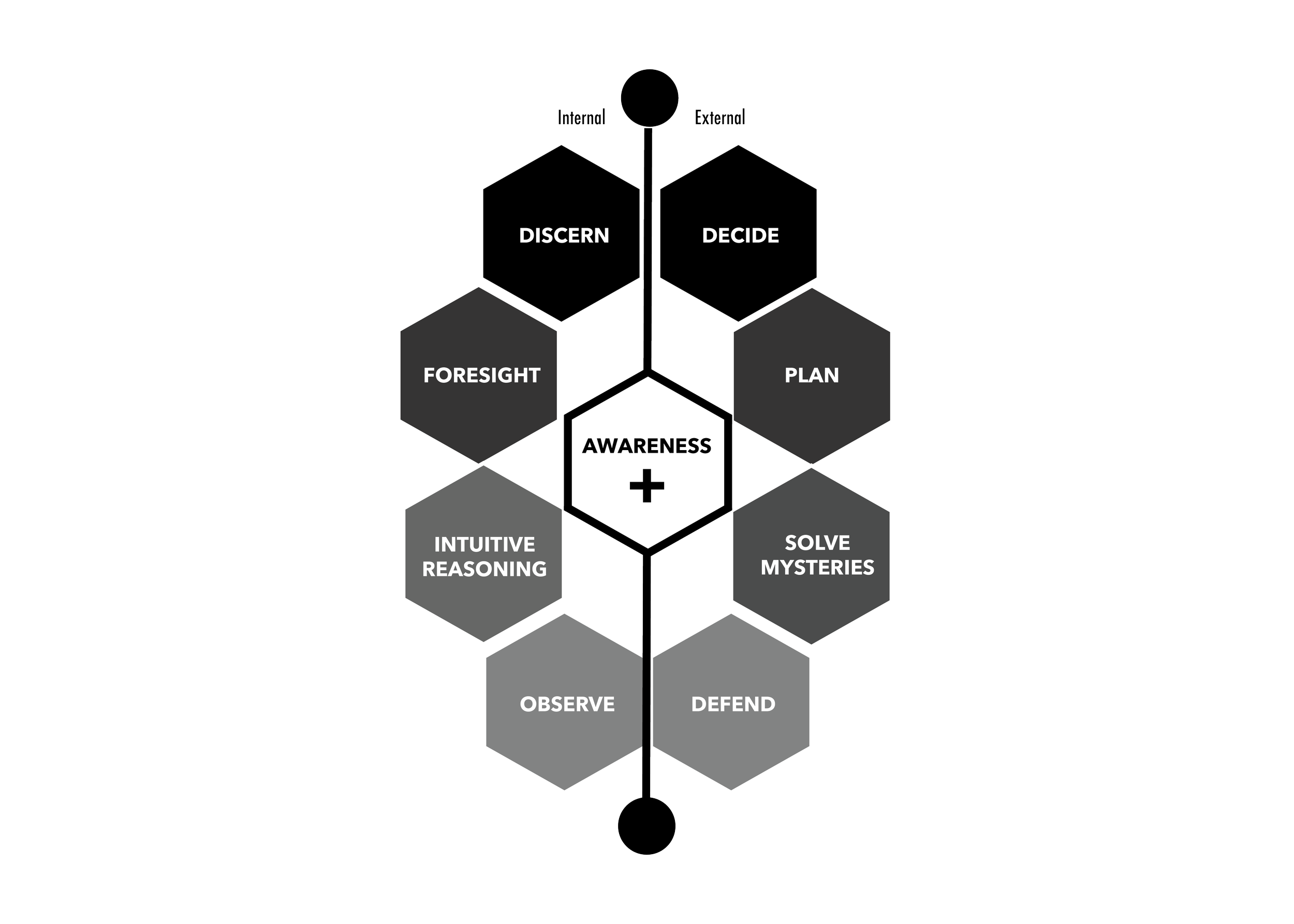
Discernment
INtuitive Motivational Design
Strengths:
Strengths are inherent abilities or qualities that a person naturally excels in. These are often cultivated and developed over time through practice and experience.
Discernment
You possess the strength of discernment, which allows you to perceive and understand subtle nuances and underlying truths in various situations. This ability enables you to see beyond surface-level appearances and identify the core issues at play, making you adept at evaluating people, environments, and circumstances with remarkable accuracy. With discernment, you can make more informed decisions, avoid potential pitfalls, and navigate complex social and professional landscapes effectively. This strength helps you build trust and credibility, as others recognize your ability to see things clearly and objectively. Discernment also enhances your problem-solving skills, as you can identify the root cause of issues and address them directly. Your perceptive nature allows you to anticipate potential challenges and opportunities, positioning you for long-term success. Overall, discernment empowers you to make sound judgments that benefit both yourself and those around you.
click + expand
-
Imagine you're a manager in a growing tech company. During a team meeting, you notice that one of your new hires, Emma, who initially appeared very enthusiastic and capable, has been unusually quiet and withdrawn. Instead of dismissing it as a temporary mood, your discernment kicks in. You schedule a one-on-one meeting with her and discover that she is struggling to adapt to the fast-paced company culture and is feeling overwhelmed by the new responsibilities.
Recognizing the underlying issue, you provide Emma with additional support and resources, such as assigning a mentor and gradually increasing her responsibilities to help her adjust at a more comfortable pace. This proactive approach not only helps Emma to integrate successfully into the team but also prevents potential future problems that could arise from her feeling unsupported or disconnected.
-
In your personal life, discernment plays a crucial role as well. Suppose you're in a close-knit group of friends, and you notice that one of your friends, John, has been acting differently. He used to be the life of the party but now seems more withdrawn and less communicative. Rather than assuming he's just busy or going through a phase, you trust your intuition and decide to have a heart-to-heart conversation with him.
During your talk, John reveals that he's been dealing with some personal issues and didn't want to burden anyone with his problems. Your perceptive nature allows you to offer him the support and understanding he needs, strengthening your friendship and providing him with a safe space to express himself.
-
Discernment also significantly impacts your decision-making process. For instance, you're considering a major investment opportunity that looks promising on the surface. While everyone else is excited about the potential returns, you take a step back and analyze the finer details. You notice subtle red flags in the company's financial reports and discrepancies in their growth projections.
Thanks to your keen discernment, you decide to conduct further research and eventually uncover significant risks that were initially overlooked. By trusting your ability to see beyond the apparent excitement, you avoid a potentially disastrous financial decision, showcasing how discernment can safeguard your interests and those who rely on your judgment.
-
Your discernment is equally valuable in collaborative environments. Imagine you're part of a cross-functional team working on a new product launch. During a brainstorming session, one team member, Alex, enthusiastically proposes an idea that garners immediate support from most of the group. However, your discernment prompts you to dig deeper into the feasibility of the proposal.
After asking insightful questions and evaluating potential implementation challenges, you uncover that Alex's idea, while creative, would strain the budget and conflict with the project's timeline. By presenting your findings constructively, you steer the team toward refining the concept into a more practical solution, ensuring the project's success while maintaining team cohesion.
-
As a mentor, discernment enhances your ability to guide others. Imagine you're mentoring a junior colleague, Sarah, who is ambitious but seems to lack focus in her career development. During your conversations, you notice a recurring theme in her interests and skills that Sarah herself hasn’t fully recognized.
You help her connect the dots, highlighting a career path that aligns with her strengths and passions. This guidance not only boosts her confidence but also sets her on a trajectory for meaningful professional growth, underscoring your ability to perceive and nurture potential in others.
-
In high-pressure situations, your discernment is a critical asset. Imagine you're managing a crisis at work involving a sudden data breach. While others react emotionally or jump to immediate conclusions, you stay calm and analyze the situation thoroughly.
You quickly identify that the breach was caused by an oversight in vendor management rather than internal negligence. This clarity enables you to take targeted action, such as addressing the vendor issue, implementing stricter security protocols, and restoring client trust. Your discernment not only resolves the crisis effectively but also strengthens your leadership reputation.
Ways we can use our strengths.
Discernment
With your keen sense of discernment, you can accurately assess situations, people, and decisions, allowing you to make wise choices. This ability to see through complexities and understand underlying motives helps guide others toward the best outcomes. By exercising discernment, you protect your team or community from potential pitfalls and steer them in the right direction.
click + expand
-
Discernment allows you to see beyond surface-level interactions and understand the underlying motives that drive people's actions. In negotiations, this means you can identify hidden agendas or true intentions, enabling you to craft strategies that better address the needs of all parties involved. In interpersonal relationships, this skill helps you navigate complex emotional dynamics, leading to more meaningful and honest communication. Understanding these motives is essential for resolving conflicts, building trust, and achieving mutually beneficial outcomes.
Practical Applications:
Sales Negotiations: Use discernment to identify the real concerns or desires of a client, allowing you to tailor your pitch to meet their deeper needs and close deals more effectively.
Conflict Resolution: Apply discernment in personal or professional conflicts to understand the root cause of disagreements, leading to solutions that address the underlying issues rather than just the symptoms.
Partnership Evaluations: In business partnerships, use discernment to assess whether potential partners have aligned goals and values, ensuring long-term compatibility and success.
Relationship Building: In personal relationships, use discernment to recognize when someone’s actions are driven by insecurity or fear, allowing you to respond with empathy and support.
-
Discernment enables you to move beyond superficial symptoms and identify the actual causes of problems, leading to more effective and lasting solutions. In business, this might involve understanding why a project is failing or why customer satisfaction is low, and then addressing those issues directly. In personal life, discernment helps you recognize emotional or psychological factors that may be influencing behavior or decision-making. This deeper understanding allows for targeted interventions that solve problems at their source rather than merely treating the symptoms.
Practical Applications:
Process Improvement: Use discernment to identify inefficiencies in business processes, allowing you to implement changes that improve productivity and reduce costs.
Health and Wellness: In personal health, apply discernment to identify lifestyle factors contributing to stress or illness, leading to more effective wellness strategies.
Team Dynamics: Use discernment to diagnose underlying issues in team dynamics, such as poor communication or unclear roles, and take steps to resolve them.
Customer Satisfaction: In business, use discernment to analyze customer feedback and identify the core issues leading to dissatisfaction, enabling you to make strategic improvements.
-
Discernment allows you to assess the true risks associated with investment opportunities by looking beyond immediate gains and considering long-term implications. This skill helps you avoid decisions based on hype or trends, focusing instead on the fundamental factors that will determine the success of an investment. By weighing the potential rewards against the risks, you can make more informed decisions that align with your financial goals. This approach is essential for building a stable and profitable investment portfolio.
Practical Applications:
Stock Market: Use discernment to evaluate the long-term potential of stocks, avoiding overhyped investments that may not deliver sustained growth.
Real Estate: Apply discernment in real estate investments by assessing factors such as location, market trends, and future development plans to ensure a profitable return.
Business Ventures: In entrepreneurship, use discernment to evaluate the risks of launching a new business or product, considering factors like market demand, competition, and resource allocation.
Retirement Planning: Apply discernment to choose investment vehicles that balance risk and reward, ensuring that your retirement savings grow steadily over time.
-
Discernment helps you evaluate the character and reliability of potential hires or team members, ensuring that they align with your organization’s culture and long-term goals. Beyond assessing qualifications, this skill allows you to determine how well individuals will fit within a team, contribute to its success, and uphold ethical standards. By focusing on character and integrity, you can build a cohesive, trustworthy team that works well together and supports the organization’s values. This approach reduces the risk of hiring mistakes and promotes a positive work environment.
Practical Applications:
Interview Techniques: Use discernment during interviews to ask questions that reveal a candidate's true character, such as how they handle ethical challenges or difficult situations.
Team Integration: Apply discernment when forming teams to ensure that new members will complement existing dynamics and contribute positively to the group.
Leadership Selection: In leadership hiring, use discernment to identify individuals with the integrity and vision necessary to guide the organization effectively.
Performance Reviews: During performance evaluations, use discernment to assess not just job performance but also how well an employee’s character aligns with the company’s values.
-
Discernment allows healthcare professionals to notice subtle symptoms or changes in a patient’s condition that might be overlooked by others, leading to more accurate and timely diagnoses. This skill is especially important in cases where symptoms are vague or when multiple conditions might present similarly. By carefully observing and interpreting these cues, you can catch issues early, before they develop into more serious health problems. This approach not only improves patient outcomes but also enhances the overall quality of care provided.
Practical Applications:
Early Detection: Use discernment to identify early signs of serious conditions, such as cancer or neurological disorders, based on subtle changes in patient behavior or test results.
Complex Cases: In cases with multiple or conflicting symptoms, apply discernment to piece together the correct diagnosis, ensuring that patients receive appropriate treatment.
Chronic Illness Management: Use discernment to monitor chronic conditions, recognizing when subtle changes indicate that a treatment plan needs adjustment.
Patient Communication: Apply discernment in patient interactions to understand when a patient might be withholding information or underreporting symptoms, leading to more accurate diagnoses.
-
Discernment is crucial in legal and investigative work, where the ability to determine truthfulness can significantly impact the outcome of a case. This skill allows you to detect inconsistencies in testimony, identify deception, and understand the true motives behind actions or statements. By carefully analyzing behavior, language, and evidence, you can build stronger cases and make more informed decisions. This approach is essential for ensuring justice and achieving fair outcomes in legal proceedings.
Practical Applications:
Witness Interrogation: Use discernment during witness interrogation to detect inconsistencies or signs of deception, strengthening the reliability of the evidence presented.
Jury Selection: In legal cases, apply discernment to evaluate potential jurors' biases or inclinations, ensuring a fair and impartial jury is selected.
Fraud Investigation: In financial or corporate investigations, use discernment to uncover fraudulent activities by identifying subtle discrepancies in documents or statements.
Contract Negotiations: Apply discernment in legal negotiations to assess the sincerity of the opposing party’s offers and intentions, leading to more favorable outcomes for your client.
-
Discernment helps leaders and counselors navigate complex ethical dilemmas by distinguishing between right and wrong, even when the answers aren’t clear-cut. This skill allows you to consider the long-term consequences of decisions and to ensure that your actions align with both ethical standards and the well-being of those affected. In leadership, this might involve balancing profit with social responsibility, while in counseling, it could mean guiding clients to make decisions that are true to their values. By applying discernment, you can lead with integrity and provide counsel that supports personal and organizational growth.
Practical Applications:
Corporate Governance: Use discernment in leadership to balance business profitability with ethical practices, ensuring that decisions benefit all stakeholders without compromising integrity.
Client Counseling: As a counselor, apply discernment to help clients navigate moral dilemmas, ensuring that their choices align with their values and contribute to their well-being.
Policy Development: In leadership roles, use discernment to develop policies that uphold ethical standards while meeting organizational goals, promoting a culture of integrity.
Conflict of Interest Management: Apply discernment in situations where potential conflicts of interest arise, ensuring that decisions are made transparently and ethically.
-
Discernment enables you to distinguish between what is merely popular and what has enduring quality and substance in art, literature, or media. This skill is crucial for curators, editors, and content creators who aim to provide audiences with works that offer depth, insight, and long-term value. By focusing on quality rather than trends, you can contribute to a richer cultural discourse and ensure that your work resonates with audiences over time. This approach helps build a reputation for excellence and integrity in your field.
Practical Applications:
Publishing: As an editor, use discernment to select manuscripts that offer unique perspectives or significant literary value, even if they are not immediately commercially viable.
Art Curation: In a gallery setting, apply discernment to choose works that challenge viewers intellectually or emotionally, rather than simply appealing to current trends.
Content Creation: For media producers, use discernment to create content that provides lasting value and impact, ensuring that your work remains relevant and respected over time.
Educational Resources: In education, apply discernment to curate teaching materials that not only meet curriculum standards but also inspire critical thinking and creativity among students.
-
Discernment allows you to appreciate and navigate the subtle cultural differences that can impact global business or travel. This skill is essential for building strong relationships, avoiding misunderstandings, and ensuring successful interactions in a multicultural environment. By understanding the underlying values, customs, and communication styles of different cultures, you can tailor your approach to meet the needs and expectations of your international counterparts. This approach fosters respect, collaboration, and success in global ventures.
Practical Applications:
International Negotiations: Use discernment in global business negotiations to understand the cultural context of your counterpart’s position, allowing you to navigate discussions more effectively and reach agreements that respect both parties' values.
Cross-Cultural Management: As a manager of a multicultural team, apply discernment to create a work environment that respects and integrates diverse cultural perspectives, leading to improved collaboration and productivity.
Travel Planning: In personal travel, use discernment to adapt to local customs and practices, enhancing your travel experience and showing respect for the host culture.
Marketing Strategies: In global marketing, apply discernment to create campaigns that resonate with different cultural audiences, ensuring that your brand message is both effective and respectful.
-
Discernment helps you navigate the vast array of options available for personal development or spiritual growth, allowing you to choose paths that truly resonate with your core values and long-term goals. This skill enables you to sift through popular trends or superficial advice and focus on practices that offer genuine and lasting benefits. By making informed choices, you can embark on a journey of growth that is deeply aligned with your true self, leading to greater fulfillment and purpose in life.
Practical Applications:
Choosing Educational Paths: Use discernment to select courses or training programs that align with your career goals and personal interests, ensuring that your investment in education leads to meaningful growth.
Spiritual Practices: In spiritual development, apply discernment to choose practices or teachings that genuinely resonate with your beliefs and values, leading to deeper spiritual fulfillment.
Personal Coaching: When seeking personal development coaching, use discernment to choose a coach whose approach aligns with your values and goals, ensuring that the guidance you receive is truly beneficial.
Lifestyle Changes: In making lifestyle changes, apply discernment to choose habits or routines that genuinely enhance your well-being and align with your long-term vision for your life.
FIT | FLEX | FORGE
Fit:
FIT – When Intuitive Design Strengths Align Perfectly with the Role
Definition in Context:
In a Fit scenario, an individual whose primary motivational drive is Intuitive Design is placed in a role that directly calls for their innate perceptiveness, foresight, and analytical depth. Their natural ability to discern truth, anticipate unseen issues, and make accurate assessments becomes essential to the success of the role. These roles demand sharp intuition, high emotional intelligence, and an ability to perceive beneath the surface—functions at the core of the intuitive design.
Examples:
Discernment + Intuitive Reasoning: A fraud analyst or forensic investigator intuitively detects inconsistencies and uncovers patterns of deception that others overlook.
Foresight + Readiness Planning: A strategic advisor or risk management professional foresees emerging threats and prepares systems for potential future scenarios.
On Guard + Defensive Acumen: A cybersecurity lead or compliance officer persistently scans for hidden vulnerabilities, using deep instinct to protect valuable assets.
Organizational Impact:
Builds high-trust decision-making environments
Improves risk detection and preemptive strategy
Elevates the team’s collective foresight and ethical confidence
FLEX – When Intuitive Design Strengths Are Adaptively Applied
Definition in Context:
In a Flex scenario, Intuitive Design strengths may not be formally required by the role, but the individual naturally applies them to enhance clarity, perception, and protective insight. Their intuitive contributions influence the team’s understanding, morale, and direction—even if subtly. These individuals often shift outcomes from behind the scenes, helping others see what’s happening below the surface.
Examples:
Solving Mysteries + Discernment: A marketing analyst, not tasked with deep investigation, instinctively uncovers customer behavior trends that lead to breakthrough campaigns.
Intuitive Reasoning + Defensive Acumen: A project team member notices overlooked flaws or emotional tensions and suggests adjustments that prevent future conflict or waste.
On Guard: In a relationally intense team, someone intuitively tracks subtle social cues and maintains emotional safety, reducing the risk of miscommunication or burnout.
Organizational Impact:
Improves communication and group alignment
Identifies problems before they escalate
Enhances ethical, emotional, and cultural intelligence
FORGE – When Intuitive Design Strengths Transform a Role or System
Definition in Context:
In a Forge scenario, Intuitive Design strengths don’t just support a role—they reinvent it. The individual perceives patterns, risks, and opportunities that others miss, and uses that insight to challenge norms, redefine workflows, or create entirely new methodologies. This is intuition applied at the system level, where perception becomes innovation.
Examples:
Foresight + Intuitive Reasoning: A project coordinator reimagines decision-making using intuition-informed models, improving long-term success across departments.
Solving Mysteries: An inquisitive team member uncovers underlying morale issues and leads the development of a cultural healing strategy based on deep emotional truths.
Decisiveness + On Guard: An overlooked analyst identifies gaps in leadership communication, stepping into a hidden leadership role that reshapes organizational narrative and transparency.
Organizational Impact:
Spurs innovation and reveals blind spots
Creates culture shifts rooted in deep truth and clarity
Reinforces systemic resilience through subtle reform
Summary of Intuitive Design Strengths Across Fit, Flex, and Forge
Rather than use a table, here’s a descriptive breakdown:
Discernment is a Fit in evaluation and ethics-heavy roles, a Flex when guiding team clarity, and a Forge when it redefines how organizations assess truth or integrity.
Decisiveness is a Fit in crisis and leadership roles, a Flex when used to move stuck teams forward, and a Forgewhen it shifts how decisions are made across an entire system.
Foresight fits perfectly in planning and risk-oriented roles, flexes by preventing subtle missteps in team dynamics, and forges new planning models that integrate values and outcomes.
Readiness Planning fits in logistics and operations, flexes through informal preparation that stabilizes the team, and forges when it expands how readiness is defined across dimensions.
Intuitive Reasoning fits in behavioral, design, or diagnostic roles, flexes by offering insights others miss, and forges through the creation of new thinking frameworks or decision-making tools.
Solving Mysteries fits roles that require uncovering truth, flexes by asking better questions in any team setting, and forges by developing new methods of investigation or insight.
On Guard fits risk and protection-focused positions, flexes through emotional and cultural safety within teams, and forges protective systems that anticipate and prevent harm.
Defensive Acumen fits in law, HR, and compliance, flexes as a behind-the-scenes protector of people or processes, and forges by building proactive policies and safeguarding systems.
Final Insight
The Intuitive Design thrives on inner clarity, foresight, and the deep drive to protect, perceive, and uncover truth. Across Fit, Flex, and Forge, these strengths create value in every environment:
In Fit, you are a precision instrument, naturally doing what you were made for.
In Flex, you are a quiet catalyst, shaping outcomes through subtle insight.
In Forge, you are a system-changer, pioneering new ways of perceiving and protecting.
This framework empowers Intuitive Design individuals to recognize how their unique way of seeing the world is always valuable—even in environments that don’t yet understand how deeply they need it.
Dispositional Strengths
-
Description text goes here
-
Description text goes here
-
Description text goes here
Functional Strengths
-
Description text goes here
-
Description text goes here
-
Description text goes here
Discernment
10 Roles Where Intuitive Design Is a Natural Match
These jobs place the Discernment strength in its element—allowing the intuitive individual to apply deep perception, inner judgment, and character reading to fulfill their role with excellence.
Fraud Analyst – Catching deception and anomalies through patterns others overlook.
HR Investigator – Discerning truth in sensitive interviews and personnel situations.
Ethics Compliance Officer – Interpreting gray areas and making principled decisions.
Character Development Coach – Helping individuals identify and refine inner motives.
Forensic Psychologist – Diagnosing behavioral traits and criminal motivations with subtle clarity.
Organizational Consultant – Uncovering hidden dysfunctions and alignment issues in systems.
Hiring Specialist – Intuitively evaluating candidate authenticity during interviews.
Security Clearance Evaluator – Assessing trustworthiness in high-stakes environments.
Conflict Mediator – Reading between words and resolving disputes through moral insight.
Spiritual Director or Advisor – Guiding others through intuitive awareness of character and intention.
FLEX – 10 Adaptive Ways Intuitive Design Enhances Any Role
These are ways people with Discernment as an intuitive strength apply it in roles that don’t demand it directly but benefit significantly from its quiet power.
Sensing when a team member is not being honest—with themselves or others—and gently prompting clarity.
Helping leadership navigate difficult personnel issues with a deeper perspective on motives.
Flagging unconscious bias in hiring decisions or evaluations.
Offering subtle redirection during meetings to bring hidden concerns into the open.
Seeing the misalignment in branding or messaging before public release and warning the team.
Helping teams interpret emotional feedback more truthfully than surface-level reactions suggest.
Anticipating relational fallout when a leader makes a poor character call.
Clarifying values for a team in moments of vision drift or moral confusion.
Spotting when someone is people-pleasing instead of offering honest input.
Quietly confronting dishonesty in team dynamics to protect the integrity of the group.
FORGE – 5 Transformational Scenarios for Discernment
These are visionary, system-shaping uses of Discernment where the intuitive person doesn’t just act—they innovate how others assess character, integrity, and truth.
Creates an internal “moral clarity index” that helps teams evaluate decisions through character and impact alignment rather than surface metrics.
Redesigns talent acquisition protocols to include intuitive screening for alignment with core organizational values.
Develops a team-wide truth-telling process, equipping teams to give each other honest feedback without fear of rejection or reprisal.
Introduces a new cultural review process to identify subtle breaches of trust, influence, or motive that are undermining company unity.
Launches a leadership integrity lab that trains upcoming managers to perceive subtle gaps between intention and action—and correct them early.
Decisiveness
INtuitive Motivational Design
Strengths:
Strengths are inherent abilities or qualities that a person naturally excels in. These are often cultivated and developed over time through practice and experience.
Decisiveness
Your decisiveness empowers you to make swift and confident decisions, even in high-pressure situations. This strength lets you weigh options quickly, trust your judgment, and take action without hesitation. Decisiveness is crucial in both personal and professional settings, as it enables you to move forward with clarity and purpose. By being decisive, you can avoid the pitfalls of overthinking and procrastination, ensuring that you make the most of opportunities as they arise. This strength also inspires confidence in others, as they see you as a reliable and authoritative figure who can be trusted to make important decisions. Decisiveness enhances your leadership capabilities, as you can guide teams and projects with certainty and direction. Ultimately, your ability to make prompt and effective decisions contributes to your overall success and efficiency.
click + expand
-
Imagine you're leading a marketing team in a fast-paced advertising agency. You and your team are working on a major campaign for a high-profile client, and the deadline is rapidly approaching. During a crucial meeting, you realize that the current strategy isn't producing the desired results, and time is running out to make significant changes.
Instead of panicking or overanalyzing the situation, you quickly assess the available options and decide to pivot the campaign's direction. You trust your judgment and choose a bold new approach that leverages the team's strengths and aligns better with the client's brand. Your swift decision and clear directive energize the team, and everyone rallies to implement the changes.
As a result, the campaign not only meets the deadline but exceeds the client's expectations, showcasing your ability to make effective decisions under pressure and lead your team to success.
-
Decisiveness plays a vital role in your personal life as well. Suppose you're planning a family vacation, and everyone has different preferences for the destination. While some family members want to relax at a beach resort, others prefer a cultural city tour. The indecision and back-and-forth discussions threaten to derail the vacation planning process.
Recognizing the need for decisive action, you take charge and evaluate the options quickly. You decide on a destination that offers both relaxation and cultural experiences, ensuring that everyone's interests are addressed. Your swift decision brings relief and excitement to your family, allowing the vacation planning to proceed smoothly and preventing any further delays.
-
Your decisiveness is also invaluable in crisis situations. Imagine you're the manager of a retail store, and there's an unexpected power outage during peak shopping hours. The store is filled with customers, and the staff is unsure how to proceed.
Without hesitation, you quickly decide to implement the store's emergency protocol. You instruct the staff to guide customers safely to the exits, ensure that the cash registers are secured, and arrange for backup power to keep essential systems running. Your confident and prompt actions prevent chaos, maintain customer safety, and protect the store's assets.
-
Decisiveness strengthens relationships by fostering trust and reducing tension. Imagine you're in a romantic relationship, and a disagreement arises about how to spend the weekend. Your partner wants to attend a concert, while you prefer a quiet evening at home.
Recognizing that prolonged indecision could lead to conflict, you assess the situation quickly and decide on a compromise: attending the concert but planning a relaxing evening the following weekend. This approach not only resolves the disagreement efficiently but also demonstrates your commitment to maintaining harmony and balance in the relationship.
-
Decisiveness is critical in the entrepreneurial world. Suppose you're the founder of a startup and need to choose between two investors offering funding, each with different terms. Time is of the essence, as your business requires the capital to continue operations.
After a thorough but swift evaluation, you decide to accept the offer that aligns better with your company’s vision and long-term goals. This decision not only secures the necessary funding but also inspires confidence in your leadership among your team and stakeholders.
-
Your decisiveness is a valuable asset in volunteer work. Imagine you're helping coordinate a community festival, and one of the lead volunteers fails to show up, leaving a gap in the schedule.
Without hesitation, you step in, reassess the assignments, and reallocate tasks among the remaining team. Your prompt decision keeps the event running smoothly, ensuring a positive experience for both the attendees and the organizing team.
Ways we can use our strengths.
Decisiveness
Your decisiveness enables you to make quick, clear, and confident decisions, even under pressure. This strength ensures that progress isn’t stalled by indecision, allowing you and those around you to move forward with purpose. By being decisive, you provide direction and leadership that others can rely on, especially in critical moments.
click + expand
-
Decisiveness in leadership involves making timely decisions that move teams forward without unnecessary delays. In business, this means assessing the situation, gathering relevant information, and then making a clear decision that guides the team’s actions. Decisiveness prevents analysis paralysis, boosts team confidence, and ensures that projects stay on track. By setting a strong example, you inspire your team to trust their own decision-making abilities and maintain momentum in their work.
Practical Applications:
Project Management: As a project manager, use decisiveness to allocate resources efficiently and set clear deadlines, ensuring that the project progresses smoothly.
Team Meetings: During meetings, make quick decisions on key issues to avoid lengthy discussions that delay action, helping the team maintain focus and productivity.
New Initiatives: When launching new initiatives, use decisiveness to establish goals and objectives, allowing your team to start work immediately with a clear understanding of expectations.
Performance Management: In leadership, use decisiveness to address performance issues promptly, providing feedback and setting improvement plans to keep the team on track.
-
In crisis situations, decisiveness is critical to managing uncertainty and preventing escalation. This involves quickly assessing the situation, understanding the potential risks and impacts, and making a decision that minimizes damage and maintains stability. Decisiveness in a crisis not only provides a clear direction for your team but also reassures stakeholders that the situation is under control. Effective crisis management depends on your ability to make swift, informed choices that prioritize safety and continuity.
Practical Applications:
Emergency Response: In a business setting, use decisiveness to implement emergency response plans quickly, ensuring the safety of employees and minimizing operational disruptions.
Public Relations: During a PR crisis, make rapid decisions on how to communicate with the public and media, controlling the narrative and protecting the organization’s reputation.
Resource Allocation: In a resource shortage, use decisiveness to prioritize essential functions and allocate resources where they are most needed, maintaining critical operations.
Operational Continuity: During a systems failure, apply decisiveness to initiate backup procedures and restore operations as quickly as possible, minimizing downtime and loss.
-
Decisiveness in implementing changes involves acting swiftly once a decision has been made, rather than hesitating or second-guessing. This approach ensures that necessary changes are put into place efficiently, allowing the organization to adapt and improve continuously. Whether it’s adjusting a business strategy or optimizing processes, decisiveness helps maintain momentum and reduces the resistance that often accompanies change. By acting decisively, you demonstrate confidence in the chosen course of action, encouraging others to support the transition.
Practical Applications:
Process Optimization: Use decisiveness to streamline workflows by quickly implementing new technologies or methodologies that improve efficiency and reduce costs.
Strategy Shifts: In response to market changes, apply decisiveness to pivot the business strategy, ensuring the company remains competitive and aligned with current trends.
Policy Updates: When updating company policies, use decisiveness to roll out changes promptly, providing clear communication and training to ensure smooth adoption.
Cultural Change: In leadership, use decisiveness to drive cultural changes within the organization, setting clear expectations and leading by example to foster a new work environment.
-
Decisiveness in conflict resolution involves taking a clear, firm stance on issues to prevent prolonged disputes and maintain harmony. This approach requires you to evaluate the situation, consider all perspectives, and then make a decision that resolves the conflict fairly and effectively. By taking a decisive position, you reduce uncertainty and demonstrate leadership, which can de-escalate tensions and encourage others to follow suit. Firmness in conflict resolution also helps establish clear boundaries and expectations, preventing future issues.
Practical Applications:
Workplace Conflicts: Use decisiveness to mediate workplace conflicts by making fair, informed decisions that address the root causes and set clear expectations for future behavior.
Negotiations: In business negotiations, apply decisiveness to take a firm stance on key terms, ensuring that your interests are protected while also reaching a mutually beneficial agreement.
Disciplinary Actions: In management, use decisiveness when addressing misconduct or performance issues, setting clear consequences and ensuring that standards are upheld.
Personal Relationships: In personal life, apply decisiveness to resolve conflicts by setting boundaries and communicating your stance clearly, fostering healthier relationships.
-
Decisiveness in project management involves setting a clear direction and making prompt decisions that keep the project on track. This requires you to evaluate the project’s needs, consider various options, and then choose the best course of action to achieve the desired outcomes. By making clear decisions, you eliminate ambiguity and ensure that all team members are aligned and focused on the same goals. Decisiveness in project management also helps prevent delays, as it minimizes the time spent on indecision and re-evaluation.
Practical Applications:
Project Planning: Use decisiveness to finalize project plans quickly, allowing the team to start work with a clear understanding of objectives, timelines, and deliverables.
Resource Management: In project management, apply decisiveness to allocate resources effectively, ensuring that all aspects of the project are adequately supported.
Problem-Solving: When challenges arise during a project, use decisiveness to choose a solution quickly, minimizing disruptions and keeping the project on schedule.
Stakeholder Communication: In managing stakeholder expectations, use decisiveness to provide clear updates and make firm commitments, ensuring that everyone is on the same page.
-
Decisiveness in prioritization involves making quick, clear decisions about which tasks are most important and should be addressed first. This skill is crucial for managing time effectively, ensuring that high-priority tasks receive the attention they need while less critical activities are deferred or delegated. By prioritizing efficiently, you can achieve your goals more effectively and reduce stress, as you focus your energy on the most impactful activities. Decisiveness in prioritization also helps you manage workload and avoid the overwhelm that comes from juggling too many tasks at once.
Practical Applications:
Daily Planning: Use decisiveness to create a daily task list that prioritizes activities based on importance and deadlines, ensuring that you stay focused and productive throughout the day.
Work-Life Balance: In personal life, apply decisiveness to prioritize activities that contribute to your well-being and happiness, ensuring that you maintain a healthy work-life balance.
Team Task Management: As a manager, use decisiveness to prioritize team tasks, delegating effectively to ensure that all critical projects are completed on time.
Crisis Response: In emergency situations, use decisiveness to quickly prioritize tasks that address the most urgent issues, ensuring that critical needs are met first.
-
Decisiveness in trading involves making quick, informed decisions to buy or sell assets based on market conditions and financial goals. This skill is essential in the fast-paced environment of financial markets, where hesitation can lead to missed opportunities or increased risks. By executing trades confidently, you can capitalize on favorable market conditions and minimize losses. Decisiveness in trading also requires you to trust your analysis and instincts, even in volatile markets, ensuring that you stick to your strategy and achieve your financial objectives.
Practical Applications:
Day Trading: In day trading, use decisiveness to make quick buy or sell decisions based on real-time market data, maximizing short-term profits.
Long-Term Investments: For long-term investments, apply decisiveness to enter or exit positions at the right time, based on thorough analysis and market trends.
Portfolio Management: As a portfolio manager, use decisiveness to rebalance portfolios regularly, ensuring that asset allocation aligns with the client’s risk tolerance and financial goals.
Risk Management: In trading, use decisiveness to set and adhere to stop-loss orders, protecting your investments from significant losses.
-
Decisiveness in making major life decisions involves evaluating your options and choosing a path forward with confidence. Whether it’s changing careers, relocating to a new city, or making significant lifestyle changes, decisiveness helps you move forward without being paralyzed by uncertainty or fear. This approach ensures that you take control of your life’s direction and pursue opportunities that align with your long-term goals. By acting decisively, you can embrace change and make transitions smoother and more successful.
Practical Applications:
Career Transitions: Use decisiveness to choose a new career path that aligns with your skills, interests, and long-term goals, allowing you to transition smoothly and with confidence.
Relocation Decisions: When considering a move, apply decisiveness to evaluate the pros and cons quickly and choose the best location for your personal and professional life.
Educational Pursuits: In deciding whether to pursue further education, use decisiveness to assess the potential benefits and make a commitment to a program that supports your career aspirations.
Lifestyle Changes: For major lifestyle changes, such as adopting a new diet or exercise routine, use decisiveness to start and stick with your new habits, ensuring long-term success.
-
Decisiveness in leadership involves making clear, confident decisions that inspire trust and motivate others to follow your lead. By demonstrating decisiveness, you create an environment where team members feel secure in the direction being taken and are more likely to support and implement your decisions. This approach helps build credibility and authority as a leader, as others see you as capable of guiding the organization toward its goals. Decisiveness also fosters a culture of action and accountability, encouraging everyone to contribute to the team’s success.
Practical Applications:
Vision Setting: In leadership, use decisiveness to articulate a clear vision and strategy for the team, inspiring confidence and commitment among team members.
Decision-Making: In team meetings, apply decisiveness to make tough decisions quickly, demonstrating your ability to lead effectively even under pressure.
Change Management: During times of organizational change, use decisiveness to communicate changes clearly and implement them swiftly, minimizing uncertainty and maintaining morale.
Performance Leadership: In managing performance, use decisiveness to set clear expectations and hold team members accountable, driving continuous improvement and achievement.
-
Decisiveness in setting boundaries involves clearly defining what is acceptable and unacceptable in your interactions with others. This skill is crucial for maintaining healthy relationships and a productive work environment, as it helps prevent misunderstandings, overcommitment, and burnout. By setting and enforcing boundaries decisively, you protect your time, energy, and well-being, while also respecting the needs and limits of others. This approach fosters mutual respect and ensures that all parties understand and adhere to agreed-upon expectations.
Practical Applications:
Work-Life Balance: Use decisiveness to set clear boundaries between work and personal life, ensuring that you have time to relax and recharge without work encroaching on your personal time.
Professional Relationships: In the workplace, apply decisiveness to establish boundaries around your availability and workload, preventing burnout and ensuring that you can deliver high-quality work.
Personal Relationships: In personal life, use decisiveness to set boundaries with family and friends, communicating clearly what you can and cannot accommodate to maintain healthy relationships.
Conflict Avoidance: In both work and personal settings, use decisiveness to set boundaries that prevent conflicts, such as being clear about your limits and expectations from the outset.
Foresight
Intuitive Motivational Design
Strengths:
Strengths are inherent abilities or qualities that a person naturally excels in. These are often cultivated and developed over time through practice and experience.
Foresight
You have the strength of foresight, enabling you to anticipate future trends, challenges, and opportunities. This ability allows you to plan strategically and prepare for what lies ahead, giving you a significant advantage in both personal and professional endeavors. Foresight involves thinking ahead and considering the long-term implications of your actions, helping you make decisions that are beneficial in the future. By leveraging foresight, you can identify potential obstacles and devise proactive solutions to mitigate risks. This strength also allows you to capitalize on emerging trends and innovations, ensuring that you stay ahead of the curve. Foresight enhances your strategic planning skills, enabling you to set realistic goals and develop effective action plans. Ultimately, this ability helps you create a clear vision for your future and work towards it with confidence and purpose.
click + expand
-
Imagine you're the CEO of a tech company. You notice early signs that a significant shift is coming in the industry toward artificial intelligence and machine learning. While your competitors are focused on their current product lines, your foresight allows you to see the potential impact of these technologies on the market.
You decide to invest in research and development, hiring experts in AI and machine learning, and begin integrating these technologies into your product offerings. Additionally, you start forming strategic partnerships with AI startups to accelerate innovation. Over time, your company becomes a leader in AI-driven solutions, and when the market eventually pivots towards these technologies, your company is well-positioned to capitalize on the trend, leaving your competitors scrambling to catch up.
-
Foresight is equally valuable in your personal life. Suppose you have children and foresee the rising costs of higher education. While your children are still young, you start investing in a college savings plan. You research various savings options, choose the most effective one, and regularly contribute to it over the years.
Because of your foresight, when your children are ready for college, you have accumulated enough savings to cover their tuition fees, reducing the financial burden on your family. This proactive planning not only ensures your children's educational future but also provides you with peace of mind.
-
Consider a scenario where you're leading a large-scale project at work. By analyzing current trends and potential challenges, you foresee that certain materials needed for the project might become scarce due to global supply chain disruptions.
Instead of waiting for the issue to impact the project, you take proactive measures. You source alternative suppliers, secure necessary materials in advance, and adjust the project timeline to account for possible delays. Your foresight ensures that the project proceeds smoothly, without the setbacks that affect other projects relying on the same materials.
-
Foresight can strengthen your relationships by helping you navigate potential challenges before they arise. For instance, you recognize that your partner is entering a particularly demanding phase at work. Anticipating the stress they might face, you take steps to create a supportive environment.
You arrange regular check-ins, take on more responsibilities at home, and plan relaxing activities to help them decompress. By proactively addressing potential stressors, you not only show understanding and care but also build a foundation of trust and mutual support that fortifies your relationship.
-
Foresight can also play a critical role in maintaining your health and well-being. You recognize that leading a sedentary lifestyle could lead to health issues in the future. Anticipating these potential problems, you decide to incorporate regular exercise and a balanced diet into your daily routine.
By making these lifestyle changes now, you mitigate the risk of developing chronic health conditions later in life. Your proactive approach not only improves your current quality of life but also ensures long-term health benefits, demonstrating the power of foresight in personal well-being.
-
Your foresight helps secure your financial stability. Imagine you anticipate that the economy might face a downturn in the next few years. Rather than waiting for the impact, you take steps to prepare by increasing your savings, diversifying your investments, and cutting back on non-essential expenses.
When the downturn arrives, your financial preparations allow you to weather the economic challenges comfortably, demonstrating how foresight can safeguard your resources and provide peace of mind.
In all these scenarios, your foresight allows you to anticipate and prepare for future developments, turning potential challenges into opportunities and ensuring long-term success and stability. Whether in professional settings, personal life, project management, relationships, health, or finances, this strength helps you create a clear and strategic path forward, enabling you to achieve your goals with confidence and purpose.
Ways we can use our strengths.
Foresight
Your ability to anticipate future events and outcomes allows you to prepare effectively for what lies ahead. This foresight helps you and your team avoid risks and seize opportunities before they arise. By thinking ahead, you create strategies that lead to long-term success and stability.
click + expand
-
Foresight enables you to anticipate market trends by analyzing current data, understanding industry shifts, and recognizing emerging patterns. This ability helps businesses stay ahead of the competition by adapting their strategies to meet future demands. By predicting these trends, companies can innovate, launch products, or pivot their business models in ways that capitalize on upcoming opportunities. This proactive approach reduces the risk of being caught off guard by market changes and positions the business for long-term success.
Practical Applications:
Product Development: Use foresight to guide the development of new products that meet emerging customer needs, ensuring they are ready for market as demand grows.
Strategic Investments: Apply foresight to make informed decisions about where to allocate resources, such as investing in technologies or markets poised for growth.
Marketing Campaigns: Use foresight to design marketing campaigns that align with future consumer behavior trends, ensuring your brand remains relevant and engaging.
Competitive Analysis: Apply foresight to anticipate competitors’ moves and develop strategies to counteract their potential impact on your market position.
-
Foresight allows you to anticipate potential challenges in your personal finances or career and take proactive steps to address them. Whether it's saving for retirement, preparing for an economic downturn, or planning a career transition, foresight helps you build resilience and achieve long-term stability. By planning ahead, you can create contingency plans, diversify your income streams, and continue growing professionally despite uncertainties. This forward-thinking approach empowers you to navigate life’s challenges with confidence and security.
Practical Applications:
Retirement Planning: Use foresight to develop a comprehensive retirement plan that accounts for potential market fluctuations and changes in your financial needs over time.
Career Development: Apply foresight to identify skills that will be in demand in the future, allowing you to pursue relevant training and education to stay competitive in your field.
Emergency Savings: Use foresight to build an emergency fund that can cover unexpected expenses, such as medical bills or job loss, providing financial security in uncertain times.
Debt Management: Apply foresight to create a debt repayment strategy that prioritizes high-interest debts and minimizes long-term financial burden.
-
Foresight enables you to stay ahead of technological advancements by identifying emerging technologies and understanding how they might impact your industry or field. This skill is crucial for innovation, as it allows you to adapt your products, services, or business models to leverage new technologies before they become mainstream. By anticipating these changes, you can position your organization as a leader in adopting and integrating new technologies, giving you a competitive edge. This proactive approach also helps you avoid obsolescence in a rapidly evolving technological landscape.
Practical Applications:
R&D Investments: Use foresight to direct research and development efforts toward technologies that are likely to shape the future of your industry, ensuring your company remains at the forefront of innovation.
Product Roadmaps: Apply foresight to create product roadmaps that incorporate upcoming technological advancements, allowing you to deliver cutting-edge solutions to customers.
Tech Partnerships: Use foresight to identify potential technology partners or acquisitions that can enhance your organization’s capabilities and accelerate innovation.
Workforce Training: Apply foresight to implement training programs that equip your workforce with the skills needed to work with emerging technologies, ensuring they are prepared for future demands.
-
Foresight in emergency management involves anticipating potential crises—such as natural disasters, pandemics, or cyberattacks—and developing plans to mitigate their impact. This proactive approach ensures that organizations, communities, and individuals are better equipped to respond quickly and effectively when a crisis occurs. By preparing for a range of scenarios, you can minimize damage, protect lives, and ensure continuity of operations. Foresight in crisis management is critical for reducing vulnerability and enhancing resilience in the face of unexpected challenges.
Practical Applications:
Disaster Preparedness Plans: Use foresight to develop comprehensive disaster preparedness plans that include evacuation procedures, communication strategies, and resource allocation.
Business Continuity Planning: Apply foresight to create business continuity plans that ensure critical operations can continue during and after a crisis, minimizing disruption and financial loss.
Crisis Drills: Use foresight to organize and conduct regular crisis drills that prepare employees or community members for various emergency scenarios, improving response times and coordination.
Supply Chain Resilience: Apply foresight to assess and strengthen supply chain resilience by identifying potential vulnerabilities and securing alternative sources for critical materials and components.
-
Foresight allows you to set long-term goals in personal development or education by envisioning the skills, knowledge, and experiences you will need to succeed in the future. This involves identifying trends in your field, understanding the evolving demands of the job market, and planning your learning and development accordingly. By setting these goals, you ensure that your personal and professional growth aligns with future opportunities and challenges. Foresight in this context helps you stay relevant, adaptable, and prepared for the future.
Practical Applications:
Educational Planning: Use foresight to choose educational programs or certifications that align with future industry needs, ensuring that your skills remain relevant and in demand.
Skill Development: Apply foresight to identify and cultivate emerging skills that will enhance your career prospects, such as digital literacy or data analysis.
Career Path Mapping: Use foresight to map out a long-term career path that includes key milestones and development opportunities, guiding your decisions and efforts over time.
Personal Growth Plans: Apply foresight to create personal growth plans that focus on areas such as leadership, communication, or emotional intelligence, helping you excel in both professional and personal contexts.
-
Foresight enables you to anticipate societal changes—such as shifts in demographics, consumer behavior, or cultural values—and adapt your business models or career paths accordingly. By understanding these trends, you can position your business or career to meet new demands, avoid obsolescence, and capitalize on emerging opportunities. This forward-thinking approach ensures that you remain competitive and relevant as society evolves. Foresight in this area is crucial for long-term sustainability and success in a rapidly changing world.
Practical Applications:
Business Model Innovation: Use foresight to redesign business models that align with changing consumer preferences, such as increased demand for sustainability or digital services.
Market Entry Strategies: Apply foresight to identify emerging markets or demographic segments that are likely to grow, guiding your market entry strategies for maximum impact.
Career Shifts: Use foresight to plan career shifts that align with societal changes, such as moving into industries that are expected to expand due to technological or cultural trends.
Product Diversification: Apply foresight to diversify product lines that cater to evolving societal needs, ensuring your business remains relevant and attractive to a broad audience.
-
Foresight in community planning or urban development involves anticipating the future needs of communities, such as housing, transportation, education, and healthcare. This ability helps planners and developers create sustainable, resilient, and livable communities that can adapt to population growth, environmental changes, and technological advancements. By identifying these needs early, you can design infrastructure and services that meet the demands of future generations. Foresight in this context is essential for building cities and communities that thrive in the long term.
Practical Applications:
Sustainable Infrastructure: Use foresight to design and implement sustainable infrastructure projects, such as green buildings or renewable energy systems, that meet future environmental standards and community needs.
Transportation Planning: Apply foresight to develop transportation networks that accommodate future population growth and technological advancements, such as autonomous vehicles or smart transit systems.
Affordable Housing Initiatives: Use foresight to plan and advocate for affordable housing projects that address future population growth and income disparities, ensuring that all residents have access to safe and affordable homes.
Public Health Facilities: Apply foresight to identify future healthcare needs and plan for the development of public health facilities that can serve growing and aging populations.
-
Foresight helps you prepare for major life transitions, such as retirement or parenthood, by anticipating the challenges and opportunities these changes will bring. This involves planning your finances, lifestyle, and support systems to ensure a smooth and successful transition. Whether it’s building a retirement nest egg, planning for the costs of raising a child, or adjusting to new roles and responsibilities, foresight allows you to approach these transitions with confidence. By preparing in advance, you can enjoy these new phases of life without unnecessary stress or uncertainty.
Practical Applications:
Retirement Savings Plans: Use foresight to create a comprehensive retirement savings plan that accounts for your desired lifestyle, healthcare needs, and potential inflation.
Parenthood Preparation: Apply foresight to prepare financially and emotionally for parenthood, including budgeting for childcare, education, and healthcare expenses.
Estate Planning: Use foresight to develop an estate plan that ensures your assets are managed and distributed according to your wishes, providing peace of mind for you and your loved ones.
Lifestyle Adjustments: Apply foresight to plan lifestyle adjustments that accommodate your new role, such as downsizing your home in retirement or setting up a nursery for a new baby.
-
Influence Policy-Making by Anticipating Societal Impacts
Foresight in policy-making involves anticipating the long-term societal impacts of current issues and trends, and using this knowledge to influence the development of policies that address future challenges. This skill is critical for shaping policies that promote social welfare, economic stability, and environmental sustainability. By understanding the potential consequences of policy decisions, you can advocate for solutions that are proactive rather than reactive, ensuring that society is better prepared for future developments. Foresight in policy-making helps create a more resilient and forward-looking society.
Practical Applications:
Legislative Proposals: Use foresight to draft and advocate for legislative proposals that address future societal challenges, such as climate change or technological unemployment.
Public Health Policies: Apply foresight to influence the development of public health policies that anticipate and mitigate the impacts of future pandemics or health crises.
Economic Planning: Use foresight to contribute to economic policies that promote long-term growth and stability, considering factors such as demographic shifts and technological advancements.
Environmental Regulations: Apply foresight to advocate for environmental regulations that protect natural resources and promote sustainability, ensuring that policies address future ecological challenges.
\
-
Foresight in leadership involves setting a clear, forward-looking vision that guides teams toward long-term success. This vision provides direction, inspiration, and motivation, helping team members understand how their efforts contribute to the organization’s future goals. By articulating a compelling vision, you can align the team’s work with the organization’s strategic objectives and create a sense of purpose that drives performance. Foresight in this context ensures that the team remains focused, adaptable, and resilient in the face of changing circumstances.
Practical Applications:
Strategic Planning: Use foresight to develop a long-term strategic plan that outlines the team’s goals, milestones, and key initiatives, providing a roadmap for future success.
Vision Communication: Apply foresight to communicate your vision effectively, ensuring that all team members understand their role in achieving the organization’s long-term objectives.
Team Alignment: Use foresight to align team activities and projects with the organization’s strategic goals, ensuring that everyone is working toward a common purpose.
Performance Metrics: Apply foresight to establish performance metrics that reflect the team’s progress toward achieving the long-term vision, providing regular feedback and motivation to stay on track.
Planning
INtuitive Motivational Design
Strengths:
Strengths are inherent abilities or qualities that a person naturally excels in. These are often cultivated and developed over time through practice and experience.
Planning/readiness
Your planning strength allows you to create detailed and effective plans to achieve your goals. This skill ensures that you consider all variables, set realistic timelines, and allocate resources efficiently. Planning involves organizing tasks, setting priorities, and developing step-by-step strategies to achieve desired outcomes. With strong planning skills, you can anticipate potential challenges and devise contingency plans to address them. This ability enhances your time management skills, ensuring that you make the most of your resources and stay on track to meet your objectives. Planning also involves setting measurable milestones and tracking progress, allowing you to adjust your strategies as needed. Ultimately, your planning strength enables you to approach complex projects with confidence and precision, ensuring successful outcomes.
click + expand
-
Imagine you are responsible for organizing an international conference for your company. The event is expected to host hundreds of attendees from around the world, including high-profile speakers and industry leaders. To ensure the event's success, you start by creating a comprehensive plan that covers every aspect of the conference.
You begin by setting clear objectives for the event, identifying key milestones, and creating a detailed timeline. You organize tasks such as venue selection, speaker invitations, travel arrangements, marketing strategies, and attendee registration. You also anticipate potential challenges, such as travel disruptions or technical issues, and develop contingency plans to address them.
Your meticulous planning ensures that each team member knows their responsibilities and deadlines. You regularly track progress and make adjustments as needed to stay on schedule. When the day of the conference arrives, everything runs smoothly. The logistics are seamless, the speakers are well-prepared, and the attendees have a positive experience. Your planning strength is evident in the successful execution of the event, earning praise from your colleagues and attendees alike.
-
Planning skills are equally valuable in your personal life. Suppose you and your partner are planning a significant home renovation. You start by outlining your goals for the renovation, such as creating more space, improving energy efficiency, and enhancing the aesthetic appeal.
You create a detailed plan that includes setting a budget, researching contractors, and creating a timeline for each phase of the renovation. You prioritize tasks, such as obtaining necessary permits, selecting materials, and scheduling inspections. You also anticipate potential setbacks, like delays in material delivery, and develop backup plans to keep the project on track.
Throughout the renovation process, you monitor progress and adjust your plans as needed. Your careful planning ensures that the project stays within budget and is completed on time, resulting in a beautifully renovated home that meets your expectations.
-
Consider a scenario where you're a student working on a complex research project. Your planning strength enables you to break down the project into manageable tasks and set a realistic timeline. You start by outlining the research objectives, identifying key resources, and developing a step-by-step strategy.
You allocate specific time slots for literature review, data collection, analysis, and writing. You set measurable milestones, such as completing the literature review within two weeks or drafting the first chapter by a specific date. You also anticipate potential challenges, such as access to research materials, and plan accordingly.
By regularly tracking your progress and adjusting your strategy as needed, you ensure that you stay on schedule and produce high-quality work. Your planning skills result in a well-organized and thoroughly researched project, earning you a high grade and positive feedback from your professors.
-
Your planning strength is particularly valuable when organizing large events. Imagine you are planning a family reunion that involves coordinating with relatives from various locations. You start by setting a date and location that works for everyone and then create a detailed plan to cover all aspects of the event.
You organize tasks such as sending out invitations, arranging accommodation, planning activities, and organizing catering. You also anticipate potential issues, like weather disruptions or last-minute cancellations, and develop contingency plans to address them.
By setting priorities and creating a timeline, you ensure that everything is done on time and within budget. You track progress regularly and make adjustments as needed. On the day of the reunion, everything goes smoothly. The activities are well-coordinated, the food is delicious, and everyone has a great time. Your planning skills ensure that the event is a memorable and enjoyable experience for all.
-
Planning enhances your ability to nurture meaningful relationships. For instance, you and your partner decide to celebrate a milestone anniversary. You begin by creating a detailed plan to ensure the day is special and memorable.
You outline activities, such as a romantic dinner, a surprise gift, and a day trip to a favorite destination. You make reservations in advance, budget for the celebration, and account for logistical details like travel arrangements. Additionally, you consider potential obstacles, such as inclement weather, and develop alternative plans to ensure the day remains enjoyable.
When the anniversary arrives, everything unfolds smoothly. Your thoughtful planning not only demonstrates your dedication but also strengthens your connection, creating cherished memories for both of you.
-
Your planning strength is critical when launching a new business. Imagine you are starting a small business and need to ensure a successful launch. You begin by conducting thorough market research and setting clear goals for your venture.
You organize tasks such as developing a business plan, securing funding, hiring team members, and designing a marketing strategy. You also anticipate potential challenges, like cash flow issues or supply chain delays, and develop contingency plans to address them.
By setting realistic timelines and measurable milestones, you ensure that every stage of the launch is well-prepared. You track progress regularly, making adjustments to keep the project on course. When launch day arrives, your planning ensures everything runs smoothly—customers are excited, operations are efficient, and your business gains positive traction in the market. Your meticulous planning helps establish a strong foundation for long-term success.
In all these scenarios, your planning strength enables you to approach complex projects with confidence and precision. Whether in professional settings, personal life, academics, event planning, relationships, or community service, your ability to create detailed and effective plans ensures successful outcomes and helps you achieve your goals.
Ways we can use our strengths.
Planning/Readiness
You excel at planning and preparing in advance, ensuring that you’re ready for any scenario. This proactive approach minimizes surprises and allows for smoother execution of tasks and goals. Your careful planning not only boosts your confidence but also reassures those who depend on you, creating an environment where everyone is equipped to succeed.
click + expand
-
Planning to be ready involves creating detailed contingency plans that ensure business operations can continue smoothly in the face of unexpected disruptions. These plans cover scenarios such as supply chain interruptions, equipment failures, or sudden shifts in market conditions. By preparing for various outcomes, businesses can minimize downtime, reduce losses, and maintain customer satisfaction even during crises. This proactive approach ensures that the company remains resilient and capable of navigating challenges effectively.
Practical Applications:
Supply Chain Disruptions: Create contingency plans for supply chain interruptions by identifying alternative suppliers and establishing emergency procurement procedures to keep production running smoothly.
IT System Failures: Develop backup protocols for IT systems, including data recovery plans and temporary manual processes, to ensure continuity in case of technical failures.
Market Shifts: Prepare contingency strategies to quickly adapt to sudden changes in market demand or economic conditions, such as pivoting to new products or services.
Human Resources: Develop plans for sudden workforce shortages due to illness or other factors by cross-training employees and maintaining a pool of temporary workers.
-
Planning for natural disasters involves creating comprehensive emergency kits and evacuation plans to ensure safety and readiness. This includes assembling necessary supplies, identifying safe evacuation routes, and conducting regular drills to familiarize everyone with the procedures. By being prepared, individuals and organizations can reduce the risk of injury, loss of life, and property damage during disasters. This readiness fosters a sense of security and confidence, knowing that effective measures are in place.
Practical Applications:
Home Safety: Assemble a home emergency kit with essential supplies such as food, water, medications, and first-aid materials, ensuring your family is prepared for natural disasters.
Workplace Evacuation: Develop and regularly update workplace evacuation plans, conducting drills to ensure employees know how to exit the building quickly and safely.
Community Planning: Coordinate with local authorities to establish community-wide disaster response plans, including designated shelters and communication strategies.
Education: Implement disaster preparedness education programs in schools, teaching students and staff how to respond effectively in emergencies.
-
Event planning requires meticulous preparation, including the development of backup plans to address potential issues such as equipment failure, weather disruptions, or no-show vendors. By considering all possible scenarios, you can ensure that the event proceeds smoothly, even if unexpected problems arise. This readiness not only enhances the event’s success but also demonstrates professionalism and reliability to clients and attendees. Having well-thought-out backup plans allows you to adapt quickly and maintain control in any situation.
Practical Applications:
Outdoor Events: For outdoor events, create contingency plans that include alternative indoor venues in case of bad weather, ensuring the event can proceed as planned.
Technical Failures: Prepare backup equipment and technical support for presentations or performances to address any potential audio-visual issues quickly.
Vendor Issues: Establish backup arrangements with secondary vendors to step in if the primary vendor fails to deliver, avoiding disruptions to the event schedule.
Logistics: Develop alternative transportation or accommodation plans for event attendees in case of travel delays or overbooking.
-
Effective resource management in project management involves planning and allocating resources such as time, money, personnel, and materials to ensure that the project stays on track. This requires anticipating needs, budgeting accurately, and monitoring resource usage throughout the project’s lifecycle. By managing resources efficiently, you can avoid waste, prevent bottlenecks, and ensure that the project is completed on time and within budget. This level of preparedness is crucial for the successful execution of any project.
Practical Applications:
Resource Allocation: Use project management tools to allocate resources efficiently, ensuring that each task has the necessary personnel and materials to be completed on time.
Budget Management: Develop a detailed budget that accounts for all potential expenses, and monitor spending closely to prevent cost overruns.
Time Management: Create a project timeline with milestones and deadlines, allowing you to track progress and make adjustments as needed to stay on schedule.
Risk Management: Identify potential resource shortages or risks and develop strategies to address them before they impact the project’s progress.
-
Planning for financial security involves creating long-term strategies to ensure that you have sufficient resources for retirement or other major life goals. This includes assessing your current financial situation, setting clear objectives, and making informed investment decisions. By planning ahead, you can build a robust financial portfolio that supports your desired lifestyle in retirement or provides financial stability for future endeavors. This proactive approach reduces financial stress and helps you achieve peace of mind.
Practical Applications:
Retirement Planning: Develop a comprehensive retirement plan that includes savings goals, investment strategies, and expected expenses, ensuring you have sufficient funds to maintain your lifestyle.
Diversified Investments: Create a diversified investment portfolio that balances risk and reward, protecting your assets while seeking growth opportunities.
Emergency Fund: Establish an emergency fund that can cover unexpected expenses, providing financial security in case of job loss, medical emergencies, or other unforeseen events.
Estate Planning: Prepare an estate plan that includes wills, trusts, and other legal documents to ensure your assets are managed and distributed according to your wishes.
-
Thorough preparation for presentations involves researching your topic in-depth, understanding your audience, and developing clear, compelling content. Additionally, having alternative approaches or backup materials ready ensures that you can adapt to any situation, such as unexpected questions or technical difficulties. This level of preparedness enhances your credibility, engages your audience, and increases the likelihood of delivering a successful presentation. Being ready with alternatives also allows you to handle unforeseen challenges confidently.
Practical Applications:
Audience Analysis: Conduct thorough research on your audience to tailor your presentation’s content and style to their interests and level of knowledge, ensuring maximum engagement.
Data Support: Prepare data and evidence to back up your key points, and have additional examples or case studies ready in case you need to elaborate on certain topics.
Technical Backups: Bring backup copies of your presentation on multiple devices (e.g., USB drive, cloud storage) and prepare alternative formats (e.g., printed handouts) in case of technical issues.
Q&A Readiness: Anticipate potential questions from your audience and prepare well-researched answers to ensure you can respond confidently and accurately.
-
Coordinating logistics for travel or large-scale operations involves detailed planning to ensure that all elements, such as transportation, accommodation, schedules, and resources, are organized and executed smoothly. This requires anticipating potential issues, such as delays or cancellations, and having contingency plans in place. By planning thoroughly, you can avoid disruptions, ensure the timely arrival of people and materials, and manage complex operations with confidence. Effective logistics coordination is key to the success of large-scale events, projects, or travel plans.
Practical Applications:
Travel Itineraries: Create detailed travel itineraries that include alternative routes, transportation options, and accommodation plans in case of delays or cancellations.
Supply Chain Management: Coordinate the logistics of supply chain operations to ensure timely delivery of goods and materials, accounting for potential disruptions.
Event Coordination: Plan and organize large-scale events with detailed schedules and logistical plans, ensuring that all aspects of the event run smoothly and on time.
Personnel Management: Coordinate the logistics of large teams by organizing travel, accommodations, and schedules, ensuring that everyone arrives and operates efficiently.
-
Anticipating project needs involves forecasting the requirements of a project at each stage and planning resources, timelines, and contingencies to meet those needs. This proactive approach helps you avoid delays, cost overruns, and resource shortages, ensuring that the project proceeds smoothly from start to finish. By planning for every aspect of the project, you can respond quickly to any changes or challenges that arise, keeping the project on track. Effective anticipation and planning are crucial for successful project management.
Practical Applications:
Resource Forecasting: Develop detailed forecasts of resource needs (e.g., materials, labor, time) for each phase of the project, ensuring that everything is in place before it’s needed.
Risk Assessment: Identify potential risks that could impact the project and create contingency plans to address them, minimizing disruptions.
Timeline Adjustments: Anticipate potential delays and build flexibility into the project timeline, allowing for adjustments without compromising the overall schedule.
Budget Planning: Create a comprehensive budget that anticipates all possible expenses, including contingency funds for unexpected costs, to keep the project financially stable.
-
Organizing personal schedules to optimize time management involves prioritizing tasks, setting realistic deadlines, and creating a structured plan for daily, weekly, and long-term activities. This approach helps you make the most of your time, ensuring that you stay productive and focused while also maintaining a healthy work-life balance. By planning your schedule carefully, you can achieve your goals more efficiently and reduce stress. Effective time management is key to personal and professional success.
Practical Applications:
Daily Task Lists: Create daily task lists that prioritize high-impact activities and set clear deadlines for each task, helping you stay focused and productive throughout the day.
Time Blocking: Use time-blocking techniques to allocate specific periods for different tasks or activities, ensuring that you dedicate sufficient time to each priority.
Long-Term Planning: Develop long-term schedules that map out key milestones, deadlines, and goals, allowing you to stay on track and avoid last-minute rushes.
Work-Life Balance: Plan your personal schedule to include time for relaxation, hobbies, and family, ensuring that you maintain a healthy balance between work and personal life.
-
Effective negotiation preparation involves gathering relevant data, understanding the interests of all parties, and developing clear strategies to achieve your objectives. By being well-prepared, you can approach negotiations with confidence, make informed decisions, and respond effectively to counteroffers or objections. Planning ahead also allows you to anticipate potential challenges and prepare alternative strategies, increasing your chances of reaching a favorable outcome. This level of preparation is essential for successful negotiations in any context.
Practical Applications:
Market Research: Conduct thorough market research to gather data on pricing, competitors, and industry trends, providing a solid foundation for your negotiation strategy.
Interest Mapping: Identify the interests and priorities of all parties involved in the negotiation, allowing you to craft proposals that address their key concerns while advancing your objectives.
BATNA Development: Prepare your Best Alternative to a Negotiated Agreement (BATNA) to strengthen your negotiating position and ensure that you have a viable fallback option.
Scenario Planning: Develop and rehearse different negotiation scenarios, including potential objections and counteroffers, so you are prepared to respond effectively during the actual negotiation.
Intuitive Reasoning
INtuitive Motivational Design
Strengths:
Strengths are inherent abilities or qualities that a person naturally excels in. These are often cultivated and developed over time through practice and experience.
Intuitive Reasoning
You possess intuitive reasoning, enabling you to solve problems and make connections that others might overlook. This strength allows you to trust your instincts and draw from your subconscious knowledge, leading to innovative solutions. Intuitive reasoning involves synthesizing information and recognizing patterns without the need for extensive analysis. This ability enhances your problem-solving skills, as you can quickly identify viable solutions and act on them. Intuitive reasoning also helps you navigate complex situations with ease, as you can rely on your gut feelings to guide you. This strength is particularly valuable in creative and innovative fields, where out-of-the-box thinking is essential. By leveraging intuitive reasoning, you can make informed decisions and uncover unique opportunities that others might miss.
examples
click + expand
-
Imagine you're a software developer working on a new application that has hit a major roadblock. The team is stuck, unable to figure out how to integrate a critical feature without causing performance issues. While others are deep into data analysis and debugging, your intuitive reasoning kicks in. You have a sudden insight to combine two seemingly unrelated algorithms you've encountered in different contexts.
Trusting your instincts, you quickly prototype this hybrid approach. To everyone's surprise, it not only resolves the integration issue but also enhances the application's overall performance. Your intuitive leap saves the project and impresses your colleagues with your innovative thinking.
-
Intuitive reasoning is especially valuable in creative professions. Suppose you're a graphic designer tasked with creating a brand identity for a new product. The client has provided some basic guidelines, but the concept feels uninspired. As you sift through various ideas, you suddenly get a gut feeling about blending vintage design elements with modern minimalist trends.
You decide to trust your intuition and develop a few mockups. The result is a unique and striking design that resonates deeply with the client's vision. Your ability to synthesize diverse influences into a cohesive whole not only delights the client but also sets a new trend in the industry.
-
In your personal life, intuitive reasoning can help you navigate relationships and make sound decisions. For instance, you might sense that a friend is struggling emotionally, even though they haven't said anything. Your intuition tells you that they need support, so you reach out and invite them for a casual chat.
During the conversation, your friend opens up about their difficulties and appreciates your timely support. Your intuitive understanding of their needs strengthens your bond and helps them through a tough time.
-
Consider a scenario where you're a business strategist facing a tough market. Traditional analysis suggests a conservative approach, but your intuition points you in a different direction. You sense an emerging trend in customer behavior that others haven't noticed yet.
Acting on this intuition, you propose a bold strategy to tap into this nascent trend. You develop a marketing campaign and product line that align with your gut feeling. As the trend starts to gain momentum, your company is already ahead of the curve, reaping significant benefits from your intuitive foresight.
-
Intuitive reasoning is crucial in fast-paced environments where quick decision-making is essential. Suppose you're a crisis manager dealing with a sudden supply chain disruption. While others are scrambling to analyze the situation, you trust your instincts and quickly identify an alternative supplier based on a vague memory from a past conference.
You contact this supplier, and they can provide the needed materials promptly. Your quick, intuitive decision averts a potential crisis and keeps operations running smoothly.
-
Your intuitive reasoning strengthens relationships by helping you understand emotions and needs that may not be explicitly expressed. Imagine you're in a new relationship and notice subtle changes in your partner's tone and body language when discussing their career. Your intuition tells you they might be facing challenges they haven’t shared yet.
You create a safe space for them to open up, asking gentle but pointed questions that encourage honesty. They reveal struggles at work, and your support helps them feel understood and valued. Your ability to intuitively grasp their needs deepens trust and fosters a more meaningful connection.
In all these scenarios, your intuitive reasoning allows you to solve problems, make connections, and uncover opportunities that others might overlook. Whether in professional settings, creative fields, personal life, strategic planning, problem-solving, or relationships, this strength helps you navigate complexities with ease and achieve innovative solutions.
Ways we can use our strengths.
Solving Mysteries Using Intuitive Reasoning
Your talent for solving mysteries through intuition enables you to uncover hidden truths and connect seemingly unrelated dots. This strength helps you unravel complex situations and provides clarity where others might be confused. By trusting your intuition, you solve problems that require deep insight and creativity, leading to breakthroughs that benefit those around you.
click + expand
-
Intuitive reasoning in law enforcement allows investigators to approach unsolved crimes by connecting disparate clues and making sense of incomplete or ambiguous evidence. This ability is crucial for piecing together complex cases where traditional methods may have failed to yield results. By trusting their instincts and recognizing subtle patterns, investigators can generate new leads and hypotheses, potentially solving cold cases that have long remained a mystery. This approach is invaluable in criminal investigations, where innovative thinking can make the difference between an unsolved case and a breakthrough.
Practical Applications:
Cold Case Reviews: Use intuitive reasoning to revisit cold cases, identifying overlooked evidence or connections that could lead to new investigative avenues.
Criminal Profiling: Apply intuitive reasoning in criminal profiling to understand the psychological patterns of suspects, leading to more accurate predictions of their behavior.
Witness Interviews: During witness interviews, use intuitive reasoning to detect inconsistencies or hidden truths that can provide new insights into the case.
Crime Scene Analysis: Employ intuitive reasoning to analyze crime scenes, interpreting subtle clues that may not be immediately apparent but could be critical to solving the case.
-
In archaeology, intuitive reasoning helps researchers uncover the mysteries of ancient civilizations by making connections between artifacts, architectural remains, and historical records. This ability allows archaeologists to piece together the lives, cultures, and technologies of people who lived thousands of years ago, often with limited physical evidence. By intuitively understanding the significance of findings and how they relate to broader historical contexts, archaeologists can develop theories that explain the evolution of human societies. This approach is essential for advancing our understanding of the past and preserving its legacy.
Practical Applications:
Site Excavation: Use intuitive reasoning to determine where to dig during archaeological excavations, increasing the chances of discovering significant artifacts or structures.
Artifact Analysis: Apply intuitive reasoning to analyze artifacts, interpreting their use and cultural significance within the context of the ancient civilization.
Historical Reconstruction: Use intuitive reasoning to reconstruct ancient societies, connecting the dots between various findings to create a coherent picture of how people lived.
Cultural Interpretation: Employ intuitive reasoning to interpret the symbolic meanings of ancient art, religious artifacts, or burial practices, shedding light on the beliefs and values of past civilizations.
-
Intuitive reasoning in financial audits and data analysis enables professionals to detect hidden patterns, anomalies, or irregularities that may indicate fraud, errors, or opportunities for optimization. This skill is crucial for uncovering issues that standard analytical methods might miss, such as subtle trends in financial transactions or discrepancies in large datasets. By trusting their instincts and looking beyond the obvious, auditors and analysts can identify underlying causes and propose effective solutions. This approach enhances the accuracy and depth of financial audits and data-driven decision-making.
Practical Applications:
Fraud Detection: Use intuitive reasoning to spot unusual patterns in financial data that may indicate fraudulent activity, leading to more effective prevention and detection efforts.
Risk Assessment: Apply intuitive reasoning in risk assessments to identify potential financial risks that are not immediately apparent from the data, helping to mitigate them proactively.
Data Mining: Use intuitive reasoning to uncover hidden trends or correlations in large datasets, providing valuable insights for business strategy or financial planning.
Performance Analysis: Employ intuitive reasoning to analyze financial performance data, identifying underlying factors that contribute to success or failure, and recommending strategic adjustments.
-
Intuitive reasoning in academic research helps historians and scholars solve historical mysteries by interpreting incomplete records, conflicting accounts, and gaps in knowledge. This ability allows researchers to connect various sources and form hypotheses that explain historical events, social movements, or cultural shifts. By using intuition to guide their investigations, scholars can uncover new perspectives on well-known histories or bring to light forgotten aspects of the past. This approach is vital for advancing historical knowledge and enriching our understanding of how past events have shaped the present.
Practical Applications:
Archival Research: Use intuitive reasoning to identify relevant documents or artifacts in archives that may hold the key to solving historical mysteries.
Source Criticism: Apply intuitive reasoning to critically analyze historical sources, discerning the reliability and biases of different accounts to construct a more accurate narrative.
Historical Reconstruction: Use intuitive reasoning to piece together historical events from fragmented or conflicting sources, providing a clearer understanding of the past.
Theory Development: Employ intuitive reasoning to develop new historical theories that challenge established interpretations and offer fresh insights into historical events.
-
Intuitive reasoning in scientific research allows scientists to develop theories that explain unexplained phenomena by synthesizing existing knowledge with new observations. This ability is particularly valuable in fields where current models fall short or where anomalies challenge established theories. By trusting their intuition, scientists can propose innovative hypotheses that push the boundaries of our understanding and guide future research. This approach is essential for scientific advancement, as it encourages exploration beyond the limits of conventional thinking.
Practical Applications:
Anomaly Investigation: Use intuitive reasoning to investigate scientific anomalies, developing theories that offer plausible explanations and guide further experimentation.
Hypothesis Generation: Apply intuitive reasoning to generate novel hypotheses that challenge existing theories and open up new areas of scientific inquiry.
Interdisciplinary Research: Use intuitive reasoning to connect concepts from different scientific disciplines, leading to breakthrough theories that address complex phenomena.
Theory Refinement: Employ intuitive reasoning to refine existing scientific theories, integrating new data and insights that improve their explanatory power.
-
Intuitive reasoning in literary analysis helps readers and scholars uncover deeper meanings, themes, and connections within a text that might not be immediately apparent. This ability allows for a more nuanced understanding of the work, revealing underlying messages, symbolic structures, or intertextual references that enrich the reading experience. By using intuition to guide their interpretations, analysts can explore the complexities of literature and contribute to a deeper appreciation of the text. This approach is vital for literary criticism, education, and creative inspiration.
Practical Applications:
Theme Exploration: Use intuitive reasoning to explore the themes and motifs in a literary work, uncovering how they interact to create a richer, more complex narrative.
Character Analysis: Apply intuitive reasoning to analyze characters’ motivations and relationships, revealing deeper psychological or philosophical insights.
Symbol Interpretation: Use intuitive reasoning to interpret symbols and metaphors in literature, uncovering hidden layers of meaning that enhance the text’s impact.
Comparative Analysis: Employ intuitive reasoning to draw connections between different literary works, identifying shared themes, styles, or influences that contribute to a broader understanding of the genre or author’s oeuvre.
-
Intuitive reasoning can be used to critically explore conspiracy theories, distinguishing between plausible explanations and unfounded speculation. This skill allows you to analyze the evidence supporting various theories, considering the motivations, logic, and inconsistencies that may be present. By using intuition to guide your investigation, you can assess the likelihood of different scenarios while remaining open to alternative explanations. This approach is important for maintaining a balanced perspective, avoiding the traps of confirmation bias, and promoting rational discourse.
Practical Applications:
Evidence Evaluation: Use intuitive reasoning to evaluate the evidence supporting a conspiracy theory, identifying credible sources and recognizing when information has been manipulated or misrepresented.
Logical Analysis: Apply intuitive reasoning to assess the logical coherence of a conspiracy theory, determining whether it is internally consistent and whether the proposed connections are plausible.
Motivation Exploration: Use intuitive reasoning to explore the motivations behind a conspiracy theory, understanding the psychological, social, or political factors that might drive its popularity.
Alternative Explanations: Employ intuitive reasoning to develop and consider alternative explanations for the events or phenomena addressed by a conspiracy theory, promoting a more balanced and informed perspective.
-
Intuitive reasoning in genealogy allows you to uncover your family history by piecing together incomplete records, oral histories, and other sources. This ability helps you make connections between relatives, trace lineage, and understand the broader historical context of your ancestors' lives. By trusting your intuition, you can navigate the complexities of genealogical research, overcoming gaps in documentation or conflicting information. This approach is essential for building a comprehensive and meaningful family history that honors your heritage.
Practical Applications:
Record Analysis: Use intuitive reasoning to analyze historical records, such as census data, birth certificates, and immigration documents, to trace your family lineage.
Oral Histories: Apply intuitive reasoning to interpret oral histories or family stories, identifying key details that can be cross-referenced with written records.
Historical Contextualization: Use intuitive reasoning to place your ancestors’ lives within the broader historical context, understanding how social, economic, or political factors influenced their experiences.
Genealogical Puzzles: Employ intuitive reasoning to solve genealogical puzzles, such as identifying unknown relatives or connecting distant branches of the family tree.
-
Intuitive reasoning in healthcare is crucial for diagnosing rare or complex medical conditions that may not present with clear or typical symptoms. This ability allows healthcare professionals to connect subtle signs, patient history, and clinical intuition to identify conditions that might otherwise be missed. By trusting their instincts and considering all possible explanations, practitioners can provide early and accurate diagnoses, leading to more effective treatment plans. This approach is especially valuable in cases where standard diagnostic procedures do not yield definitive answers.
Practical Applications:
Symptom Recognition: Use intuitive reasoning to recognize rare symptoms or combinations of symptoms that suggest the presence of an uncommon medical condition.
Differential Diagnosis: Apply intuitive reasoning to develop a differential diagnosis that considers a wide range of possibilities, even those that are rare or atypical.
Case Study Analysis: Use intuitive reasoning to analyze medical case studies, drawing parallels between past cases and current patients to identify potential diagnoses.
Patient History Integration: Employ intuitive reasoning to integrate detailed patient histories with current symptoms, identifying patterns that might indicate a rare condition.
-
Intuitive reasoning is a powerful tool for writers and game designers when creating fictional mysteries that captivate and challenge audiences. This ability allows you to weave intricate plots, develop compelling characters, and plant subtle clues that keep readers or players engaged and guessing. By trusting your intuition, you can craft stories that are not only entertaining but also intellectually stimulating, with twists and turns that feel both surprising and satisfying. This approach is essential for creating immersive and memorable experiences in literature and interactive media.
Practical Applications:
Plot Development: Use intuitive reasoning to develop complex, multi-layered plots that keep readers or players engaged, with twists and turns that are both unexpected and logical.
Character Creation: Apply intuitive reasoning to create characters with hidden motives, secrets, or connections that gradually unfold as the mystery progresses.
Clue Planting: Use intuitive reasoning to plant subtle clues throughout the story or game that lead to the mystery’s resolution, ensuring that they are challenging yet fair.
Storytelling Pacing: Employ intuitive reasoning to pace the mystery’s unfolding, balancing tension and revelation to maintain suspense and satisfaction throughout the narrative.
-
Intuitive reasoning in linguistics allows researchers to decipher ancient texts and languages that have been lost or forgotten over time. This skill involves recognizing patterns in symbols, syntax, and phonetics that may not have a direct reference in modern languages. By intuitively understanding the context and possible meanings, linguists can reconstruct languages, interpret ancient writings, and unlock the knowledge contained within them. This approach is crucial for preserving historical knowledge and understanding the evolution of human communication.
Practical Applications:
Language Reconstruction: Use intuitive reasoning to piece together the grammar and vocabulary of extinct languages by comparing them with related languages or dialects.
Text Interpretation: Apply intuitive reasoning to interpret ancient manuscripts or inscriptions, making educated guesses about the meaning of unknown words or phrases based on context and symbolism.
Symbol Decoding: Use intuitive reasoning to decode symbols or pictographs found in ancient texts, linking them to known concepts or cultural practices.
Cross-Linguistic Analysis: Employ intuitive reasoning to compare multiple ancient languages, identifying similarities that can provide clues to their meanings and origins.
-
Intuitive reasoning in forensic science allows investigators to analyze evidence in ways that reveal connections or insights that might not be immediately apparent. This skill is vital in cases where forensic data, such as DNA, fingerprints, or ballistic reports, may not provide straightforward answers. By intuitively connecting different pieces of evidence, investigators can develop a coherent narrative of the crime, identify suspects, or exonerate the innocent. This approach is essential for solving complex cases and ensuring that justice is served.
Practical Applications:
Evidence Correlation: Use intuitive reasoning to correlate various pieces of forensic evidence, such as matching DNA to crime scenes or linking weaponry to specific injuries, to build a case.
Crime Scene Reconstruction: Apply intuitive reasoning to reconstruct the sequence of events at a crime scene, using forensic evidence to create a plausible scenario that fits all the facts.
Suspect Identification: Use intuitive reasoning to analyze forensic evidence in the context of suspect behavior or known criminal patterns, narrowing down potential suspects.
Case Reassessment: Employ intuitive reasoning to reassess cold cases by reinterpreting forensic evidence with fresh insights, potentially uncovering new leads or overturning wrongful convictions.
ability to solve mysteries
INtuitive Motivational Design
Strengths:
Ability to solve mysteries
Your ability to solve mysteries means you excel at uncovering hidden truths and resolving complex puzzles. This strength is particularly valuable in investigative and analytical roles, where uncovering details and understanding intricate situations is crucial. Solving mysteries involves gathering information, identifying patterns, and drawing logical conclusions based on the evidence. This ability enhances your critical thinking skills, as you can approach problems systematically and methodically. Your talent for solving mysteries allows you to tackle complex issues with confidence and precision. This strength also involves a keen attention to detail, as you can spot subtle clues that others might overlook. Ultimately, your ability to solve mysteries empowers you to bring clarity and resolution to ambiguous and challenging situations.
Example in Professional Setting:
Imagine you are a forensic accountant tasked with investigating potential financial fraud within a large corporation. While reviewing the company’s financial records, you notice a series of small, irregular transactions that seem insignificant on their own. However, your ability to solve mysteries kicks in, and you start to piece together a pattern.
You systematically gather more data, cross-referencing the transactions with other records. Your keen attention to detail uncovers a complex scheme where funds were being siphoned off into hidden accounts. Your investigation not only reveals the fraud but also identifies the individuals responsible, bringing clarity and justice to the situation. Your ability to solve this financial puzzle saves the company from further losses and helps restore its integrity.
Example in Personal Life:
In your personal life, solving mysteries can be just as impactful. Suppose your friend has been acting unusually distant and upset, but they haven’t shared what’s bothering them. Using your ability to solve mysteries, you observe their behavior closely and recall past conversations. You notice they’ve been avoiding topics related to their job.
Trusting your instincts, you gently probe about work and discover that they are facing significant challenges there. By identifying the root of their distress, you can offer the right support and advice, helping your friend navigate their issues more effectively. Your talent for uncovering the hidden truth strengthens your relationship and provides your friend with the clarity they need.
Example in Problem-Solving:
Consider a scenario where you are a software engineer working on a project with persistent, elusive bugs that are causing system failures. Despite extensive testing, the team cannot pinpoint the issue. Your ability to solve mysteries allows you to take a different approach. You start by reviewing the codebase meticulously, looking for any inconsistencies or patterns.
Your detailed analysis reveals a subtle but critical error in a rarely used module. By isolating and fixing this error, you resolve the bugs and stabilize the system. Your methodical problem-solving not only impresses your team but also ensures the project’s success, highlighting your ability to tackle complex technical challenges.
Example in Investigative Roles:
As a detective, your ability to solve mysteries is essential. Imagine you are investigating a high-profile case where the evidence is minimal and the situation ambiguous. You visit the crime scene, meticulously gathering all available information and observing details others might miss.
You interview witnesses, cross-checking their statements and identifying inconsistencies. Your attention to subtle clues—like an overlooked piece of jewelry or an unusual behavior—helps you connect the dots. Through careful analysis and logical deduction, you uncover the perpetrator’s identity and motives, solving the case and bringing justice to the victims.
Example in Academic Research:
In academic research, solving mysteries can drive significant discoveries. Suppose you are a biologist researching a disease with unknown origins. You gather extensive data from various sources, looking for patterns in the spread and impact of the disease. Your ability to solve mysteries helps you identify a previously unnoticed correlation between environmental factors and disease outbreaks.
Further investigation confirms your hypothesis, leading to a breakthrough in understanding the disease’s origins and pathways. Your research not only advances scientific knowledge but also paves the way for developing effective treatments and preventive measures.
Example in Leadership:
In leadership, your ability to solve mysteries can be a game-changer. Imagine you’re managing a team with declining performance, and the reasons for the drop are unclear. Instead of making assumptions, you approach the situation with a detective's mindset.
You gather data, such as team feedback, project outcomes, and workflow patterns. Through careful analysis, you identify a disconnect between team members’ roles and their strengths. By realigning responsibilities and addressing communication gaps, you resolve the underlying issues. Your efforts restore the team’s performance and morale, showcasing your talent for solving complex organizational puzzles.
In all these scenarios, your ability to solve mysteries empowers you to uncover hidden truths, resolve complex puzzles, and bring clarity to challenging situations. Whether in professional settings, personal life, problem-solving, investigative roles, academic research, or leadership, this strength enhances your critical thinking and problem-solving skills, enabling you to tackle ambiguities with confidence and precision.
Strengths are inherent abilities or qualities that a person naturally excels in. These are often cultivated and developed over time through practice and experience.
click + expand
-
Your ability to solve mysteries means you excel at uncovering hidden truths and resolving complex puzzles. This strength is particularly valuable in investigative and analytical roles, where uncovering details and understanding intricate situations is crucial. Solving mysteries involves gathering information, identifying patterns, and drawing logical conclusions based on the evidence. This ability enhances your critical thinking skills, as you can approach problems systematically and methodically. Your talent for solving mysteries allows you to tackle complex issues with confidence and precision. This strength also involves a keen attention to detail, as you can spot subtle clues that others might overlook. Ultimately, your ability to solve mysteries empowers you to bring clarity and resolution to ambiguous and challenging situations.
Example in Professional Setting:
Imagine you are a forensic accountant tasked with investigating potential financial fraud within a large corporation. While reviewing the company’s financial records, you notice a series of small, irregular transactions that seem insignificant on their own. However, your ability to solve mysteries kicks in, and you start to piece together a pattern.
You systematically gather more data, cross-referencing the transactions with other records. Your keen attention to detail uncovers a complex scheme where funds were being siphoned off into hidden accounts. Your investigation not only reveals the fraud but also identifies the individuals responsible, bringing clarity and justice to the situation. Your ability to solve this financial puzzle saves the company from further losses and helps restore its integrity.
Example in Personal Life:
In your personal life, solving mysteries can be just as impactful. Suppose your friend has been acting unusually distant and upset, but they haven’t shared what’s bothering them. Using your ability to solve mysteries, you observe their behavior closely and recall past conversations. You notice they’ve been avoiding topics related to their job.
Trusting your instincts, you gently probe about work and discover that they are facing significant challenges there. By identifying the root of their distress, you can offer the right support and advice, helping your friend navigate their issues more effectively. Your talent for uncovering the hidden truth strengthens your relationship and provides your friend with the clarity they need.
Example in Problem-Solving:
Consider a scenario where you are a software engineer working on a project with persistent, elusive bugs that are causing system failures. Despite extensive testing, the team cannot pinpoint the issue. Your ability to solve mysteries allows you to take a different approach. You start by reviewing the codebase meticulously, looking for any inconsistencies or patterns.
Your detailed analysis reveals a subtle but critical error in a rarely used module. By isolating and fixing this error, you resolve the bugs and stabilize the system. Your methodical problem-solving not only impresses your team but also ensures the project’s success, highlighting your ability to tackle complex technical challenges.
Example in Investigative Roles:
As a detective, your ability to solve mysteries is essential. Imagine you are investigating a high-profile case where the evidence is minimal and the situation ambiguous. You visit the crime scene, meticulously gathering all available information and observing details others might miss.
You interview witnesses, cross-checking their statements and identifying inconsistencies. Your attention to subtle clues—like an overlooked piece of jewelry or an unusual behavior—helps you connect the dots. Through careful analysis and logical deduction, you uncover the perpetrator’s identity and motives, solving the case and bringing justice to the victims.
Example in Academic Research:
In academic research, solving mysteries can drive significant discoveries. Suppose you are a biologist researching a disease with unknown origins. You gather extensive data from various sources, looking for patterns in the spread and impact of the disease. Your ability to solve mysteries helps you identify a previously unnoticed correlation between environmental factors and disease outbreaks.
Further investigation confirms your hypothesis, leading to a breakthrough in understanding the disease’s origins and pathways. Your research not only advances scientific knowledge but also paves the way for developing effective treatments and preventive measures.
In all these scenarios, your ability to solve mysteries empowers you to uncover hidden truths, resolve complex puzzles, and bring clarity to challenging situations. Whether in professional settings, personal life, problem-solving, investigative roles, or academic research, this strength enhances your critical thinking and problem-solving skills, enabling you to tackle ambiguities with confidence and precision.
Ways we can use our strengths.
Solving Mysteries Using Intuitive Reasoning
Your talent for solving mysteries through intuition enables you to uncover hidden truths and connect seemingly unrelated dots. This strength helps you unravel complex situations and provides clarity where others might be confused. By trusting your intuition, you solve problems that require deep insight and creativity, leading to breakthroughs that benefit those around you.
click + expand
-
Intuitive reasoning in law enforcement allows investigators to approach unsolved crimes by connecting disparate clues and making sense of incomplete or ambiguous evidence. This ability is crucial for piecing together complex cases where traditional methods may have failed to yield results. By trusting their instincts and recognizing subtle patterns, investigators can generate new leads and hypotheses, potentially solving cold cases that have long remained a mystery. This approach is invaluable in criminal investigations, where innovative thinking can make the difference between an unsolved case and a breakthrough.
Practical Applications:
Cold Case Reviews: Use intuitive reasoning to revisit cold cases, identifying overlooked evidence or connections that could lead to new investigative avenues.
Criminal Profiling: Apply intuitive reasoning in criminal profiling to understand the psychological patterns of suspects, leading to more accurate predictions of their behavior.
Witness Interviews: During witness interviews, use intuitive reasoning to detect inconsistencies or hidden truths that can provide new insights into the case.
Crime Scene Analysis: Employ intuitive reasoning to analyze crime scenes, interpreting subtle clues that may not be immediately apparent but could be critical to solving the case.
-
In archaeology, intuitive reasoning helps researchers uncover the mysteries of ancient civilizations by making connections between artifacts, architectural remains, and historical records. This ability allows archaeologists to piece together the lives, cultures, and technologies of people who lived thousands of years ago, often with limited physical evidence. By intuitively understanding the significance of findings and how they relate to broader historical contexts, archaeologists can develop theories that explain the evolution of human societies. This approach is essential for advancing our understanding of the past and preserving its legacy.
Practical Applications:
Site Excavation: Use intuitive reasoning to determine where to dig during archaeological excavations, increasing the chances of discovering significant artifacts or structures.
Artifact Analysis: Apply intuitive reasoning to analyze artifacts, interpreting their use and cultural significance within the context of the ancient civilization.
Historical Reconstruction: Use intuitive reasoning to reconstruct ancient societies, connecting the dots between various findings to create a coherent picture of how people lived.
Cultural Interpretation: Employ intuitive reasoning to interpret the symbolic meanings of ancient art, religious artifacts, or burial practices, shedding light on the beliefs and values of past civilizations.
-
Intuitive reasoning in financial audits and data analysis enables professionals to detect hidden patterns, anomalies, or irregularities that may indicate fraud, errors, or opportunities for optimization. This skill is crucial for uncovering issues that standard analytical methods might miss, such as subtle trends in financial transactions or discrepancies in large datasets. By trusting their instincts and looking beyond the obvious, auditors and analysts can identify underlying causes and propose effective solutions. This approach enhances the accuracy and depth of financial audits and data-driven decision-making.
Practical Applications:
Fraud Detection: Use intuitive reasoning to spot unusual patterns in financial data that may indicate fraudulent activity, leading to more effective prevention and detection efforts.
Risk Assessment: Apply intuitive reasoning in risk assessments to identify potential financial risks that are not immediately apparent from the data, helping to mitigate them proactively.
Data Mining: Use intuitive reasoning to uncover hidden trends or correlations in large datasets, providing valuable insights for business strategy or financial planning.
Performance Analysis: Employ intuitive reasoning to analyze financial performance data, identifying underlying factors that contribute to success or failure, and recommending strategic adjustments.
-
Intuitive reasoning in academic research helps historians and scholars solve historical mysteries by interpreting incomplete records, conflicting accounts, and gaps in knowledge. This ability allows researchers to connect various sources and form hypotheses that explain historical events, social movements, or cultural shifts. By using intuition to guide their investigations, scholars can uncover new perspectives on well-known histories or bring to light forgotten aspects of the past. This approach is vital for advancing historical knowledge and enriching our understanding of how past events have shaped the present.
Practical Applications:
Archival Research: Use intuitive reasoning to identify relevant documents or artifacts in archives that may hold the key to solving historical mysteries.
Source Criticism: Apply intuitive reasoning to critically analyze historical sources, discerning the reliability and biases of different accounts to construct a more accurate narrative.
Historical Reconstruction: Use intuitive reasoning to piece together historical events from fragmented or conflicting sources, providing a clearer understanding of the past.
Theory Development: Employ intuitive reasoning to develop new historical theories that challenge established interpretations and offer fresh insights into historical events.
-
Intuitive reasoning in scientific research allows scientists to develop theories that explain unexplained phenomena by synthesizing existing knowledge with new observations. This ability is particularly valuable in fields where current models fall short or where anomalies challenge established theories. By trusting their intuition, scientists can propose innovative hypotheses that push the boundaries of our understanding and guide future research. This approach is essential for scientific advancement, as it encourages exploration beyond the limits of conventional thinking.
Practical Applications:
Anomaly Investigation: Use intuitive reasoning to investigate scientific anomalies, developing theories that offer plausible explanations and guide further experimentation.
Hypothesis Generation: Apply intuitive reasoning to generate novel hypotheses that challenge existing theories and open up new areas of scientific inquiry.
Interdisciplinary Research: Use intuitive reasoning to connect concepts from different scientific disciplines, leading to breakthrough theories that address complex phenomena.
Theory Refinement: Employ intuitive reasoning to refine existing scientific theories, integrating new data and insights that improve their explanatory power.
-
Intuitive reasoning in literary analysis helps readers and scholars uncover deeper meanings, themes, and connections within a text that might not be immediately apparent. This ability allows for a more nuanced understanding of the work, revealing underlying messages, symbolic structures, or intertextual references that enrich the reading experience. By using intuition to guide their interpretations, analysts can explore the complexities of literature and contribute to a deeper appreciation of the text. This approach is vital for literary criticism, education, and creative inspiration.
Practical Applications:
Theme Exploration: Use intuitive reasoning to explore the themes and motifs in a literary work, uncovering how they interact to create a richer, more complex narrative.
Character Analysis: Apply intuitive reasoning to analyze characters’ motivations and relationships, revealing deeper psychological or philosophical insights.
Symbol Interpretation: Use intuitive reasoning to interpret symbols and metaphors in literature, uncovering hidden layers of meaning that enhance the text’s impact.
Comparative Analysis: Employ intuitive reasoning to draw connections between different literary works, identifying shared themes, styles, or influences that contribute to a broader understanding of the genre or author’s oeuvre.
-
Intuitive reasoning can be used to critically explore conspiracy theories, distinguishing between plausible explanations and unfounded speculation. This skill allows you to analyze the evidence supporting various theories, considering the motivations, logic, and inconsistencies that may be present. By using intuition to guide your investigation, you can assess the likelihood of different scenarios while remaining open to alternative explanations. This approach is important for maintaining a balanced perspective, avoiding the traps of confirmation bias, and promoting rational discourse.
Practical Applications:
Evidence Evaluation: Use intuitive reasoning to evaluate the evidence supporting a conspiracy theory, identifying credible sources and recognizing when information has been manipulated or misrepresented.
Logical Analysis: Apply intuitive reasoning to assess the logical coherence of a conspiracy theory, determining whether it is internally consistent and whether the proposed connections are plausible.
Motivation Exploration: Use intuitive reasoning to explore the motivations behind a conspiracy theory, understanding the psychological, social, or political factors that might drive its popularity.
Alternative Explanations: Employ intuitive reasoning to develop and consider alternative explanations for the events or phenomena addressed by a conspiracy theory, promoting a more balanced and informed perspective.
-
Intuitive reasoning in genealogy allows you to uncover your family history by piecing together incomplete records, oral histories, and other sources. This ability helps you make connections between relatives, trace lineage, and understand the broader historical context of your ancestors' lives. By trusting your intuition, you can navigate the complexities of genealogical research, overcoming gaps in documentation or conflicting information. This approach is essential for building a comprehensive and meaningful family history that honors your heritage.
Practical Applications:
Record Analysis: Use intuitive reasoning to analyze historical records, such as census data, birth certificates, and immigration documents, to trace your family lineage.
Oral Histories: Apply intuitive reasoning to interpret oral histories or family stories, identifying key details that can be cross-referenced with written records.
Historical Contextualization: Use intuitive reasoning to place your ancestors’ lives within the broader historical context, understanding how social, economic, or political factors influenced their experiences.
Genealogical Puzzles: Employ intuitive reasoning to solve genealogical puzzles, such as identifying unknown relatives or connecting distant branches of the family tree.
-
Intuitive reasoning in healthcare is crucial for diagnosing rare or complex medical conditions that may not present with clear or typical symptoms. This ability allows healthcare professionals to connect subtle signs, patient history, and clinical intuition to identify conditions that might otherwise be missed. By trusting their instincts and considering all possible explanations, practitioners can provide early and accurate diagnoses, leading to more effective treatment plans. This approach is especially valuable in cases where standard diagnostic procedures do not yield definitive answers.
Practical Applications:
Symptom Recognition: Use intuitive reasoning to recognize rare symptoms or combinations of symptoms that suggest the presence of an uncommon medical condition.
Differential Diagnosis: Apply intuitive reasoning to develop a differential diagnosis that considers a wide range of possibilities, even those that are rare or atypical.
Case Study Analysis: Use intuitive reasoning to analyze medical case studies, drawing parallels between past cases and current patients to identify potential diagnoses.
Patient History Integration: Employ intuitive reasoning to integrate detailed patient histories with current symptoms, identifying patterns that might indicate a rare condition.
-
Intuitive reasoning is a powerful tool for writers and game designers when creating fictional mysteries that captivate and challenge audiences. This ability allows you to weave intricate plots, develop compelling characters, and plant subtle clues that keep readers or players engaged and guessing. By trusting your intuition, you can craft stories that are not only entertaining but also intellectually stimulating, with twists and turns that feel both surprising and satisfying. This approach is essential for creating immersive and memorable experiences in literature and interactive media.
Practical Applications:
Plot Development: Use intuitive reasoning to develop complex, multi-layered plots that keep readers or players engaged, with twists and turns that are both unexpected and logical.
Character Creation: Apply intuitive reasoning to create characters with hidden motives, secrets, or connections that gradually unfold as the mystery progresses.
Clue Planting: Use intuitive reasoning to plant subtle clues throughout the story or game that lead to the mystery’s resolution, ensuring that they are challenging yet fair.
Storytelling Pacing: Employ intuitive reasoning to pace the mystery’s unfolding, balancing tension and revelation to maintain suspense and satisfaction throughout the narrative.
-
Intuitive reasoning in linguistics allows researchers to decipher ancient texts and languages that have been lost or forgotten over time. This skill involves recognizing patterns in symbols, syntax, and phonetics that may not have a direct reference in modern languages. By intuitively understanding the context and possible meanings, linguists can reconstruct languages, interpret ancient writings, and unlock the knowledge contained within them. This approach is crucial for preserving historical knowledge and understanding the evolution of human communication.
Practical Applications:
Language Reconstruction: Use intuitive reasoning to piece together the grammar and vocabulary of extinct languages by comparing them with related languages or dialects.
Text Interpretation: Apply intuitive reasoning to interpret ancient manuscripts or inscriptions, making educated guesses about the meaning of unknown words or phrases based on context and symbolism.
Symbol Decoding: Use intuitive reasoning to decode symbols or pictographs found in ancient texts, linking them to known concepts or cultural practices.
Cross-Linguistic Analysis: Employ intuitive reasoning to compare multiple ancient languages, identifying similarities that can provide clues to their meanings and origins.
-
Intuitive reasoning in forensic science allows investigators to analyze evidence in ways that reveal connections or insights that might not be immediately apparent. This skill is vital in cases where forensic data, such as DNA, fingerprints, or ballistic reports, may not provide straightforward answers. By intuitively connecting different pieces of evidence, investigators can develop a coherent narrative of the crime, identify suspects, or exonerate the innocent. This approach is essential for solving complex cases and ensuring that justice is served.
Practical Applications:
Evidence Correlation: Use intuitive reasoning to correlate various pieces of forensic evidence, such as matching DNA to crime scenes or linking weaponry to specific injuries, to build a case.
Crime Scene Reconstruction: Apply intuitive reasoning to reconstruct the sequence of events at a crime scene, using forensic evidence to create a plausible scenario that fits all the facts.
Suspect Identification: Use intuitive reasoning to analyze forensic evidence in the context of suspect behavior or known criminal patterns, narrowing down potential suspects.
Case Reassessment: Employ intuitive reasoning to reassess cold cases by reinterpreting forensic evidence with fresh insights, potentially uncovering new leads or overturning wrongful convictions.
INtuitive Motivational Design
Strengths:
observant
Observant
You are highly observant, noticing details that others might miss. This strength allows you to gather valuable information from your surroundings, contributing to your ability to make informed decisions and spot potential issues before they arise. Being observant involves paying close attention to both the physical environment and the behaviors of people around you. This ability enhances your situational awareness, enabling you to respond appropriately to changes and developments. Your observant nature helps you identify opportunities and risks that others might overlook, giving you a strategic advantage. This strength also involves being attuned to non-verbal cues, allowing you to understand underlying emotions and intentions. Ultimately, your keen observation skills enable you to navigate complex situations with insight and precision.
Example in Professional Setting:
Imagine you are a project manager leading a team meeting to discuss the progress of a critical project. While presenting updates, you notice that one team member, Alex, seems unusually quiet and keeps avoiding eye contact. Your observant nature picks up on these non-verbal cues, indicating that Alex might have concerns or issues that aren't being voiced.
After the meeting, you approach Alex privately and encourage them to share their thoughts. Alex reveals that they are facing difficulties with a specific task and feel overwhelmed. Thanks to your keen observation, you can address the issue promptly by providing the necessary support and resources. This proactive approach not only resolves Alex's concerns but also ensures the project's continued progress and maintains team morale.
Example in Personal Life:
Your observant nature is equally beneficial in your personal life. Suppose you are at a family gathering, and you notice that your cousin, Sarah, who is usually very outgoing, seems withdrawn and distracted. Others might not see the change in her demeanor, but your attention to detail tells you something is amiss.
You take the time to sit down with Sarah and gently ask if everything is okay. She opens up about some personal challenges she has been facing, and your support and understanding provide her with much-needed comfort. Your ability to notice the subtle changes in her behavior allows you to be there for her when she needs it most, strengthening your family bond.
Example in Safety and Security:
Consider a scenario where you are responsible for security at a large event. As you monitor the crowd, your observant nature helps you notice a person behaving suspiciously, repeatedly scanning the area and avoiding security personnel. While others might overlook this behavior amidst the busy environment, you trust your instincts and decide to keep a close watch on them.
Your vigilance pays off when you prevent a potential security threat, ensuring the safety of all attendees. Your ability to notice subtle details and take appropriate action demonstrates the critical role observation plays in maintaining security and preventing incidents.
Example in Creative Fields:
In creative professions, being observant can significantly enhance your work. Suppose you are a writer working on a novel. While people-watching in a café, you notice a couple having a deep, animated conversation. You pay attention to their body language, the way they interact, and the emotions conveyed through their gestures.
These observations provide rich material for your characters, bringing authenticity and depth to your writing. Your ability to notice and incorporate subtle details from real life into your work makes your storytelling more compelling and relatable.
Example in Customer Service:
In a customer service role, being observant can lead to exceptional service. Imagine you work in a hotel, and you notice a guest in the lobby looking around with a confused expression. Instead of waiting for them to approach the front desk, you proactively go over and offer assistance.
The guest appreciates your attentiveness and mentions they were trying to find the conference room. You personally guide them to their destination, enhancing their experience and leaving a positive impression of the hotel's service. Your ability to notice and address guests' needs before they even ask sets a high standard for customer service.
Example in Leadership:
Observation plays a vital role in leadership. Suppose you are the manager of a sales team. During a routine review, you notice that one team member, Mia, consistently outperforms in certain types of sales but struggles with others. Instead of focusing solely on overall results, you delve deeper and identify a pattern: Mia excels in relationship-based sales but finds transactional ones challenging.
Recognizing this, you reassign Mia to a client-facing role that leverages her strengths, while providing training to improve in other areas. Your observation not only boosts Mia’s confidence and performance but also enhances the team’s overall efficiency.
In all these scenarios, your observant nature enables you to gather valuable information, understand underlying issues, and take proactive steps to address them. Whether in professional settings, personal life, safety and security, creative fields, customer service, or leadership, your keen observation skills provide you with a strategic advantage, allowing you to navigate complex situations with insight and precision.
Strengths are inherent abilities or qualities that a person naturally excels in. These are often cultivated and developed over time through practice and experience.
click + expand
-
You are highly observant, noticing details that others might miss. This strength allows you to gather valuable information from your surroundings, contributing to your ability to make informed decisions and spot potential issues before they arise. Being observant involves paying close attention to both the physical environment and the behaviors of people around you. This ability enhances your situational awareness, enabling you to respond appropriately to changes and developments. Your observant nature helps you identify opportunities and risks that others might overlook, giving you a strategic advantage. This strength also involves being attuned to non-verbal cues, allowing you to understand underlying emotions and intentions. Ultimately, your keen observation skills enable you to navigate complex situations with insight and precision.
Example in Professional Setting:
Imagine you are a project manager leading a team meeting to discuss the progress of a critical project. While presenting updates, you notice that one team member, Alex, seems unusually quiet and keeps avoiding eye contact. Your observant nature picks up on these non-verbal cues, indicating that Alex might have concerns or issues that aren't being voiced.
After the meeting, you approach Alex privately and encourage them to share their thoughts. Alex reveals that they are facing difficulties with a specific task and feel overwhelmed. Thanks to your keen observation, you can address the issue promptly by providing the necessary support and resources. This proactive approach not only resolves Alex's concerns but also ensures the project's continued progress and maintains team morale.
Example in Personal Life:
Your observant nature is equally beneficial in your personal life. Suppose you are at a family gathering, and you notice that your cousin, Sarah, who is usually very outgoing, seems withdrawn and distracted. Others might not see the change in her demeanor, but your attention to detail tells you something is amiss.
You take the time to sit down with Sarah and gently ask if everything is okay. She opens up about some personal challenges she has been facing, and your support and understanding provide her with much-needed comfort. Your ability to notice the subtle changes in her behavior allows you to be there for her when she needs it most, strengthening your family bond.
Example in Safety and Security:
Consider a scenario where you are responsible for security at a large event. As you monitor the crowd, your observant nature helps you notice a person behaving suspiciously, repeatedly scanning the area and avoiding security personnel. While others might overlook this behavior amidst the busy environment, you trust your instincts and decide to keep a close watch on them.
Your vigilance pays off when you prevent a potential security threat, ensuring the safety of all attendees. Your ability to notice subtle details and take appropriate action demonstrates the critical role observation plays in maintaining security and preventing incidents.
Example in Creative Fields:
In creative professions, being observant can significantly enhance your work. Suppose you are a writer working on a novel. While people-watching in a café, you notice a couple having a deep, animated conversation. You pay attention to their body language, the way they interact, and the emotions conveyed through their gestures.
These observations provide rich material for your characters, bringing authenticity and depth to your writing. Your ability to notice and incorporate subtle details from real life into your work makes your storytelling more compelling and relatable.
Example in Customer Service:
In a customer service role, being observant can lead to exceptional service. Imagine you work in a hotel, and you notice a guest in the lobby looking around with a confused expression. Instead of waiting for them to approach the front desk, you proactively go over and offer assistance.
The guest appreciates your attentiveness and mentions they were trying to find the conference room. You personally guide them to their destination, enhancing their experience and leaving a positive impression of the hotel's service. Your ability to notice and address guests' needs before they even ask sets a high standard for customer service.
In all these scenarios, your observant nature enables you to gather valuable information, understand underlying issues, and take proactive steps to address them. Whether in professional settings, personal life, safety and security, creative fields, or customer service, your keen observation skills provide you with a strategic advantage, allowing you to navigate complex situations with insight and precision.
-
Description text goes here
-
Description text goes here
-
Description text goes here
-
Description text goes here
-
Description text goes here
-
Description text goes here
Ways we can use our strengths.
Observant
Your sharp observational skills allow you to notice details and patterns that others might miss. This attentiveness helps you gather crucial information and understand situations more fully. By being observant, you can preempt issues and identify opportunities, ensuring that you and your team are always informed and prepared.
click + expand
-
Being observant allows you to identify untapped opportunities in the market by noticing gaps that others might overlook. This could involve recognizing underserved customer segments, unmet needs, or emerging trends that haven't yet been capitalized on. By paying close attention to these subtle indicators, you can develop products or services that address these gaps, giving your business a competitive advantage. This ability is crucial for entrepreneurs and business leaders looking to innovate and grow in a crowded marketplace.
Practical Applications:
Product Development: Use your observational skills to identify market gaps and develop new products or services that fill those needs, giving your business a unique selling proposition.
Competitive Analysis: Apply your observant nature to analyze competitors' offerings, identifying weaknesses or areas they haven't addressed, and using this insight to differentiate your own products.
Customer Feedback: Observe customer behavior and feedback to spot dissatisfaction with current market offerings, then create solutions that better meet their expectations.
Strategic Planning: Use observations of market trends and consumer behavior to inform your business strategy, ensuring you stay ahead of the curve in a dynamic marketplace.
-
An observant nature allows you to catch subtle but crucial details in contracts or legal documents that others might miss. This attention to detail can prevent costly mistakes, legal disputes, or unfavorable terms from slipping through. By thoroughly reviewing these documents and noticing inconsistencies, ambiguities, or unusual clauses, you can protect your interests or those of your clients. This skill is particularly valuable in law, business negotiations, and contract management, where precision and vigilance are key.
Practical Applications:
Contract Review: Use your observational skills to thoroughly review contracts before signing, ensuring that all terms are clear, fair, and aligned with your expectations.
Legal Compliance: Apply your attention to detail to ensure that all legal documents comply with relevant laws and regulations, avoiding potential legal pitfalls.
Negotiation Leverage: Use your ability to spot details to identify clauses that could be renegotiated for better terms, giving you an advantage in negotiations.
Risk Management: In risk management, carefully observe and identify potential liabilities or risks in legal documents, allowing you to mitigate them effectively.
-
Being observant of body language enables you to read emotions and intentions in personal or professional interactions more accurately. This skill helps you understand what others might not be expressing verbally, such as discomfort, enthusiasm, or deceit. By noticing subtle cues like facial expressions, posture, and gestures, you can respond more empathetically and effectively, whether in negotiations, team dynamics, or personal relationships. This awareness fosters better communication and builds stronger, more trusting relationships.
Practical Applications:
Negotiation Tactics: Use your ability to read body language during negotiations to gauge the other party’s true feelings about proposals, adjusting your strategy accordingly.
Conflict Resolution: In conflict resolution, observe body language to detect underlying emotions, helping you address the root causes of disagreements more effectively.
Team Leadership: As a team leader, observe your team’s body language during meetings to assess their engagement, stress levels, and overall morale, allowing you to take appropriate action.
Personal Relationships: Use your observational skills in personal relationships to recognize when someone is upset or uncomfortable, enabling you to offer support or initiate a meaningful conversation.
-
An observant nature allows you to spot potential safety hazards in workplaces or public spaces that others might overlook. This ability to notice unsafe conditions, such as exposed wiring, slippery floors, or poorly maintained equipment, helps prevent accidents and injuries. By identifying these risks early, you can take corrective action to ensure a safer environment for everyone. This skill is crucial in roles like safety management, facility maintenance, and public health, where vigilance can save lives and prevent costly incidents.
Practical Applications:
Workplace Inspections: Use your observational skills to conduct thorough workplace inspections, identifying hazards and ensuring compliance with safety regulations.
Public Safety: Apply your attention to detail in public spaces, noticing potential dangers like broken sidewalks or unsecured equipment, and reporting them to the appropriate authorities.
Safety Training: In safety training, use your ability to spot hazards to educate others on how to recognize and address risks in their environments.
Accident Prevention: Implement proactive safety measures based on your observations, such as installing warning signs or improving lighting in high-risk areas.
-
Being observant in a healthcare setting allows you to notice subtle changes in a patient’s health that might indicate the onset of a condition or a reaction to treatment. This ability to detect early signs of illness, discomfort, or complications is crucial for timely intervention and effective care. By paying close attention to these changes, you can adjust treatment plans, provide appropriate care, and improve patient outcomes. This skill is essential for nurses, doctors, and other healthcare providers who are responsible for patient monitoring and care.
Practical Applications:
Early Diagnosis: Use your observational skills to notice early symptoms of illness in patients, leading to quicker diagnoses and more effective treatment.
Treatment Monitoring: Apply your attention to detail to monitor patients’ responses to treatment, adjusting medication or care plans as needed to ensure the best outcomes.
Patient Communication: Observe changes in a patient’s demeanor or behavior, using these insights to guide conversations about their health and well-being.
Emergency Response: In emergency situations, use your ability to spot subtle changes in vital signs or appearance to identify patients who need immediate attention.
-
An observant nature helps you see patterns in data or behaviors that others might miss, allowing for deeper insights and more accurate conclusions in research. This skill is invaluable in scientific, social, or market research, where identifying trends, correlations, or anomalies can lead to significant discoveries. By recognizing these patterns, you can develop theories, validate hypotheses, or make informed predictions. This approach enhances the quality and impact of your research, leading to more meaningful contributions to your field.
Practical Applications:
Data Analysis: Use your observational skills to analyze datasets, identifying patterns or trends that can inform research conclusions or business strategies.
Behavioral Studies: Apply your attention to detail in behavioral research to spot patterns in human or animal behavior that reveal underlying psychological or social dynamics.
Market Research: In market research, observe consumer behavior patterns to identify emerging trends or shifts in preferences, guiding product development and marketing efforts.
Hypothesis Testing: Use your ability to see patterns to test hypotheses, ensuring that your research is based on robust and repeatable observations.
-
Being observant enhances your ability to appreciate art by allowing you to notice details that others might overlook, such as subtle brushstrokes, color contrasts, or thematic elements. This deeper level of observation helps you understand the artist’s intent, technique, and the emotional or cultural context of the work. By paying close attention to these nuances, you can gain a richer, more informed appreciation of the artwork, whether in visual arts, literature, or performance. This skill is valuable for artists, critics, and art enthusiasts who seek to deepen their engagement with creative works.
Practical Applications:
Art Criticism: Use your observational skills to write detailed and insightful art critiques that highlight the nuances and intricacies of the artwork.
Curatorial Work: Apply your attention to detail in curatorial roles to select and organize art exhibits that emphasize the unique qualities and themes of each piece.
Art Creation: As an artist, use your ability to observe fine details to enhance your own work, incorporating subtle elements that add depth and meaning.
Art Education: In art education, teach students to observe and appreciate the details in art, helping them develop a more sophisticated understanding of different artistic styles and techniques.
-
Being observant allows you to spot emerging trends in fashion or technology by noticing subtle shifts in consumer preferences, cultural influences, or technological advancements. This ability to recognize the early signs of change helps you stay ahead of the curve, whether you’re developing new products, setting trends, or adapting to market demands. By identifying these trends early, you can position yourself or your business as a leader in the industry. This skill is particularly valuable in fast-paced fields like fashion design, tech innovation, and marketing.
Practical Applications:
Product Development: Use your observational skills to identify emerging trends in technology or fashion, guiding the development of products that align with future consumer demand.
Trend Forecasting: Apply your ability to spot trends to forecast future directions in your industry, helping companies make strategic decisions about product lines or marketing strategies.
Brand Positioning: In branding, use your insights into trends to position your brand as a trendsetter, creating marketing campaigns that resonate with early adopters.
Fashion Design: As a fashion designer, use your observational skills to incorporate emerging trends into your collections, keeping your designs fresh and relevant.
-
Being observant enables you to notice small signs of stress or discomfort in others, such as changes in body language, tone of voice, or behavior. This ability allows you to offer support or intervention before the situation escalates, fostering a more compassionate and responsive environment. By recognizing these signs early, you can address the underlying issues, whether in personal relationships, team dynamics, or customer service. This approach helps build trust and strengthens relationships, as people feel understood and cared for.
Practical Applications:
Team Management: Use your observational skills to identify signs of stress in team members, offering support or adjusting workloads to prevent burnout.
Customer Service: In customer service roles, notice subtle signs of dissatisfaction or discomfort in clients, addressing their concerns promptly to improve their experience.
Conflict Resolution: Apply your ability to observe stress in personal relationships, intervening early to resolve conflicts or offer emotional support.
Counseling: In counseling or therapy, use your observational skills to detect signs of distress in clients, guiding your approach to provide the most effective support.
-
An observant nature allows you to catch errors in written work or creative projects that might go unnoticed by others. This attention to detail is essential for ensuring the quality and accuracy of content, whether it’s in writing, design, or other creative endeavors. By carefully reviewing and editing work, you can identify and correct mistakes, inconsistencies, or flaws, leading to a polished and professional final product. This skill is invaluable in roles like editing, content creation, and quality assurance, where precision is key to success.
Practical Applications:
Editing: Use your observational skills to meticulously edit written work, catching grammatical errors, typos, and inconsistencies that could undermine the content’s quality.
Quality Control: Apply your attention to detail in creative projects, reviewing designs, layouts, or prototypes for flaws or inconsistencies before final production.
Proofreading: As a proofreader, use your ability to spot errors to ensure that all written materials are accurate and polished, enhancing the credibility of the publication.
Content Review: In content creation, use your observational skills to review and refine content, ensuring that it meets high standards of quality and coherence.
INtuitive Motivational Design
Strengths:
Ability to defend
Ability to Defend
Your ability to defend enables you to protect yourself and others effectively, both physically and intellectually. This strength ensures that you can stand your ground in debates, advocate for your beliefs, and safeguard those under your care. Defending involves being assertive and confident in expressing your viewpoints while respecting others. This ability enhances your leadership skills, as you can advocate for your team and ensure their interests are represented. Your ability to defend also involves critical thinking and quick decision-making, allowing you to respond effectively to challenges and threats. This strength fosters a sense of security and trust among those around you, as they know you can be relied upon to stand up for what is right. Ultimately, your ability to defend empowers you to navigate conflicts and protect your well-being and that of others.
Example in Professional Setting:
Imagine you're in a team meeting where your colleague, Maria, is presenting a new project proposal. During the discussion, another colleague unfairly criticizes her ideas, making baseless claims and undermining her credibility. Your ability to defend kicks in, and you step in to support Maria.
You calmly and assertively counter the criticisms with well-articulated arguments, highlighting the strengths of Maria's proposal and providing evidence to refute the baseless claims. Your defense not only helps Maria feel supported but also shifts the focus back to a constructive discussion about the project's merits. This act of defending demonstrates your commitment to justice and integrity, earning you respect from your colleagues and fostering a positive team environment.
Example in Personal Life:
In your personal life, your ability to defend can be equally impactful. Suppose you're at a family gathering, and a relative starts making inappropriate comments about another family member. Recognizing the need to stand up for what is right, you intervene.
You assertively but respectfully address the inappropriate behavior, explaining why the comments are harmful and should not be tolerated. Your willingness to defend the targeted family member helps to stop the negative behavior and promotes a more respectful and supportive family atmosphere. This act of defending demonstrates your commitment to maintaining healthy and positive relationships within your family.
Example in Academic Setting:
Consider a scenario where you are a student, and during a class debate, a fellow student presents an unpopular but well-reasoned opinion. Some classmates start attacking the student personally rather than engaging with their arguments. Your ability to defend comes into play.
You step in to redirect the discussion, emphasizing the importance of respecting different viewpoints and focusing on the arguments rather than personal attacks. By defending the student's right to express their opinion, you help create a more inclusive and respectful academic environment where diverse perspectives are valued.
Example in Leadership:
As a leader, your ability to defend your team is crucial. Suppose you're a manager, and during a performance review meeting, upper management questions the decisions and performance of your team based on incomplete information. You recognize the need to stand up for your team.
You provide a comprehensive overview of your team's achievements, clarifying any misunderstandings and presenting data to support your defense. You also highlight the challenges your team has faced and how they've overcome them. Your ability to defend your team ensures that their efforts are recognized and valued, boosting their morale and fostering a sense of loyalty and trust.
Example in Crisis Management:
Your ability to defend is vital in crisis situations. Imagine you're in charge of a community organization, and there's a public dispute involving misinformation that could harm the organization's reputation. Your quick decision-making and critical thinking are essential in this scenario.
You organize a press conference to address the misinformation directly, presenting clear and factual information to set the record straight. Your assertive and confident response helps to mitigate the damage, protect the organization's reputation, and reassure stakeholders. This act of defending not only resolves the immediate crisis but also strengthens the organization's credibility.
Example in Relationships:
In relationships, your ability to defend strengthens trust and mutual respect. Suppose your partner is unfairly criticized by a mutual acquaintance during a social gathering. Recognizing the need to stand up for your partner, you step in and address the criticism.
You calmly but firmly explain why the remarks are unfounded and inappropriate, shifting the conversation to a more respectful tone. Your defense reassures your partner that you value and support them, deepening the bond between you. This ability to protect your loved ones fosters a sense of safety and trust in your relationship.
In all these scenarios, your ability to defend enables you to protect yourself and others, uphold justice and integrity, and foster a sense of security and trust. Whether in professional settings, personal life, academic environments, leadership roles, crisis management, or relationships, this strength empowers you to navigate conflicts and challenges effectively, ensuring the well-being and protection of those around you.
Strengths are inherent abilities or qualities that a person naturally excels in. These are often cultivated and developed over time through practice and experience.
click + expand
-
Your ability to defend enables you to protect yourself and others effectively, both physically and intellectually. This strength ensures that you can stand your ground in debates, advocate for your beliefs, and safeguard those under your care. Defending involves being assertive and confident in expressing your viewpoints while respecting others. This ability enhances your leadership skills, as you can advocate for your team and ensure their interests are represented. Your ability to defend also involves critical thinking and quick decision-making, allowing you to respond effectively to challenges and threats. This strength fosters a sense of security and trust among those around you, as they know you can be relied upon to stand up for what is right. Ultimately, your ability to defend empowers you to navigate conflicts and protect your well-being and that of others.
Example in Professional Setting:
Imagine you're in a team meeting where your colleague, Maria, is presenting a new project proposal. During the discussion, another colleague unfairly criticizes her ideas, making baseless claims and undermining her credibility. Your ability to defend kicks in, and you step in to support Maria.
You calmly and assertively counter the criticisms with well-articulated arguments, highlighting the strengths of Maria's proposal and providing evidence to refute the baseless claims. Your defense not only helps Maria feel supported but also shifts the focus back to a constructive discussion about the project's merits. This act of defending demonstrates your commitment to justice and integrity, earning you respect from your colleagues and fostering a positive team environment.
Example in Personal Life:
In your personal life, your ability to defend can be equally impactful. Suppose you're at a family gathering, and a relative starts making inappropriate comments about another family member. Recognizing the need to stand up for what is right, you intervene.
You assertively but respectfully address the inappropriate behavior, explaining why the comments are harmful and should not be tolerated. Your willingness to defend the targeted family member helps to stop the negative behavior and promotes a more respectful and supportive family atmosphere. This act of defending demonstrates your commitment to maintaining healthy and positive relationships within your family.
Example in Academic Setting:
Consider a scenario where you are a student, and during a class debate, a fellow student presents an unpopular but well-reasoned opinion. Some classmates start attacking the student personally rather than engaging with their arguments. Your ability to defend comes into play.
You step in to redirect the discussion, emphasizing the importance of respecting different viewpoints and focusing on the arguments rather than personal attacks. By defending the student's right to express their opinion, you help create a more inclusive and respectful academic environment where diverse perspectives are valued.
Example in Leadership:
As a leader, your ability to defend your team is crucial. Suppose you're a manager, and during a performance review meeting, upper management questions the decisions and performance of your team based on incomplete information. You recognize the need to stand up for your team.
You provide a comprehensive overview of your team's achievements, clarifying any misunderstandings and presenting data to support your defense. You also highlight the challenges your team has faced and how they've overcome them. Your ability to defend your team ensures that their efforts are recognized and valued, boosting their morale and fostering a sense of loyalty and trust.
Example in Crisis Management:
Your ability to defend is vital in crisis situations. Imagine you're in charge of a community organization, and there's a public dispute involving misinformation that could harm the organization's reputation. Your quick decision-making and critical thinking are essential in this scenario.
You organize a press conference to address the misinformation directly, presenting clear and factual information to set the record straight. Your assertive and confident response helps to mitigate the damage, protect the organization's reputation, and reassure stakeholders. This act of defending not only resolves the immediate crisis but also strengthens the organization's credibility.
In all these scenarios, your ability to defend enables you to protect yourself and others, uphold justice and integrity, and foster a sense of security and trust. Whether in professional settings, personal life, academic environments, leadership roles, or crisis management, this strength empowers you to navigate conflicts and challenges effectively, ensuring the well-being and protection of those around you.
-
Description text goes here
-
Description text goes here
-
Description text goes here
-
Description text goes here
-
Description text goes here
-
Description text goes here
Ways we can use our strengths.
Ability to defend
Your ability to defend yourself and others ensures that you can protect what is important. Whether it’s safeguarding ideas, people, or resources, your defensive skills provide security and peace of mind. By standing strong, you create a safe environment where progress and growth can flourish.
click + expand
-
The ability to defend in the legal field involves representing and protecting the rights of clients in court or during negotiations. This could include criminal defense, civil litigation, or advocating for individuals’ rights in matters such as discrimination, contracts, or family law. By effectively defending your client’s interests, you help ensure that justice is served and that legal processes are fair. This skill is crucial for lawyers, legal advocates, and public defenders who are committed to upholding the law and advocating for those in need.
Practical Applications:
Court Representation: Use your ability to defend to represent clients in court, presenting compelling arguments that protect their legal rights and achieve favorable outcomes.
Legal Negotiations: Apply your defense skills during negotiations to secure fair settlements or contracts that protect your client’s interests.
Client Advocacy: In legal advocacy, use your ability to defend to protect vulnerable clients, such as victims of abuse or discrimination, ensuring they receive the justice they deserve.
Pro Bono Work: Use your legal defense skills to offer pro bono services for individuals who cannot afford legal representation, helping them navigate the legal system and protect their rights.
-
The ability to defend intellectual property involves protecting ideas, inventions, or creative works from unauthorized use or infringement. This could include filing patents, trademarks, or copyrights, and taking legal action against those who violate these protections. By defending intellectual property, you ensure that creators and businesses retain control over their innovations and receive the recognition and financial rewards they deserve. This skill is vital for entrepreneurs, artists, and legal professionals specializing in intellectual property law.
Practical Applications:
Patent Protection: Use your ability to defend to secure patents for new inventions, preventing others from copying or profiting from your original ideas without permission.
Trademark Defense: Apply your defense skills to protect brand names, logos, or other trademarks from infringement, ensuring that your brand’s identity remains unique and legally protected.
Copyright Enforcement: Use your ability to defend to take legal action against copyright infringement, ensuring that your creative works are not used without authorization or compensation.
Licensing Agreements: In business, use your defense skills to negotiate and enforce licensing agreements that protect your intellectual property while allowing for controlled use by others.
-
The ability to defend in social justice involves standing up for individuals or groups who are marginalized, oppressed, or facing discrimination. This could include advocating for equal rights, protesting injustices, or working to change policies that perpetuate inequality. By defending the rights and dignity of others, you contribute to a more just and equitable society. This skill is essential for activists, community leaders, and social workers who are passionate about making a difference in their communities.
Practical Applications:
Advocacy Campaigns: Use your ability to defend to lead advocacy campaigns that raise awareness of social justice issues and push for legislative or policy changes.
Community Support: Apply your defense skills in community activism by organizing support networks for marginalized groups, ensuring they have access to resources and protection.
Legal Aid: Use your ability to defend to provide legal aid to individuals facing discrimination or injustice, helping them navigate the legal system and fight for their rights.
Public Speaking: In social justice work, use your defense skills to speak out against injustices in public forums, rallying others to join the cause and advocate for change.
-
The ability to defend in information technology involves protecting computer systems, networks, and data from cyber threats such as hacking, malware, or data breaches. This requires staying ahead of emerging threats, implementing robust security measures, and responding quickly to incidents. By defending against cyber threats, you help ensure the integrity, confidentiality, and availability of critical information. This skill is crucial for IT professionals, cybersecurity experts, and network administrators who are responsible for safeguarding digital assets.
Practical Applications:
Network Security: Use your ability to defend to implement firewalls, intrusion detection systems, and encryption protocols that protect networks from unauthorized access or attacks.
Incident Response: Apply your defense skills to quickly identify and respond to cybersecurity incidents, minimizing damage and restoring systems to secure operation.
Employee Training: Use your ability to defend to educate employees about cybersecurity best practices, reducing the risk of human error leading to security breaches.
Data Protection: In IT, use your defense skills to ensure that sensitive data is stored securely and that access is strictly controlled, protecting it from theft or loss.
-
The ability to defend your ideas in debates or academic discussions involves presenting well-reasoned arguments, backed by evidence, to support your positions against counterarguments. This requires critical thinking, effective communication, and the confidence to stand by your beliefs while engaging respectfully with differing viewpoints. By defending your ideas, you contribute to intellectual discourse, refine your thinking, and influence others. This skill is valuable in academia, public speaking, and any setting where ideas are challenged and debated.
Practical Applications:
Academic Research: Use your ability to defend to present and defend your research findings in academic journals, conferences, or peer reviews, contributing to the advancement of knowledge in your field.
Public Debates: Apply your defense skills in public debates, where you advocate for your ideas on social, political, or ethical issues, influencing public opinion and policy.
Classroom Discussions: In education, use your ability to defend to engage in classroom discussions, where you present and support your viewpoints, encouraging critical thinking among peers.
Thesis Defense: In graduate studies, use your defense skills to successfully defend your thesis or dissertation before a committee, demonstrating your expertise and the validity of your research.
-
The ability to defend in a family context involves creating and maintaining a safe and secure environment for your loved ones. This could include physical security measures, such as locks and alarm systems, as well as emotional security, like fostering open communication and setting healthy boundaries. By defending your family’s well-being, you help ensure their safety, happiness, and overall health. This skill is vital for parents, guardians, and anyone responsible for the care and protection of others.
Practical Applications:
Home Security Systems: Use your ability to defend to install and maintain home security systems, such as alarms, cameras, and smart locks, to protect your family from intrusions.
Emergency Preparedness: Apply your defense skills to prepare your home and family for emergencies, such as fires or natural disasters, by creating evacuation plans and keeping supplies on hand.
Boundary Setting: Use your ability to defend to establish and enforce boundaries that protect your family’s time, space, and emotional well-being, ensuring a peaceful home environment.
Health Safeguards: In family care, use your defense skills to protect your family’s health by staying informed about potential risks, such as environmental hazards or contagious diseases, and taking preventive measures.
-
The ability to defend in human resources or leadership roles involves advocating for the rights and interests of employees within an organization. This includes ensuring fair treatment, addressing grievances, and protecting employees from discrimination or unfair practices. By defending your team or staff, you help create a positive work environment where employees feel valued and supported. This skill is crucial for HR professionals, managers, and leaders who are responsible for maintaining a fair and productive workplace.
Practical Applications:
Employee Advocacy: Use your ability to defend to advocate for employees’ needs and concerns in meetings with upper management, ensuring that their voices are heard and respected.
Conflict Resolution: Apply your defense skills to mediate conflicts between employees or between employees and management, ensuring that resolutions are fair and uphold workers’ rights.
Policy Enforcement: Use your ability to defend to enforce workplace policies that protect employees from harassment, discrimination, or unsafe working conditions.
Career Development: In leadership, use your defense skills to support employees’ career growth, advocating for opportunities such as promotions, training, or mentorship programs.
-
The ability to defend in personal relationships or work environments involves setting and maintaining clear boundaries that protect your time, energy, and well-being. This could include saying no to unreasonable demands, managing expectations, and ensuring that interactions remain respectful and mutually beneficial. By defending your boundaries, you maintain healthy relationships and prevent burnout or resentment. This skill is essential for personal development, workplace harmony, and overall mental health.
Practical Applications:
Personal Boundaries: Use your ability to defend to establish personal boundaries with friends, family, and colleagues, ensuring that your needs are respected and your time is valued.
Work-Life Balance: Apply your defense skills to maintain a healthy work-life balance by setting limits on work hours and commitments, preventing burnout.
Respectful Communication: In personal or professional interactions, use your ability to defend to communicate boundaries clearly and respectfully, ensuring that others understand and honor them.
Conflict Management: Use your defense skills to manage conflicts that arise from boundary violations, addressing issues assertively while maintaining positive relationships.
-
The ability to defend your business against competitors involves making strategic decisions that protect your market position, intellectual property, and customer base. This could include innovation, brand differentiation, or legal action to prevent unfair competition. By defending your business, you ensure its sustainability and growth in a competitive market. This skill is crucial for entrepreneurs, business leaders, and managers who are responsible for navigating competitive challenges.
Practical Applications:
Market Differentiation: Use your ability to defend to develop unique products or services that differentiate your business from competitors, making it harder for others to encroach on your market share.
Competitive Intelligence: Apply your defense skills to gather and analyze information about competitors, allowing you to anticipate their moves and respond effectively.
Customer Loyalty Programs: Use your ability to defend to create customer loyalty programs that strengthen relationships with existing clients and make it more difficult for competitors to lure them away.
Legal Defense: In business, use your defense skills to protect your company from unfair competition or infringement through legal action, such as filing lawsuits or seeking injunctions.
-
The ability to defend your values in ethical or moral discussions involves articulating and standing by your principles in conversations where they might be challenged. This requires a strong sense of integrity, the courage to speak out, and the ability to present your case persuasively. By defending your values, you contribute to ethical decision-making and uphold standards of behavior that align with your beliefs. This skill is important in leadership, community involvement, and personal relationships, where moral and ethical issues often arise.
Practical Applications:
Ethical Decision-Making: Use your ability to defend to guide ethical decision-making in your organization or community, ensuring that actions and policies align with core values.
Moral Leadership: In leadership roles, apply your defense skills to stand up for ethical practices, even when faced with opposition or pressure to compromise.
Public Discourse: Use your ability to defend to participate in public debates or discussions about ethical issues, advocating for positions that reflect your values and promoting social responsibility.
Personal Integrity: In personal relationships, use your defense skills to maintain integrity by standing up for your beliefs and values, even when it’s difficult or unpopular.